Key Takeaways:
-
June 2026 saw a cluster of serious U.S. recreational boating accidents, including multiple Coast Guard–assisted rescues and several life-threatening injuries and fatalities.
-
Seven notable U.S. incidents between June 4–25, 2026 involved jetty strikes, sheriff's patrol boat collisions, capsizing in rough seas, high-speed impacts, and a deadly two-boat crash near Chicago's Monroe Harbor.
-
Coast Guard, sheriff's marine units, and local fire/rescue agencies played critical roles in locating missing boaters, towing damaged vessels, and air-lifting severely injured passengers.
-
Common risk factors included operating at night or in low visibility, inattention at the helm, possible impairment, excessive speed, and unfamiliarity with local waters.
-
Beyond U.S. lakes and coastal waters, June 2026 maritime safety concerns extended to the North Sea, Black Sea, and South China Sea, where commercial ships, fishing vessels, and coast guards operated in rough seas and contested waters.
-
Victims and families affected by June 2026 boating and maritime accidents can pursue legal and compensation options, including Jones Act and maritime injury claims.
Why June 2026 Maritime Accidents Matter:
June 2026 produced a troubling concentration of maritime accidents across U.S. waters, from a cabin cruiser that ran aground on a Rhode Island jetty to a fatal two-boat collision on Lake Michigan near Monroe Harbor. Between June 4 and June 25, seven major recreational boating incidents left at least two people dead, multiple victims in critical condition, and several vessels damaged beyond repair. This article focuses primarily on those seven U.S. incidents, then broadens to address wider maritime risk trends that affected vessel operators across the Atlantic ocean, the south china sea, and busy commercial shipping lanes.
The U.S. Coast Guard, state wildlife agencies, county sheriff’s marine units, and local fire departments each played vital roles in the rescue efforts that followed these crashes. Reports state that many of the same risk factors appeared across incidents: night operations, operator inattention, speed near hazards, and absent life jackets. Understanding what went wrong in each case is essential for every boater heading out on a lake, river, or coastal harbor this summer.
These incidents also fit into a broader 2026 pattern. Internationally, 335 marine incident reports were received from January to March 2026 alone, with 44 serious incidents reported in the same period. Whether you are a weekend lake boater or a professional mariner, the lessons from June 2026 apply.
Major US Maritime Accidents in June 2026: 7 Notable Boating Incidents:
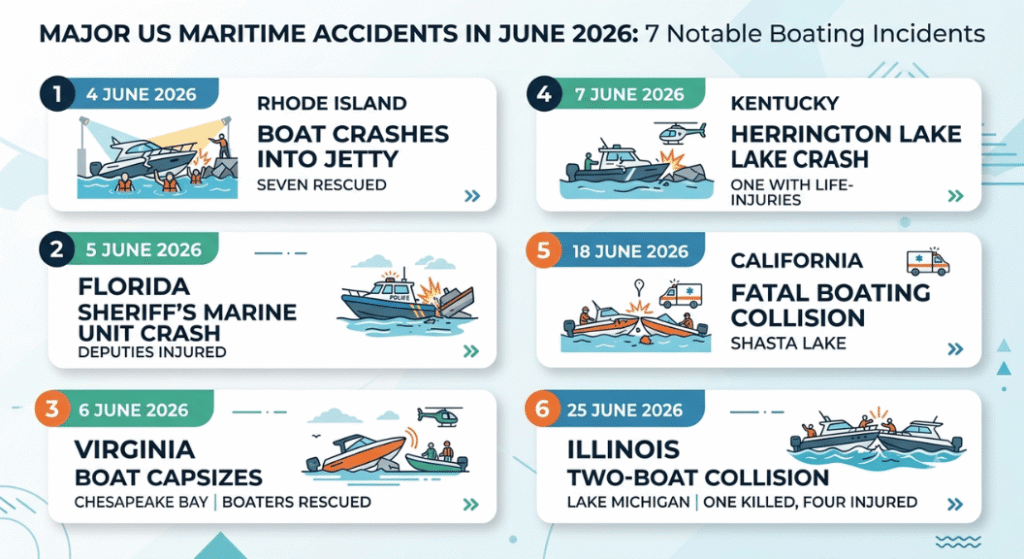
Between June 4 and June 25, 2026, authorities documented a jetty strike in Rhode Island, a sheriff’s marine unit collision in Florida, a capsized boat in Chesapeake Bay off Virginia, a severe dock impact on Herrington Lake in Kentucky, a single-boat crash on Balsam Lake in Wisconsin, a fatal shoreline collision on Shasta Lake in California, and a deadly two-boat collision on Lake Michigan off Chicago. Three of these events involved life-threatening or fatal injuries, and at least one vessel was considered a total loss after the damage it sustained. Most required multi-agency responses, with the coast guard or local marine units arriving to coordinate search, rescue, and investigation operations.
Shared patterns cut across nearly every incident: operating in darkness or low visibility, navigating close to jetties, docks, or rocky shore areas, and potential operator impairment or distraction. In multiple cases, bystanders and Good Samaritans pulled injured people from the water before official responders could reach the scene. The sections below break down each accident by date, location, vessel type, casualties, and investigative status.
Boat Crashes Into Jetty, Seven Rescued (Rhode Island) – 4 June 2026:
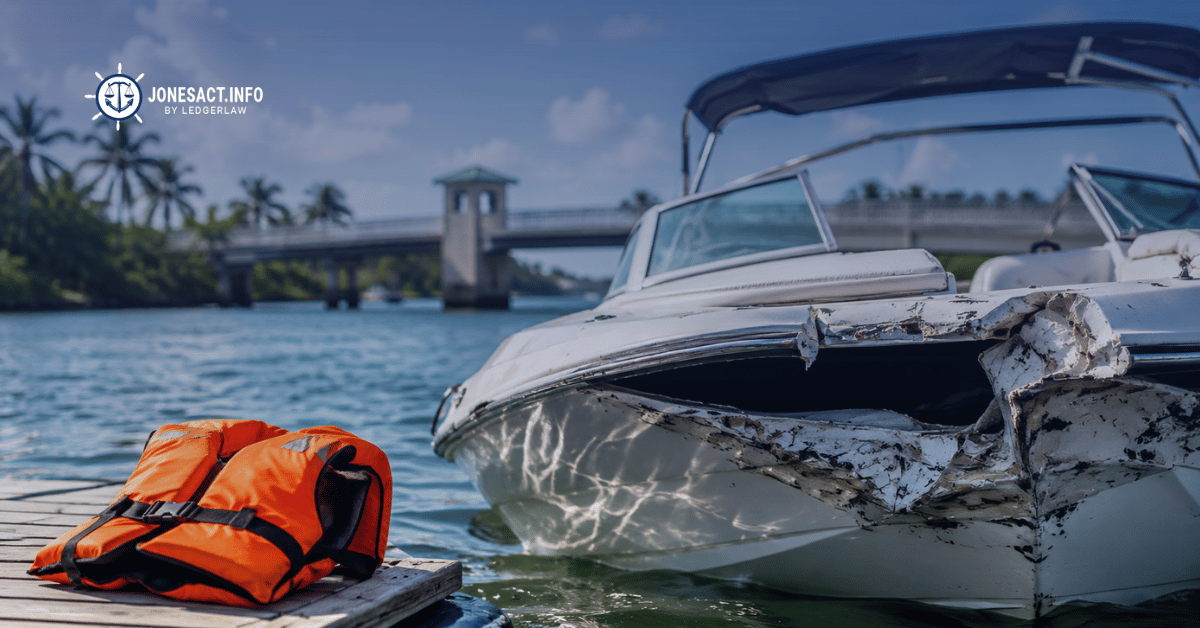
Shortly after midnight on June 4, 2026, a 42-foot Sea Ray cabin cruiser struck a jetty near Wickford, Rhode Island and came hard aground on the rocks. Seven people were on board. The night collision threw the vessel onto the jetty with enough force to compromise the hull, leaving it lodged and immobile in the darkness. The North Kingstown Fire Department, Rhode Island Department of Environmental Management, Narragansett Bay Marine Task Force, the Harbor Master, and the U.S. Coast Guard all responded to the scene.
All seven occupants were rescued. One person was hospitalized for injuries, while the remaining six either refused treatment or were uninjured. The operator was charged with refusal to submit to a chemical impairment test. Investigators are examining speed, lighting, and navigation decisions leading up to the crash, according to a BoatTEST accidents roundup. The refusal to take the impairment test raises both criminal and civil exposure, and injured passengers may have grounds to pursue compensation through negligence and failure-to-maintain-lookout claims.
Seven rescued after jetty collision – but the operator’s refusal to submit to a chemical test now drives both a criminal case and potential civil liability.
Deputies Injured in Sheriff’s Marine Unit Boat Crash (Florida) – 5 June 2026:
On June 5, 2026, two Putnam County Sheriff’s Office marine unit boats collided on the St. Johns River in Florida while returning from a “Boaters Skip Day” event. The collision caused damage to both vessels, though no civilians were on board and no life-threatening injuries were reported. Several deputies suffered minor injuries such as bumps and bruises, with one taken to the hospital for a cut.
The Florida Fish and Wildlife Conservation Commission is handling the investigation, while the sheriff’s office conducts an internal review of body-cam footage, marine-unit training records, and boat handling protocols. Contributing factors believed to be under examination include wake effects, excessive speed, and close-formation maneuvering after a long shift on the river. The incident highlights operational safety themes for law-enforcement marine units: clear radio communication, defined formation protocols, and fatigue management when crew members have been on the water for extended hours. No pontoon or civilian boat was involved-this was strictly a patrol vessel incident.
Boaters Rescued After Boat Capsizes in Chesapeake Bay (Virginia) – 6 June 2026:
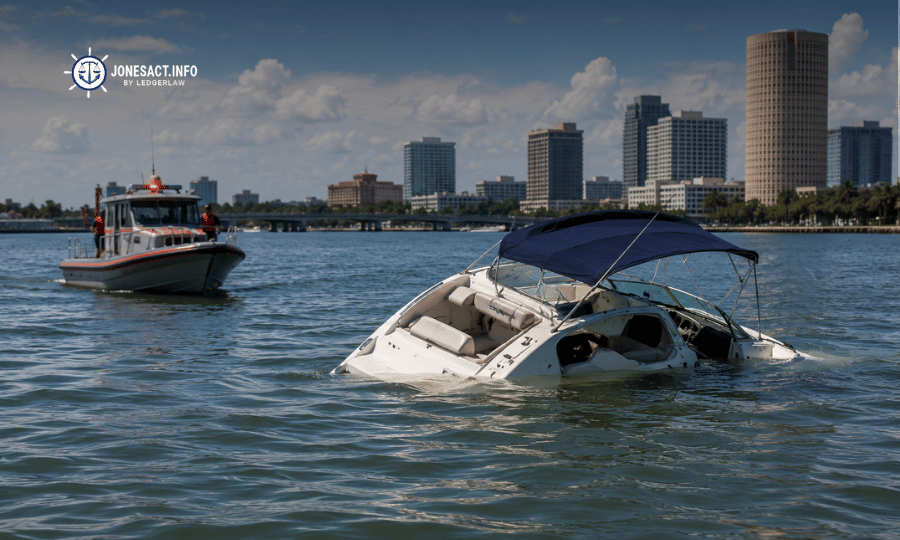
During the early morning hours of June 6, 2026, a small recreational vessel capsized in Chesapeake Bay off Virginia Beach, throwing all occupants into the water. The Coast Guard received a distress call around 9:20 a.m. and dispatched a boat crew, which coordinated with the Virginia Beach EMS Marine Rescue Team and local fire and rescue units to pull the victims from the choppy bay.
Coast Guard search-and-rescue doctrine in busy waterways like Chesapeake Bay prioritizes rapid deployment of the nearest available asset-often a 45-foot response boat-while simultaneously alerting nearby vessels to assist.
Reports state no collision with another vessel occurred. Likely contributors included rough seas, possible overloading, shifting weight, or a wake from a passing ship. The rescue efforts underscored a critical message: life jackets save lives. In wind-against-tide conditions, a small craft can capsize in seconds, and even strong swimmers face hypothermia and disorientation. Monitoring weather forecasts and wearing personal flotation devices are non-negotiable precautions for anyone on the bay in stormy weather.
Boat Crash on Herrington Lake Leaves One with Life-Threatening Injuries (Kentucky) – 7 June 2026:
Accident at a glance: June 7, 2026 – Herrington Lake, Mercer County, Kentucky – one life-threatening injury, two others treated with minor injuries.
A recreational boat on Herrington Lake struck a dock during the overnight hours, a period of near-total darkness on the lake. One person suffered life-threatening injuries and was flown by air ambulance to the University of Kentucky hospital. Two others were treated at the scene but declined transport. The Mercer County Fire Department, EMS, Sheriff’s Department, and Kentucky Fish & Wildlife all responded.
The investigation is examining speed, nighttime conditions, and possible operator inattention or impairment. The force of impact against the pier was severe enough that the vessel’s structural integrity was compromised. For the critically injured victim, future claims for medical bills, long-term care, and lost wages may arise if the operator is found negligent. Kentucky’s boating laws require operators to maintain a proper lookout and safe speed at all times, especially at night when fixed hazards like docks are nearly invisible without proper lighting.
Single-Boat Crash on Balsam Lake (Wisconsin) – 13 June 2026:
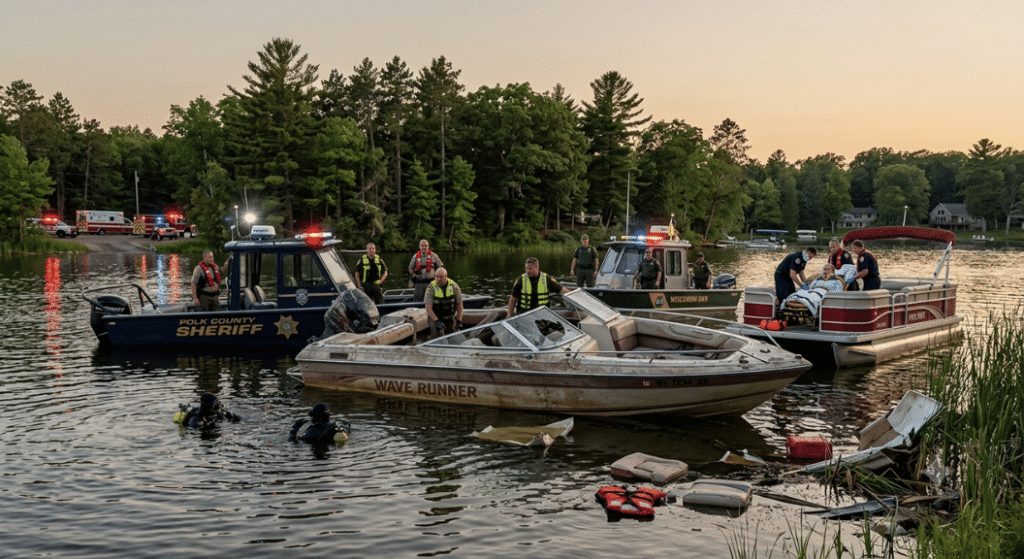
On June 13, 2026, a single motorboat on Balsam Lake in Polk County, Wisconsin ran aground on rocks near an island and was driven up onto shore. There were two occupants aboard. The driver sustained head injuries, while a female passenger suffered serious leg and arm injuries. Emergency services requested a life-flight helicopter for the passenger, according to dispatch audio reported by local news.
Bystanders on nearby boats brought both injured people to shore before official responders arrived-a reminder that immediate bystander assistance on inland lakes can be the difference between life and death. The dispatch audio suggested the boat may have been traveling too fast or was operated by someone unfamiliar with the rocky shallows around the island. The vessel was effectively a total loss after being driven onto the rocks. Safety experts emphasize the need for local charts or depth knowledge, slower speeds near islands, and sober operation, especially at dusk or in reduced visibility.
Fatal Boating Collision on Shasta Lake (California) – 18 June 2026:
At approximately 5:21 p.m. on June 18, 2026, a vessel struck the shoreline near Town Creek Cove on Shasta Lake in Northern California, ejecting all three occupants. Vingenzo Anthony Colletti, 47, of Palo Cedro, was killed. A juvenile and an adult woman were injured. Good Samaritans aboard a nearby boat transported the victims to Bridge Bay Marina for emergency treatment.
The juvenile was wearing a personal flotation device; the two adults were not. The Shasta County Sheriff’s Boating Safety Unit and Coroner’s Office are investigating the crash under Case #SCSO26-003048, examining speed, visibility, and possible mechanical issues. Official updates may be posted on the Shasta County Sheriff’s Facebook page. The San Francisco Chronicle also reported on the incident. Community reaction around Shasta Lake marinas has included renewed calls for improved safety patrols and mandatory PFD use, particularly after this became the second water fatality in the area in a short period. The stark contrast-a child wearing a life jacket survived while unprotected adults did not fare as well-illustrates a preventable gap in safety gear compliance.
Two-Boat Collision on Lake Michigan Kills One, Injures Four (Illinois) – 25 June 2026:
Shortly before midnight on June 25, 2026, two boats returning to port collided approximately 1.5 miles offshore near Monroe Harbor off downtown Chicago on Lake Michigan. Fourteen people were aboard the two vessels-one roughly 38 feet and the other 42 feet. ABC News reported that one vessel overtook the other from behind as both headed toward shore, resulting in a hard collision.
Twenty-six-year-old Johanna H. Gregory was killed. Five victims were transported to hospitals-three to Northwestern Memorial and two to Stroger Hospital-in serious to grave condition. Nine others refused medical treatment on scene. Lake conditions at the time included 1–2 foot rollers and water temperature around 65°F; the Chicago Fire Department stated that conditions did not appear to be a factor in the collision.
The Coast Guard towed both damaged boats, one to Queen’s Landing near Buckingham Fountain, and transferred passengers to Chicago Marine Police headquarters. The Illinois Department of Natural Resources is leading the ongoing investigation, with support from the Coast Guard and Chicago police. Investigators are examining whether alcohol, speed, visibility, and unsafe overtaking in darkness contributed to the crash. Lawyers for passengers on the smaller vessel have publicly stated they will investigate liability and whether the larger cabin cruiser struck the smaller boat. Surviving victims and the family of the deceased may pursue wrongful death claims under either maritime or state law.
Timeline of Major US Boating Accidents in June 2026:
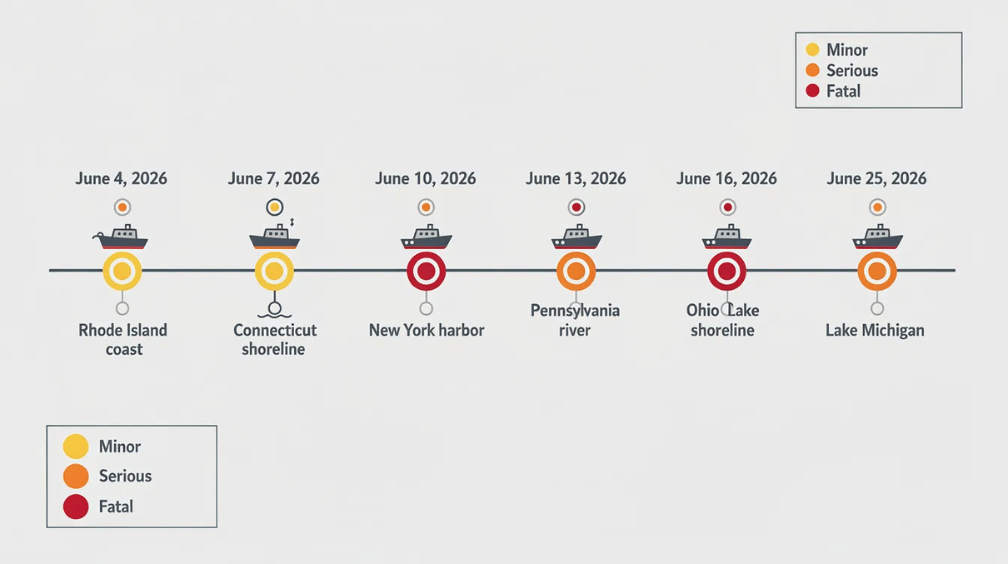
What this infographic shows:
Date | Location | Incident Type | Severity |
June 4 | Wickford, RI | Jetty strike | 1 hospitalized |
June 5 | St. Johns River, FL | Patrol boat collision | Minor injuries |
June 6 | Chesapeake Bay, VA | Capsizing | Rescue, no fatalities |
June 7 | Herrington Lake, KY | Dock impact | 1 life-threatening |
June 13 | Balsam Lake, WI | Ran aground | 2 serious injuries |
June 18 | Shasta Lake, CA | Shoreline strike | 1 fatality |
June 25 | Lake Michigan, IL | Two-boat collision | 1 fatality, 4 critical |
Totals across all seven incidents: 2 fatalities, at least 6 life-threatening or serious injuries, dozens of people involved in rescue operations.
Common Risk Factors and Safety Lessons from June 2026 Maritime Accidents:
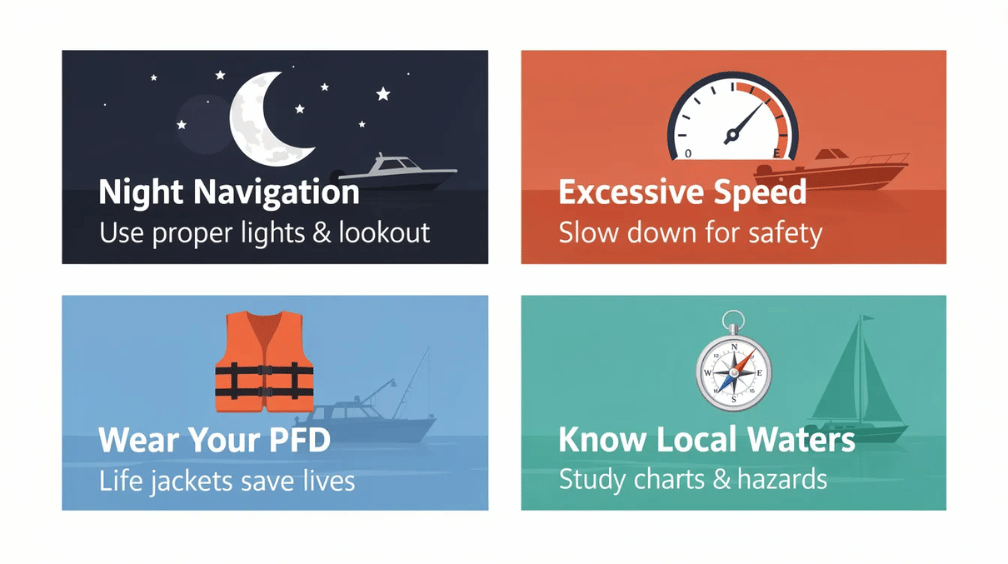
Risk Factors Identified Across June 2026 Incidents:
-
Night navigation and limited visibility: The Rhode Island jetty strike, Herrington Lake dock crash, and Lake Michigan collision all occurred at night or just before midnight. Darkness eliminates depth perception and makes fixed hazards invisible.
-
Excessive speed near hazards: The Balsam Lake grounding, Shasta Lake shoreline impact, and Monroe Harbor overtaking all involved vessels believed to be moving too fast for conditions.
-
Absent or inconsistent PFD use: At Shasta Lake, the child wearing a life jacket survived ejection while unprotected adults suffered fatal or serious injuries. Across incidents, adult life jacket use was inconsistent.
-
Operator impairment or distraction: The Rhode Island operator refused a chemical test; the Lake Michigan collision is under investigation for possible alcohol involvement.
Safety Checklist:
-
Always wear a PFD-not just children.
-
Slow down near jetties, docks, islands, and harbor traffic.
-
Never overtake another vessel blindly at night.
-
Check weather and nautical charts before departure.
Key Safety Lessons from June 2026 Boating and Maritime Accidents:
Recurring Failures on U.S. Waters:
The maritime accidents of June 2026 collectively reveal persistent safety failures: operators pushing speed near known hazards, failing to maintain a proper lookout, boating under the influence or while fatigued, and underestimating how quickly conditions change on open water. Every boater heading out on a lake or coastal waterway should internalize these concrete lessons: slow down near jetties and docks, always know your route before dark, wear a PFD regardless of swimming ability, file a float plan with someone on shore, and never attempt to overtake another vessel without clear visibility and communication.
Routine tasks can become high-risk without proper controls. This principle applies equally to weekend recreational boaters and professional mariners. Crew should wear personal flotation devices during deck operations, and fatigue management is critical to prevent falls overboard. Effective fall prevention measures are necessary during deck work-a lesson reinforced by a deckhand who fell overboard on 13 December 2023 in a separate but instructive incident. That case demonstrated how exhaustion and complacency during routine operations can lead to tragedy.
Carbon Monoxide: The Silent Threat Below Deck:
One hazard that receives too little attention in boating safety discussions is carbon monoxide exposure. Carbon monoxide can enter vessel cabins from heaters and generators, and poor ventilation increases the risk of carbon monoxide exposure significantly. Carbon monoxide levels can rise to fatal levels in 3.5 hours, yet carbon monoxide is difficult to detect without an alarm. Maritime NZ highlights carbon monoxide risks for vessel operators and recommends installing CO detectors in all enclosed cabin spaces.
Lessons from Global Maritime Incidents:
Similar principles apply to commercial workboats and fishing vessels facing rough seas and long shifts. In June 2026, geopolitical conflicts significantly disrupted maritime operations worldwide. The Strait of Hormuz experienced military strikes on merchant vessels, and the International Maritime Organization reported at least 46 attacks on shipping in the Strait of Hormuz. Over 700 ships were stranded due to conflicts in the strait, and a maritime evacuation scheme for stranded ships was coordinated in June 2026. Over 20,000 seafarers were affected by maritime incidents related to regional conflicts in June 2026.
The conflict in the Middle East reduced traffic through the Suez Canal, and escalating regional conflicts increased operational risks for maritime transit through the gulf and beyond. There was an increase in marine insurance rates due to attacks on shipping, with insurance costs and freight rates rising due to instability in maritime operations. International maritime bodies called for respect for freedom of navigation during conflicts.
A passenger catamaran collision occurred in Croatian waters in June 2026, resulting in three fatalities and one missing person. A supply vessel collision in Singapore resulted in three crew deaths. In separate incidents, a man died after falling from a boat into the Anacostia River, and the body of a missing boater was recovered from Lake Guntersville. Water ingress and flooding remain leading causes of vessel losses globally-whether on a sailboat in the pacific ocean, a tanker in the north sea, a fishing boat near the philippine sea, or a barge moored in the black sea.
Reports from around the world document similar risks: a fishing vessel near cobblers reef ran aground and partially sank; three bodies were recovered near playa de marica after a boat capsized; a vessel near crystal beach caught fire, requiring passengers to deploy a life raft; and a landing craft named Sistersville ii was involved in a separate river incident. Near o pillo, a small craft sank after striking submerged debris. A seaweed farm operation off south korea lost a boat when it capsized, and three crew from a fishing boat operating off alaska were pulled from the water after their vessel took on water. In the gulf, a moored tanker broke free during stormy conditions. Near the coast of north africa heading south, a pontoon carrying four people was struck by a larger ship and partially sank, while the search for a missing sailboat from a cross-strait passage continued. These shipwrecks and incidents-many still under ongoing investigation-reinforce that gear, training, and vigilance are universal requirements whether you are on a quiet inland lake or navigating a contested sea.
Regulatory Response:
Clusters of accidents in a short time frame often prompt state agencies and the Coast Guard to review enforcement priorities and public-education campaigns. The HNS Convention will enter into force on 29 November 2027, adding another layer of international regulation for hazardous and noxious substances transported by sea. In the U.S., state boating commissions are already examining whether mandatory operator education courses and enhanced night-navigation rules could reduce the kind of incidents documented throughout June 2026.
Understanding Your Legal Rights After a June 2026 Maritime Accident:
Who Qualifies for Maritime Claims:
The legal framework that applies after a boating accident depends on who you are. Recreational passengers injured in a collision or capsizing on U.S. waters typically file claims under state negligence and wrongful death statutes. Professional mariners-deckhands, engineers, crew members on commercial vessels-may qualify for protections under the Jones Act, which allows injured seamen to sue their employers for negligence when hurt on navigable waters.
Jones Act and General Maritime Law:
The Jones Act is a key remedy for crew on workboats, commercial fishing vessels, and similar operations. If a fishing vessel deckhand is injured during a collision similar to the June 2026 incidents, the Jones Act permits them to seek damages for lost wages, medical expenses, and pain and suffering. General maritime law also provides remedies through unseaworthiness claims and the doctrine of maintenance and cure, which requires vessel owners to pay for an injured crew member’s medical treatment and basic living expenses until they reach maximum medical improvement.
State vs. Federal Jurisdiction:
For accidents on inland lakes like Herrington Lake, Balsam Lake, Shasta Lake, or Lake Michigan, both state wrongful death or personal injury law and federal maritime law may apply. The question of which framework governs often depends on whether the waterway is considered “navigable” under federal law and whether the person injured was a passenger, operator, or crew member. Statutes of limitations vary-Jones Act claims generally carry a three-year window, while some state deadlines are shorter.
Protecting Your Claim:
If you were involved in a June 2026 boating accident, prompt action is essential. Document your injuries with photos, preserve witness contact information, obtain copies of any Coast Guard or state agency report filed for the incident, and avoid making statements to insurance adjusters before consulting an attorney. Evidence from the vessel-damage to the hull, steering, throttle, and navigation lights-can deteriorate or be destroyed quickly, so preservation requests should be made as soon as possible.
Contact Us for June 2026 Boating Accident–Related Issues:
If you or a loved one was affected by any of the maritime accidents in June 2026-whether on a U.S. lake, coastal waterway, or at sea-JonesAct.info can help you understand your legal options. The firm focuses on maritime and Jones Act claims, assisting injured seamen, workboat crew, and in appropriate cases, recreational boating accident victims who need guidance after collisions, capsizings, or groundings.
Before your consultation, gather any available documentation: incident reports, Coast Guard case numbers, medical records, photographs of vessel damage, and insurance policy information related to the June 2026 accident. Having these materials ready allows for a more productive initial case evaluation.
JonesAct.info consultations are confidential, and representation may be available on a contingency-fee basis, meaning you pay nothing unless your case results in a recovery. Whether an operator is disputing fault or a vessel owner argues that the incident was an unavoidable accident, experienced maritime counsel can evaluate the facts and advise you on next steps. Reach out today through the firm’s website, phone, or contact form for a free case evaluation.
Conclusion: June 2026 Maritime Accidents and the Path Forward:
June 2026 demonstrated, in painful detail, that even familiar waters can turn deadly when operators ignore fundamental safety principles. Between June 4 and June 25, seven serious U.S. boating incidents produced two confirmed fatalities, multiple life-threatening injuries, and boats damaged or destroyed across six states. These were not freak events on remote seas-they happened on popular recreational lakes and well-traveled harbors where thousands of boaters operate every weekend.
The broader 2026 maritime landscape reinforced these domestic lessons on a global scale. From the strait near the Middle East to the north sea, from inland rivers to the pacific ocean, maritime incidents continued to claim lives and disrupt commerce. The common threads-human error, inadequate safety gear, poor visibility, and complacency-are preventable.
The most important takeaways from June 2026 remain straightforward: always wear life jackets, manage your speed, stay sober on the water, know the hazards in your area, and never overtake another vessel without clear sightlines. For those already affected by these tragedies, specialized maritime legal support is available to help navigate medical bills, lost income, and the path to accountability. Learning from June 2026 is the best way to ensure fewer families face similar devastation in the months and years ahead.
FAQ
Frequently Asked Questions

A 42-foot Sea Ray cabin cruiser struck a jetty near Wickford, Rhode Island shortly after midnight, running hard aground on the rocks with seven people aboard.
All seven people on board were rescued; one was hospitalized for injuries and six were uninjured or refused treatment.
Yes, the operator was charged with refusing to submit to a chemical impairment test.
Two sheriff marine unit boats collided on the St. Johns River while returning from a special event; the exact cause is under investigation by Florida Fish and Wildlife.
No, all injuries were minor-bumps, bruises, and one cut requiring hospital treatment.
No civilians were aboard or involved; only sheriff's deputies were on the two patrol boats.
A small recreational vessel capsized off Virginia Beach, throwing all occupants into choppy water; Coast Guard and local rescue teams retrieved everyone.
The Coast Guard responded to a distress call and coordinated with Virginia Beach EMS Marine Rescue and local fire/rescue units to bring the victims to shore.
Yes, one person suffered life-threatening injuries and was airlifted to the University of Kentucky hospital.
The boat struck a dock on Herrington Lake in Mercer County, Kentucky during overnight hours.
The motorboat ran aground on rocks near an island, likely due to excessive speed or unfamiliarity with the shallow rocky area.
Yes, the driver had head injuries and a female passenger had serious leg and arm injuries; a life-flight was requested for the passenger.
A vessel struck the shoreline near Town Creek Cove, ejecting all three occupants; one adult male died, while a juvenile and adult woman were injured.
Two boats returning to port near Monroe Harbor collided about 1.5 miles offshore when one vessel overtook the other from behind at night, involving 14 people total.
Five people were transported to hospitals in serious to grave condition, and nine others refused medical treatment at the scene.
Yes, 26-year-old Johanna H. Gregory was killed in the collision.
Investigations involved the U.S. Coast Guard, state departments of natural resources, fish and wildlife agencies, county sheriff's offices, and boating safety units depending on the jurisdiction.
The key lessons include always wearing PFDs, avoiding nighttime boating without proper lighting, maintaining safe speeds near hazards, staying sober, and filing float plans before departure.