Key Takeaways:
-
Most maritime unsecured cargo crash and debris impact claims must be filed within three years under federal law, but some deadlines are as short as 30 days for notice or one year for filing.
-
The legal clock usually starts on the date the cargo crash occurred or the date the injury occurred and was reasonably discovered.
-
Different deadlines apply depending on whether the claim falls under the Jones Act, unseaworthiness, DOHSA, LHWCA, or OCSLA, and these laws can overlap in a single cargo accident.
-
Multiple liable parties may share fault, including vessel owners, cargo loaders, stevedoring companies, equipment manufacturers, and non-maritime third parties like trucking companies and a freight broker.
-
Delaying action risks losing most critical evidence and permanently forfeiting your right to pursue compensation, so contact an accident lawyer for a free consultation immediately.
-
This article uses concrete dates, examples, and timelines so readers can quickly understand their legal options and legal limits after a maritime cargo crash.
Maritime Lawsuit Deadline for Unsecured Cargo Crash Accidents:
An unsecured maritime cargo crash occurs when improperly secured containers, deck loads, or cargo gear break loose, fall, or shift aboard a vessel or at a dock, causing debris impact, personal injury, or death. Unsecured cargo crashes happen aboard container ships, barges, oil platforms, and during port loading operations. Cargo accidents can result in traumatic brain injuries and paralysis, and falling cargo can cause severe vehicle damage and injuries to anyone in the impact zone.
The statute of limitations for maritime lawsuits generally falls under three years, but the actual deadline depends on who you are, where the injury occurred, and which statute applies. Missing the lawsuit deadline permanently bars recovery of damages, regardless of how strong your evidence may be. The sections below break down every major deadline by claim type so you can act before time runs out.

What Counts as an Unsecured Maritime Cargo Crash?
Unsecured maritime cargo crashes include a wide range of incidents where cargo securement fails at sea or in port:
-
Falling cargo from container ship decks during heavy seas.
-
Cargo shifts inside vessel holds due to improper stowage or overloaded vehicles.
-
Loose deck cargo on barges striking crew members.
-
Debris impact from cranes, spreader bars, or cargo gear during loading and unloading.
-
Falling objects from elevated container stacks onto longshore workers below.
On land, similar cargo securement concepts apply to commercial trucks and dump trucks hauling freight along interstate highways, but different legal regimes control at sea. Over 200,000 unsecured cargo crashes occurred from 2011 to 2014, and unsecured cargo caused 715 deaths and 16,595 injuries in one year. Cargo must be secured to prevent shifting or falling during transport, whether aboard a vessel or a motor carrier on the highway. These numbers demonstrate why accidents happen far more often than most people assume.
General Three-Year Maritime Tort Deadline (46 U.S.C. § 30106):
Under General Maritime Law, personal injury claims generally have a three-year statute of limitations. This uniform federal rule under 46 U.S.C. § 30106 applies to negligence, unseaworthiness, and most debris impact claims involving unsecured cargo on navigable waters. It applies regardless of which U.S. state the vessel was in because it is a federal maritime rule, not a state personal injury deadline.
Key exceptions to keep in mind:
-
Claims against U.S. government vessels carry a shorter two-year limit.
-
OCSLA claims on offshore platforms may borrow state deadlines as short as one year.
-
Contractual time limits in tickets or bills of lading can override the three-year period.
When the Maritime Statute of Limitations Clock Starts Running:
For most unsecured cargo crashes, the three-year clock starts on the calendar date of the accident. For example, if a container falls and crushes a seaman on September 6, 2026, the deadline to file is September 6, 2029.
The statute of limitations may not start until the injured party discovers their injury. This discovery rule applies in latent injury scenarios, such as when exposure to hazardous materials in cargo causes symptoms months later. Courts may also delay the start date when an employer conceals conditions, but these exceptions are narrow. Do not assume you will receive extra time. If your injury occurred more than two years ago, treat your case as urgent.
Shorter Deadlines When the U.S. Government Is a Liable Party:
If the vessel is owned by the U.S. government, the filing deadline for claims is typically two years. This applies when unsecured cargo or debris impact involves a U.S. Navy, Coast Guard, or other government vessel, governed by the Suits in Admiralty Act or Public Vessels Act.
-
The two-year deadline is strictly enforced.
-
Administrative claim steps may be required before filing suit.
-
Missing the two-year window can completely bar the claim.
-
If a government contractor was involved, treat the deadline as two years at most.
How Contractual Time Limits Can Shorten Your Cargo Claim:
Passenger tickets, cargo bills of lading, and carriage contracts often contain very short time limits. Cruise ship passenger claims often have a reduced filing timeframe of one year, and some require written notice within six months. Lawsuits against ocean carriers for cargo damage must be filed within one year under COGSA. Written notice of claims for hidden damages under COGSA must be submitted within 3 days of delivery.
For example, a cruise passenger injured by falling luggage containers from a crane during embarkation could face a one-year contractual deadline, even though the federal statute allows three years. The shorter period usually controls. Save all tickets, booking confirmations, and shipping documents, and let an attorney review them promptly for hidden time bars. The carrier’s insurer will enforce these provisions aggressively.
Why Delays Are Especially Dangerous in Unsecured Cargo Crash Cases:
Evidence in cargo crash cases disappears quickly after an accident. Victims of maritime accidents must preserve evidence immediately after an incident because cargo, securing gear, and logbooks are often repaired, moved, or discarded shortly after an unsecured cargo crash. Vessel owners and the insurance company often conduct internal investigations without giving injured maritime workers access.
Time sensitive evidence that can vanish includes:
-
Cargo loading documentation and cargo loading records.
-
CCTV footage from the dock or vessel.
-
Maintenance logs for cranes and lashings.
-
Vessel movement and voyage data recorder information.
-
Stowage plans and cargo securement checklists.
Even if the three-year deadline seems far away, practical evidence loss can severely weaken your case long before the statute of limitations expires.
Key Maritime Time Limits by Type of Unsecured Cargo Claim:
Each major maritime statute has its own deadline, coverage rules, and procedural requirements. Below is a practical roadmap for injured maritime workers, families, and passengers dealing with a cargo crash or debris impact.
Jones Act Claims for Seamen Injured by Falling Cargo:
The jones act covers seamen who spend a significant portion of their work time on a vessel in navigation. Seamen injured under the Jones Act have three years to file a lawsuit for employer negligence. If the claim involves a U.S. government vessel, the deadline shortens to two years with additional procedural steps. An injured worker who is a seaman may have both Jones Act and unseaworthiness claims arising from the same unsecured cargo incident, each governed by the three-year maritime tort deadline.
Unseaworthiness Claims After Cargo Securement Failures:
Unseaworthiness means the vessel, its equipment, or crew is not reasonably fit for its intended use. Defective lashings, overloaded decks, or unsafe cargo securement practices all qualify. The statute of limitations for unseaworthiness claims is three years from the date the unsafe condition caused injury. Unlike Jones Act claims, you do not need to prove employer negligence for unseaworthiness. You must only show that an unsafe condition existed and caused your injury.
Wrongful Death at Sea (DOHSA) from Cargo Crash or Debris Impact:
The Death on the High Seas Act covers deaths caused by wrongful acts occurring more than three nautical miles from shore, including fatalities from unsecured cargo crashes. Wrongful death claims under General Maritime Law typically have a three-year statute of limitations from the date of death. DOHSA claims are brought by personal representatives for surviving relatives and focus primarily on economic losses. Families affected by offshore cargo accident fatalities should coordinate Jones Act, unseaworthiness, and DOHSA claims within the three-year window by contacting an accident lawyer immediately.
Longshore and Harbor Workers’ Compensation Act (LHWCA) Deadlines:
The LHWCA covers shoreside maritime workers like longshoremen, stevedores, and harbor workers injured by falling cargo during loading and unloading. Two strict deadlines apply:
-
Injured seamen must notify their employer within 30 days under the LHWCA (or within 30 days of learning the injury is work-related).
-
Longshore and Harbor Workers' Compensation Act claims must be filed within one year of injury.
LHWCA compensation is separate from third-party negligence lawsuits against vessel owners or equipment manufacturers, which still follow the three-year maritime tort deadline.
Outer Continental Shelf Lands Act (OCSLA) and Offshore Platform Cargo Accidents:
OCSLA extends state laws, including statutes of limitations, to injuries on fixed offshore platforms on the Outer Continental Shelf. For example, if an unsecured crane load crashes onto a worker on a drilling platform off Louisiana, a one- or two-year state deadline may apply. Because OCSLA uses adjacent state law, deadlines vary widely by location. Offshore workers injured by cargo securement failures should not assume they have three years and must treat their case as potentially subject to a much shorter limit.
Maintenance and Cure: Timing and the Doctrine of Laches:
Maintenance and cure is the shipowner’s obligation to provide living expenses and medical treatment to injured seamen until maximum medical improvement, including in falling cargo cases. There is no fixed three-year statute of limitations for maintenance and cure claims. Instead, courts apply the doctrine of laches, requiring filing within a reasonable time. Courts often use the three-year period as a benchmark, but seamen should act promptly rather than rely on laches as an excuse for delay.
Identifying Liable Parties in Unsecured Maritime Cargo Crashes:
Multiple parties can be liable for unsecured cargo accidents. Identifying all negligent parties early is critical because different defendants may be subject to different legal limits and notice requirements.
Vessel Owners, Operators, and Charterers:
Vessel owners and operators bear primary legal responsibility for providing a seaworthy vessel and enforcing safe cargo securement practices. Charterers may share liability if they control loading plans or insist on unsafe cargo configurations. Lawsuits against these parties must still be filed within the applicable maritime deadline.
Cargo Loaders, Stevedores, and Terminal Operators:
A cargo loader, stevedoring company, or terminal operator can be liable when they fail to properly secure cargo, leading to cargo shifts, scattered cargo, or debris impact. Examples include using inadequate lashings, ignoring working load limits, or failing to balance weight in containers. Injured seamen and longshore workers may have both LHWCA benefits and separate negligence claims against these other responsible parties, each with its own deadline.
Manufacturers of Cargo Securement Equipment:
Defective chains, straps, twist locks, cranes, or spreader bars can fail, causing cargo falling onto crew or dock workers. Product liability claims against manufacturers are usually treated as maritime torts subject to the three-year limit when the injury occurs on navigable waters. Preserve broken gear and document serial numbers, loading records, and inspection history immediately. These product liability claims can help hold negligent parties accountable.
Non-Maritime Third Parties (Trucking, Rail, and Inland Transport):
In mixed cases, an unsecured load falling from a ship may lead to a truck accident or other incidents involving commercial trucks, railcars, or inland depots. FMCSA regulations require cargo to be firmly secured during transport, and 49 CFR Part 393 outlines specific cargo securement standards for every motor carrier. Florida Statute 316.520 mandates all loose loads be secured, and drivers must inspect cargo securement within the first 50 miles of a trip.
On land, a truck driver hauling unsecured truck cargo along interstate highways at highway speed creates enormous risk of road debris striking other drivers. Truck accident cases involving scattered cargo, overloaded vehicles, or dump trucks often require a truck accident attorney to investigate weigh station records, weight tickets, duty status logs, the aggregate working load limit, and tie down devices. Trucking companies, the freight broker, and the motor carrier may all share fault. Florida’s statute of limitations is 2 years for personal injury claims, and wrongful death claims in Florida also have a 2-year deadline-significantly shorter than the federal maritime three-year rule. Improper loading and improper maintenance of truck cargo are common causes of unsecured cargo crash incidents on land.

Evidence and Causation in Falling Cargo and Debris Impact Claims:
Proving how and why cargo falls or shifts is technically complex and time-sensitive. Prompt evidence preservation is as important as meeting the statute of limitations because physical evidence and digital records disappear quickly.
Key Evidence in Maritime Cargo Securement Cases:
Evidence such as ship logs and black box data is crucial in maritime lawsuits. Critical evidence in maritime cases includes:
-
Cargo manifests, stowage plans, bills of lading, and loading checklists.
-
Inspection logs for cranes, lashings, twist locks, and tie down devices.
-
Maintenance logs and equipment replacement histories.
-
Voyage data recorder information and CCTV from the vessel and terminal.
-
Photographs of cargo before and after the accident, including the accident scene.
-
A police report if the incident involved port authorities or law enforcement.
-
Weigh station records and weight tickets for mixed land/sea cargo.
Attorneys often send immediate preservation letters to prevent this physical evidence from being altered or destroyed. Contacting a lawyer promptly improves evidence preservation chances.
Establishing Causation: From Cargo Securement Failure to Injury:
Lawyers must link a specific cargo securement failure-inadequate lashings, overloading, unsecured material on deck-to the cargo crash and the victim’s injuries, including spinal cord injuries and other catastrophic harm. Expert witnesses in naval architecture or marine cargo operations may analyze scene photos, stowage plans, and testimony to reconstruct events and prove liability. Patterns of prior incidents, near-miss reports, or safety violations help show that an operator failed to exercise reasonable care before the accident.
Practical Steps After an Unsecured Maritime Cargo Crash:
Here is what accident victims-seamen, longshore workers, passengers-should do immediately after a falling cargo or debris impact incident.
Immediate Safety and Medical Actions:
Move out of the path of further falling objects or truck debris if possible. Alert crew or supervisors to shut down cargo operations. Seek medical treatment immediately, even if injuries seem minor. Request copies of all medical records and keep a personal log of symptoms, work limitations, and treatment dates from day one.
Documenting the Cargo Crash Scene:
Take photos or video of the cargo securement setup, broken equipment, debris impact areas, and any warning signs. Note the exact time, weather conditions, sea state, and vessel location. Collect contact information for witnesses, including crew members, longshore workers, and third-party contractors present at the accident scene.
Reporting the Incident and Protecting Your Rights:
File an accident report according to company procedure, but do not sign any statement that minimizes injuries or admits fault without legal advice. Injured seamen should notify their employer promptly to preserve Jones Act and maintenance and cure rights. Longshore workers must comply with LHWCA notice rules. After addressing medical needs, contacting a maritime accident lawyer is vital to preserve evidence and calculate the correct lawsuit deadline.
Contact a Maritime Cargo Accident Lawyer:
Unsecured maritime cargo crashes involve complex laws, strict filing deadlines, and aggressive defense strategies by vessel owners, their insurance company, and legal teams. If you or a loved one has been injured by falling cargo, cargo shifts, or debris impact, request a free consultation to review the accident timeline, applicable statutes, and your legal options.
Early attorney involvement helps identify all liable parties, send preservation letters for time sensitive evidence, and ensure every maritime injury claim is filed within the correct limitation period. A managing attorney experienced in maritime cases can evaluate whether your claim falls under the Jones Act, LHWCA, DOHSA, OCSLA, or general maritime law, and act accordingly.
Many maritime injury lawyers work on a contingency fee, a percentage of what is recovered, with no fee if there is no recovery. Ask any lawyer about costs before you hire them.

Maritime Cargo Crash Deadlines at a Glance:
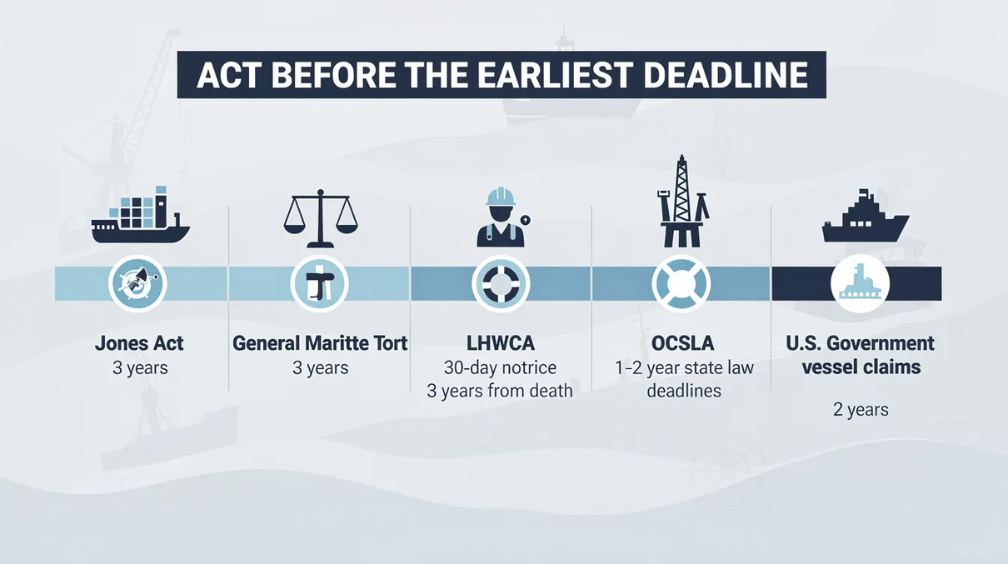
This visual compares key time limits across the six major maritime statutes. Each bar is labeled by statute name, who it covers (seamen, longshore workers, families), and the exact number of years from the date of the accident or death. Personal injury, wrongful death, and workers’ compensation claims are distinguished by color. The bottom banner reinforces: act before the earliest deadline.
How Falling Cargo Maritime Claims Work:
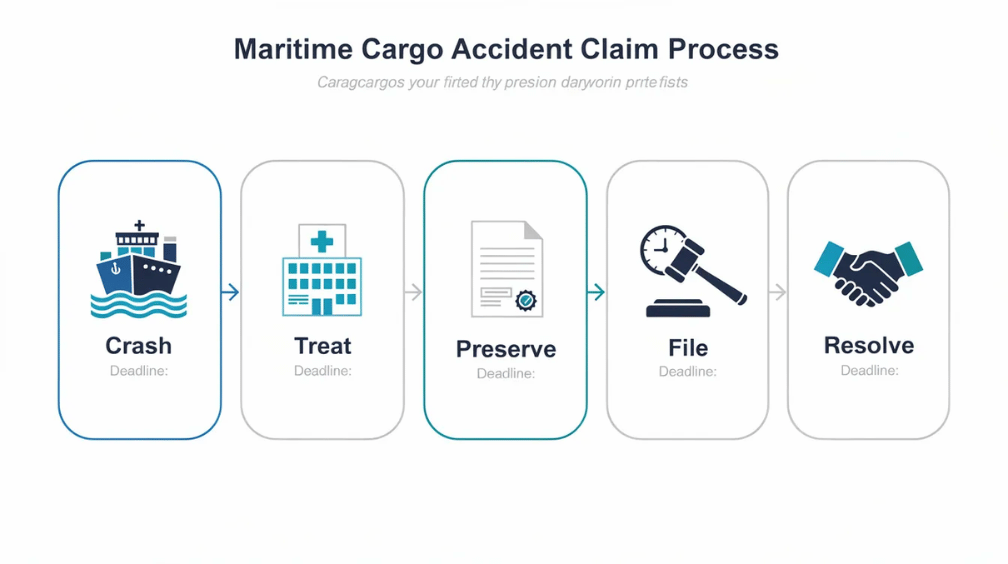
This visual illustrates the lifecycle of a maritime cargo accident claim: accident and debris impact, medical treatment, reporting, evidence preservation, legal analysis, claim filing, and potential settlement or trial. Key deadlines appear along the path-a 30-day employer notice bubble under the LHWCA stage, and a three-year lawsuit marker near the filing stage. The final panel reminds readers that consulting an cargo accident lawyer early helps navigate both medical and legal steps.
Conclusion:
Unsecured maritime cargo crashes-whether from falling cargo, shifting loads, or debris impact-are governed by strict legal limits that can be as short as one year in some cases and three years in many others. Understanding which statute applies (Jones Act, unseaworthiness, DOHSA, LHWCA, OCSLA, or general maritime law) is essential to protecting your right to pursue compensation and avoiding a missed deadline that permanently bars your claim.
Do not wait. Document the incident fully, preserve every piece of physical evidence you can, and contact an experienced maritime accident lawyer for a free consultation to evaluate your rights and next steps. Your legal options narrow with every passing day.
Maritime Lawsuit Deadline FAQs (Core Legal Questions)
Below are answers to the most common timing and negligence questions about maritime claims for injury and death.
FAQ
Frequently Asked Questions
Most maritime personal injury lawsuits, including unsecured cargo crash claims, must be filed within three years of the injury under 46 U.S.C. § 30106, with exceptions for government vessels (two years) and certain offshore platform cases.
In most non-government maritime tort cases, injured people and families have three years from the date of the accident or death to file suit, but delays are risky because evidence degrades rapidly.
The clock usually starts on the day of the accident, but for latent injuries it can start when the injury is discovered or should reasonably have been discovered.
Yes, unseaworthiness claims are generally subject to the same three-year maritime tort statute of limitations, starting from the date the unsafe condition caused injury.
Most Jones Act negligence claims must be filed within three years of the date of injury or discovery, but cases involving U.S. government vessels may have a two-year limit and additional procedural requirements.
You may still have claims under general maritime law, LHWCA, DOHSA, or state law, each with its own deadline, so a maritime attorney should review your worker status and accident facts quickly.
Courts will usually dismiss your case outright if you miss the applicable statute of limitations, and even shorter delays cause loss of key evidence and weaken settlement leverage.
Negligence must be proven for Jones Act and many general maritime tort claims, while unseaworthiness focuses on unsafe vessel conditions, and LHWCA benefits do not require proving employer fault.
Seek medical care, report the accident according to vessel or employer procedures, document the scene and witnesses, and contact a maritime injury lawyer promptly to protect deadlines and evidence.
Spouses, children, or personal representatives may bring wrongful death or survival claims under the Jones Act, DOHSA, or state law, but must do so within the applicable statute of limitations-usually three years or less.
Yes, injured passengers, visitors, and nearby workers may have claims under general maritime law, DOHSA for deaths offshore, or state negligence law, and they face the same three-year or shorter deadlines depending on where and how the accident occurred.
Depending on the applicable law, victims may recover medical expenses, lost wages, loss of earning capacity, pain and suffering, and in fatal cases, funeral costs and loss of financial support for eligible family members.
The location can affect which laws and courts apply, but U.S. maritime statutes like the Jones Act and DOHSA often still protect U.S. seamen and families even when accidents occur far from the U.S. coastline.
Maritime cases are governed by specialized federal statutes and typically a three-year deadline, while truck accident cases usually follow state negligence law with two-year or similar limits. On land, a truck driver hauling unsecured truck cargo faces FMCSA regulations and state laws like Florida Statute 316.520, and accident victims may need to hold negligent parties accountable through a truck accident attorney who reviews fmcsa regulations, police report records, and loading records.
Many maritime injury lawyers work on a contingency fee, a percentage of what is recovered, with no fee if there is no recovery. Ask any lawyer about costs before you hire them.