Key Takeaways:
-
There are more than 4 million recreational boaters in California.
-
Boats get into accidents in California more often than in most other states.
-
Northern Lakes has the highest fatality rate.
-
Southern Coast has the highest accident rate.
-
Most accidents happen because the person operating the boat either doesn't have experience or isn't paying attention to what he's/she's doing.
Boating is a great way to pass the time and enjoy life. It can also be a great way to earn a living (if you don’t get seasick).
California is a boater’s paradise. There are lots of lakes to pick from. And great boating weather year-round.
The problem is the more often you boat, the more likely you are to get into an accident.
What Is Considered a Reportable Boating Accident?
The law says a reportable boating accident is one that:
-
Results in someone getting hurt, going missing, or dying.
-
One that causes a total loss to at least one boat.
-
One that causes at least $500 in property damage (this includes damage to boats and other structures, such as a dock).
Common Types of Reportable Boating Accidents:
-
Crashing into something that's not moving on the water (besides a boat).
-
Crashing into another boat.
-
Grounding.
-
Swamping.
-
Someone falling overboard.
When Should You Report a Boating Accident?
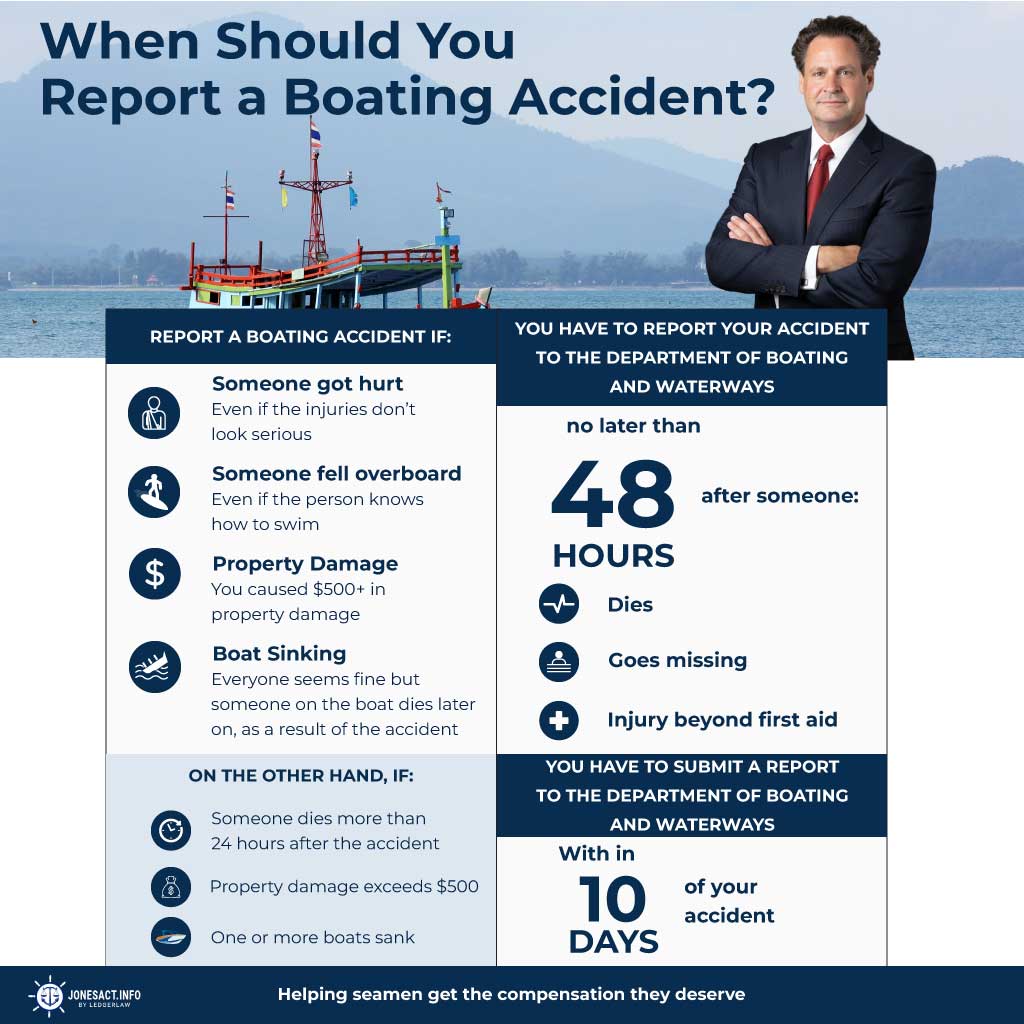
Report a boating accident if:
-
Someone got hurt. Even if the injuries don't look serious.
-
Someone fell overboard. Even if the person knows how to swim.
-
You think you might have caused $500 in property damage.
-
Your boat sank, or the other person's boat sank.
-
Everyone seems fine but someone on the boat dies later on, as a result of the accident.
You have to report your accident to the Department of Boating and Waterways no later than 48 hours after someone:
-
Dies.
-
Goes missing.
-
Get injured beyond what first aid can handle.
On the other hand, if:
-
Someone died more than 24 hours after the accident.
-
Property damage will cost more than $500 to fix.
-
One or more boats sank.
You have to submit a report to the Department of Boating and Waterworks within ten days of your accident.
California Boating Accident Report Rules & How to File It?
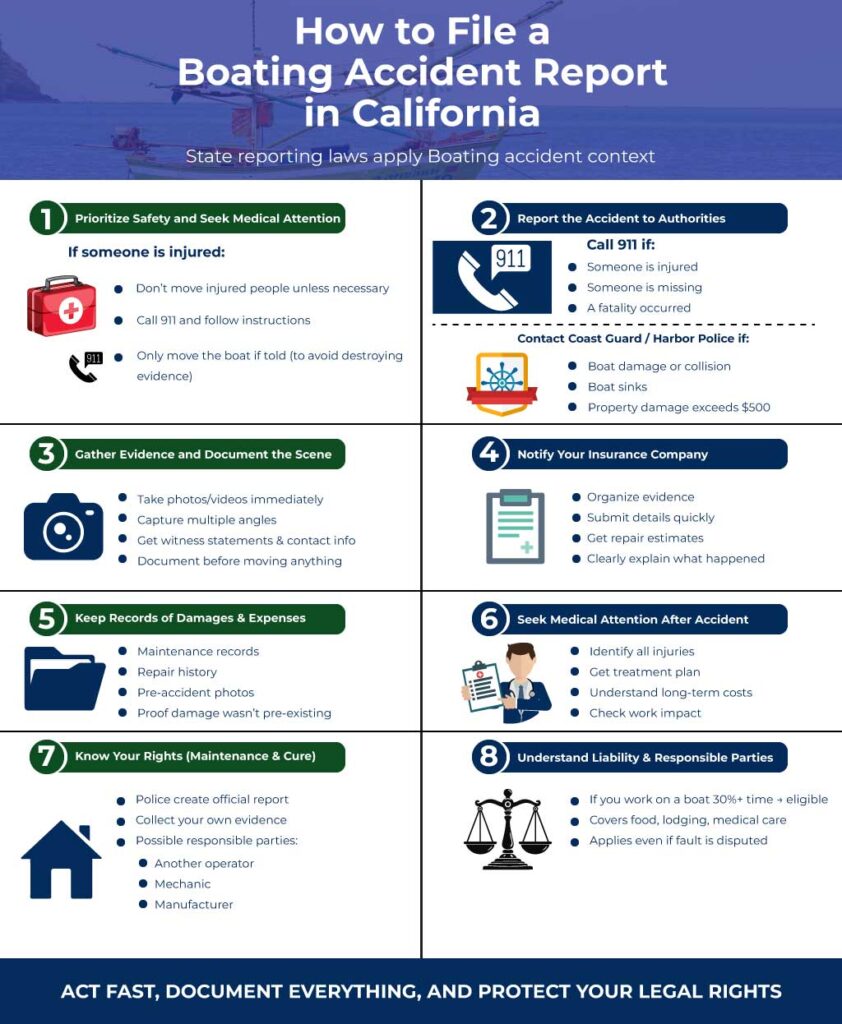
Each state has boating accident reporting laws.
California’s no exception
Prioritize Safety and Seek Medical Attention:
If someone got hurt:
-
Don’t. Move. Them. Unless you have to, to keep them safe.
-
Call 911. Follow the operator’s instructions.
-
Only move the boat if the operator tells you to. The move could destroy evidence.
Report the Accident to the Proper Authorities:
Did someone:
-
Get hurt?
-
Go missing?
-
Die?
If so, call 911.
Did the accident:
-
Damage another boat or a fixed object.
-
Make a boat sink.
-
Cause property damage in excess of $500 but didn’t hurt anyone?.
If so, call the Coast Guard or harbor police.
Gather Evidence and Document the Scene:
If you don’t take photos or get a video? It’s “he said, she said.”
Especially if you have to move the boats before first responders or the local Coast Guard get there.
Get as many shots as you can. From as many angles as you can.
You also want to get other people to back you up.
Ask others in the boats or people who saw the accident from nearby boats (or the dock) to say something. Or get their contact information for later on.
Notify Your Insurance Company Carefully:
-
Collect and organize your evidence from the accident scene.
-
Collect your information so your insurer can process your claim without delay.
-
Have a professional give a cost estimate for repairing damage.
-
Tell your insurance agency exactly what happened.
Keep Detailed Records of Damages and Expenses:
Every boat owner should have:
-
Maintenance records.
-
Repair records.
-
Recent images of the boat before the accident.
These records show that the damage wasn’t pre-existing. Which means insurance is responsible to cover it.
If you work on someone else’s boat full-time, see a doctor right after your accident.
Your doctor will:
-
Identify all the injuries from the accident.
-
Tell you what further treatments you need.
-
Tell you how much your medical care will cost long-term.
-
Let you know if your injuries will impact your ability to work on a boat in the future.
Your doctor’s trip shouldn’t cost you a dime.
People who work on a boat more than 30% of the time can file a maintenance and cure claim with an employer.
This claim covers:
-
Food.
-
Lodging.
-
Medical care.
Even if there’s a dispute about who’s to blame for the accident.
Understand Liability and Identify Responsible Parties:
Playing the “Blame Game” sucks. But you do have to know who’s responsible for a boating accident.
Law enforcement officials on the scene should draw up a report. Your insurance agency will take their conclusions seriously.
But that doesn’t mean you shouldn’t collect evidence on your own.
Maybe a mechanic didn’t fix the other person’s boat properly.
Perhaps the boat manufacturer created a boat with defective parts.
Where Should I File My Boating Accident Report?
Did someone get hurt? Call 911.
Is there just property damage? Call the Coast Guard or harbor police.
Is the accident reportable? Report it to the Department of Boating and Waterways.
What Are The Benefits of Reporting an Accident?
Reporting an accident is the first step in getting medical care. This. Is. Vital.
It’s easy to miss an injury until days or even weeks later.
You need to see a doctor right after your accident to document your case.
If not, your insurer and the guilty party may claim your new medical problems weren’t from the accident.
Plus, it’s the law. You’re legally required to report the accident. There are penalties for not reporting
A report shows what happened and who’s to blame. It’s an official account that can help you get compensation
California Failure to Report Boating Accident Penalty:
Not reporting a boating accident is a misdemeanor in California. You could be:
-
Fined up to $1,000.
-
Thrown in jail for up to six months.
-
Both.
Boater Card Requirements:
If you operate a boat in California, you have to have a boater card.
Boaters over the age of 60 used to be exempt. But not anymore.
Every. Single. Boat. Operator. Must have a boater card.
Start Your California Boating Accident Report Claim With JonesAct.Info:

Anyone who gets hurt while boating can sue the person (or people) who caused the accident.
But people who work on a boat at least 30% of the time can file a claim under the Jones Act.
If you file a Jones Act claim, you have a lower “burden of proof” than someone who files a regular negligence claim.
Put in simple terms, your odds are good for winning your case.
And we can help.
We specialize in helping seamen get compensation after a boat accident.
Call us for a free consultation. We’ll tell you if you have a valid case. And help you move it forward.
Conclusion:
Boating is fun. And can be profitable. But it can also be dangerous.
If there’s an accident, make sure everyone is safe. Call for help immediately.
Once everyone’s gotten medical care and you’ve reported the accident, call your insurance company.
If need be, call a maritime lawyer too.
A good lawyer can:
-
Help you collect evidence.
-
Help you organize your evidence.
-
Deal with insurers for you.
-
File a lawsuit.
-
Speak for you in court and during settlement negotiations.
-
Increase your odds of getting compensated.
FAQ
Frequently Asked Questions


- When someone gets hurt
- When someone goes missing
- When someone dies
- If there's property damage that will cost more than $500 to fix
- If a boat sinks (even if it's worth less than $500)
- Make sure no-one is missing or hurt
- Move the boats if they could cause another accident
- Call for help and to report the accident
- Don't move unless you absolutely have to. You could make your injuries worse.
- If there are other people on the boat with you, make sure no-one else is hurt
- Check that no-one went missing
- Call 911
You have to file a report if the damage is worth more than $500.
You also have to file a report if someone on the other boat was hurt, went missing, or died. Even if the other boat didn't sustain damage.
Yes. But you don't necessarily have to.
First responders and boating law enforcement officials can report an accident online too.
What the other boater does (or doesn't do) does no impact your legal obligations.
You still have to report the accident if:
- Someone got hurt, went missing, or died
- A boat sank
- There was damage that'll cost more than $500 to fix
In your report, make it clear that you don't have the information for the other boat.
Yes.
- You could be fined. Or face jail time. Or both.
- Your insurance agency might deny your claim.
See above.
It could if the accident is your fault. But not reporting the accident will have consequences a lot more severe than a simple rise in premiums. In addition to fines and jail time, you could face a liability lawsuit. And your insurer might even decide to cancel your policy or at least refuse to renew it since you've proven you're not trustworthy.