Key Takeaways:
-
Almost 2,700 maritime casualties happened in 2023 alone.
-
743 of these casualties were serious. And 45 were very serious.
-
75 investigations were launched.
-
Workers injured at sea can claim compensation, but not under regular liability laws.
-
Maritime law governs injuries that happen at sea.
Working at sea is dangerous. Even if you’re not in an active war zone. Or the middle of a storm.
Common dangers include:
-
Drowning/almost drowning.
-
Broken bones.
-
Burns.
-
Exposure to hazardous materials.
-
Injuries from repetitive strain.
An Overview On Maritime Law:
Maritime laws are laws governing what happens on the open sea.
It also governs what happens if a maritime worker has an accident at sea and one or more parties are to blame.
The Jones Act:
The Jones Act allows those working at sea to sue employers and/or other responsible parties in the event of a mishap.
However, this law only applies if:
-
The accident occurred while the boat was sailing.
-
The person has a substantial, long-term connection to the vessel.
-
The accident happened on an oil rig in the ocean.
Longshore and Harbor Workers’ Compensation Act:
Have you been hurt while working:
-
On navigable waters in the United States?
-
On a pier?
-
At a dock, terminal, or wharf?
-
Outlines the rights of people traveling on covered waterways.
If so, the LHWCA applies to you. Like the Jones Act, it allows you to sue for mishaps that occur while working close to a vessel. If the injury happened when working on or close to a ship, or doing work related to a ship. A secretary who works at an office near the shore and has a slip-and-fall accident is covered by workers compensation insurance.
General Maritime Law:
General maritime law defines where to sue if you’re hurt at sea. It says that:
-
International waters? That depends on your ship’s flag. But U.S. citizens with foreign employers might still be able to file a case under the Jones Act.
-
Not a U.S. citizen? You can sue under the Jones Act if you're working on a ship owned by a U.S. company or flying a U.S. flag.
What Are The Common Maritime Accidents & Injuries in Seattle?
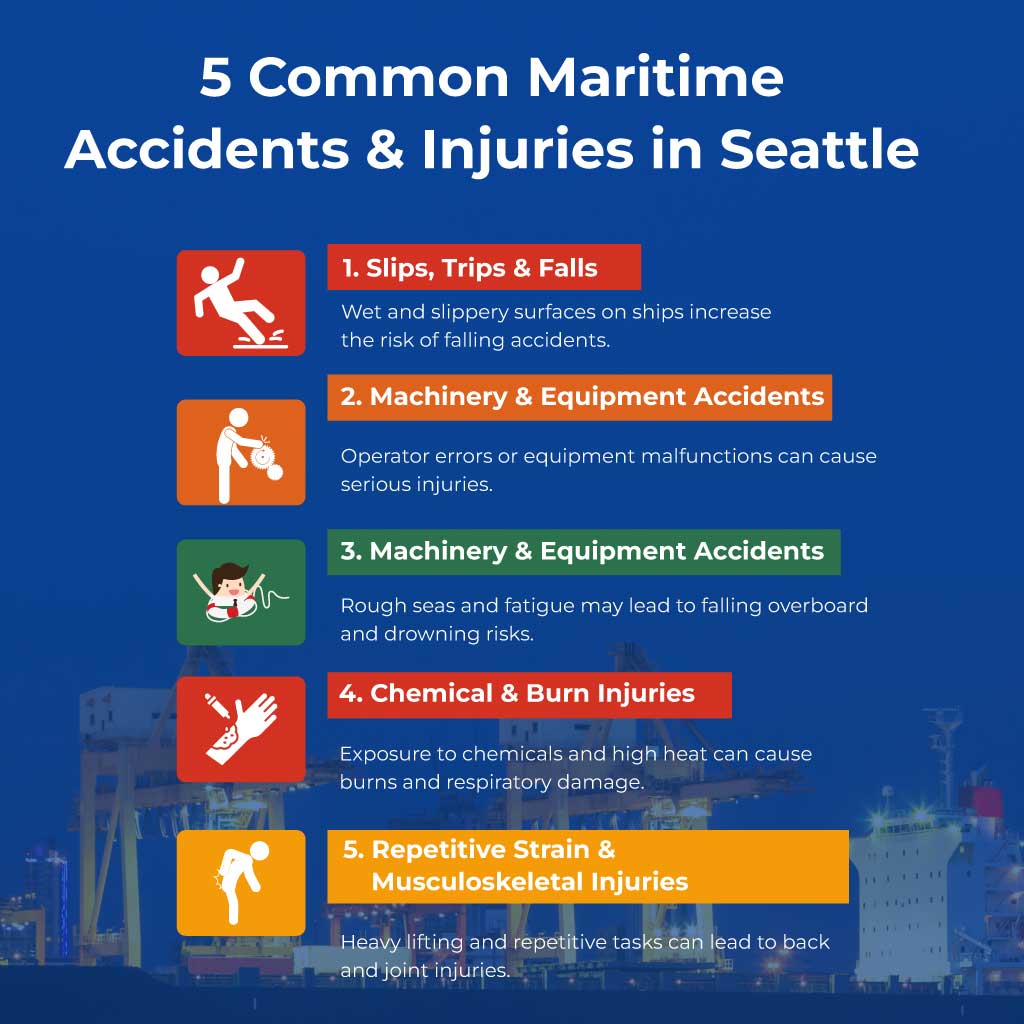
The shipping industry isn’t a safe one. Accidents happen. A lot.
Slips, Trips, and Falls:
Slips, trips, and falls can happen anywhere. But working on wet surfaces makes them even more likely.
Machinery & Equipment Accidents:
-
Operator mistakes are common. The operator could be untrained, make a mistake, or show up to work plastered.
-
Machinery can malfunction. Especially if it hasn't been properly maintained
-
Lifting equipment (such as cranes) can accidently snag the wrong thing (or person).
Overboard & Drowning Incidents:
If you fall overboard while working on a boat? It might go unnoticed.
But even if someone saw and came to help, you could still almost drown. Especially in stormy weather. Or if you’re not a good swimmer.
Chemical & Burn Injuries:
Chemical and burn injuries are common among maritime workers:
-
You could get burned handling hot equipment or touching hot surfaces.
-
If you're on a ship built before 1980, the odds are it was made with asbestos. And you'll probably breathe plenty of it in your cramped quarters.
-
If you work on an oil rig or tanker, there is a high risk of breathing in benzene. It's a chemical used for maintenance and tank cleaning.
-
You could get a "cold burn" working in refrigerated areas or if refrigerated gasses get loose.
Repetitive Strain & Musculoskeletal Injuries:
Ship work is repetitive. Lift. Carry. Move. Repeat.
It’s easy to suffer repetitive strain injuries and musculoskeletal injuries. Especially if your employer isn’t giving you the right machinery and equipment for doing your job.
What to Do Immediately After a Maritime Injury in Seattle?
-
Get to safety. Your life is always the #1 priority.
-
Document what happened if you can. Do you have a phone on you? Film the surroundings. Does someone else nearby have a phone? Ask them to do it too.
-
See who witnessed the accident. You'll want to ask for their statements later.
-
See the ship's doctor as soon as you can. See a doctor on land as soon as you can.
-
Get a thorough exam even if you feel fine. Some injuries are asymptomatic for weeks or even months.
-
Talk to your supervisor about what happened and why.
-
If you're at sea for a long time, keep a diary. It's evidence. And it can even jog your memory if you forget important details.
The Process – How to Sue for Maritime Injury in Seattle:
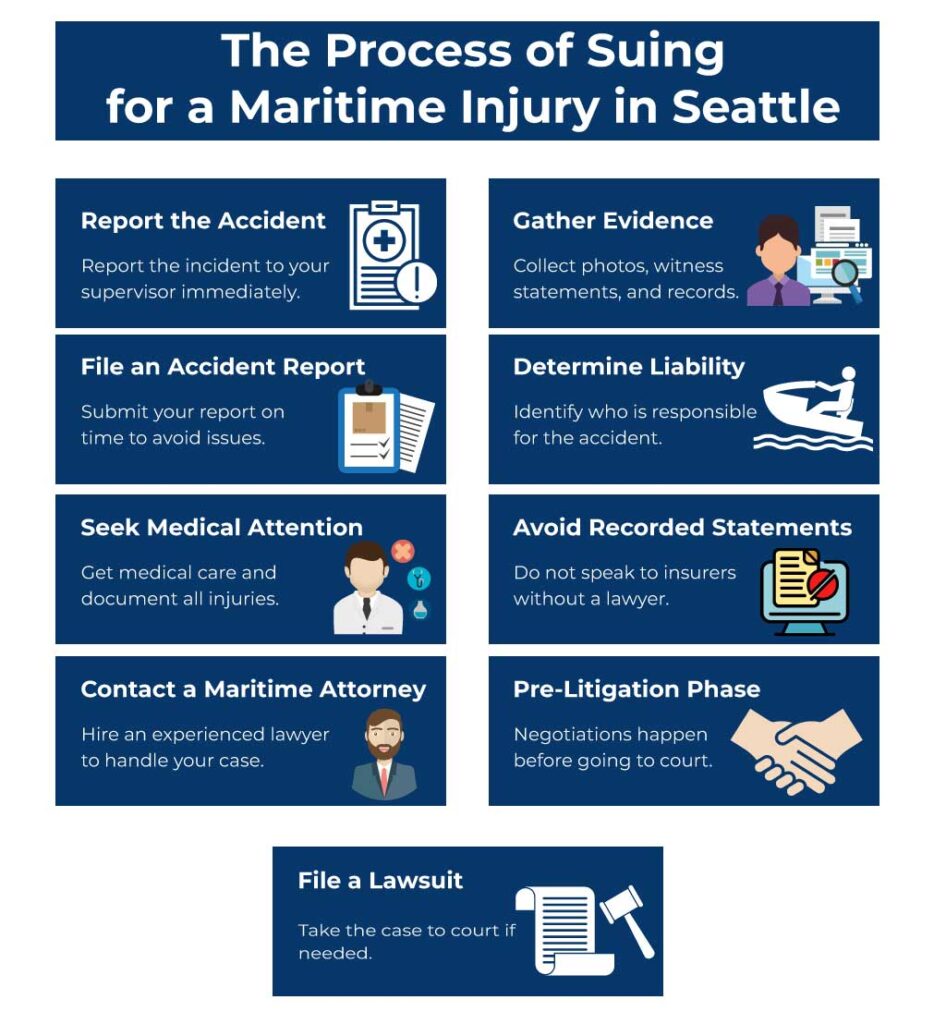
In a liability lawsuit, you have to show that most of the evidence is in your favor.
But seamen who file a case under the Jones Act just have to show that the other party was at least partly responsible.
Even so, suing for a maritime injury isn’t a walk in the park. You have to do things right or your case will tank.
Report Your Accident to a Supervisor:
Report the accident to your supervisor right away. This establishes, for the record, that something happened to you.
Gather Evidence to Establish Fault:
You need evidence to show who’s at fault. This can include:
-
Photos.
-
Videos.
-
Maintenance records.
-
Witness testimony.
-
Medical records.
-
Expert witness testimony for complicated cases.
File Your Accident Report Promptly:
File your report right away. There is a time limit and filing too late will cost you compensation even if you have strong evidence.
Determine Liability After a Boating Accident in Seattle:
Find out who’s at fault. It could be:
-
Another maritime worker.
-
Your supervisor.
-
The company that made the machinery on your boat.
-
The company that loaded or packed the cargo on your ship.
-
The mechanic who's supposed to maintain the machinery on your ship.
-
Your ship's captain.
There’s often more than one party at fault. Make sure you list them all.
Seek Immediate Medical Attention:
See a doctor. Immediately.
Even if it’s just the ship doctor.
Make sure the doctor lists all injuries and gives a cost estimate for treatment.
If your injuries will make it impossible for you to keep working, get a statement for that too.
Avoid Giving Recorded Statements to Insurance or Investigators:
Insurance investigators can act friendly. But they aren’t.
They’re not looking for ways to help you. They’re looking for ways to minimize your injuries and/or blame them on you.
Avoid talking to them and never give them a recorded statement if you don’t have a lawyer with you.
Contact an Experienced Seattle Maritime Attorney:
You need a good Seattle maritime lawyer if you want to file a case under the Jones Act.
Your lawyer will:
-
Collect evidence.
-
Find expert witnesses.
-
Talk to insurers on your behalf.
-
File your case in court.
-
Handle settlement negotiations.
Understand the Pre-Litigation Phase:
Cases don’t go to court right away. First:
-
awyers on both sides collect evidence.
-
Negotiations happen. Both sides either agree to settle or decide not to.
-
The judge sets a date for the case. Even then, it will take months or even years (for very complicated cases) before you get a verdict.
-
As your bills pile up, you might want to apply for financing. Many companies will pay you up-front if you're filing a lawsuit. Once you win, you repay the money (with interest). If you don't win, you don't pay.
Filing a Lawsuit (If Necessary):
Is the other side only offering a lowball settlement?
Was gross negligence involved, and you want to make sure someone doesn’t get away with it?
If so, your lawyer can file a lawsuit and take your case to court.
Where you file depends on:
-
Where the injury happened.
-
Your nationality.
-
Who hired you?
Why do People Sue in Maritime Injury Claims?
People file maritime injury claims for many reasons:
-
They lost a loved one.
-
They need money for medical bills.
-
They need to recoup lost wages.
-
They can't work at sea anymore and need to train for a new career.
-
They suffered emotional harm.
-
They saw gross negligence and want to make sure others don't get hurt.
Types of Maritime Injury Claims:
There is more than one type of maritime injury claim. Your lawyer will be able to tell you the best type of claim to file for your situation.
Jones Act Claim:
You can file a Jones Act Claim if you’re a seaman working for an American company, or are an American seaman. These cases are ideal because the burden of proof is low. You can get compensation even if you were partly at fault.
Maintenance and Cure Claims:
-
You should get compensation for lost wages.
-
You should get compensation for medical care.
Maintenance and cure should last until you’re able to start working again.
But sometimes employers balk at shelling the money out. Your boss may claim you don’t need as much time off, or your medical bills are actually lower.
Unseaworthiness Claim:
If your injury happened because the vessel wasn’t seaworthy, you can file an unseaworthiness claim.
How do such claims work? Consider the following example:
Todd slips on the deck. He breaks his arm. Why? Because it was night and the deck lights weren’t working. He has grounds to sue.
Barney suffered repetitive strain injuries because the cargo ship company didn’t hire enough workers for his boat and he had to lift more things (and lift them more often). This is grounds for an unseaworthiness claim.
Negligence Claim:
Negligence happens when:
-
Someone didn't do something they were supposed to do.
-
Someone did something they weren't supposed to do.
Sometimes more than one person or entity was negligent. You can sue all responsible parties.
How Can A Maritime Law Attorney From JonesAct.info Help with Your Claim:

Anyone filing any type of maritime-related claim in court needs a good lawyer.
The other side(s) will have one. Or teams of them.
A lawyer will help you determine:
-
Who's at fault.
-
What type of evidence you need.
-
Where to file your case.
Your lawyer will also help you:
-
Gather evidence.
-
Get witnesses.
-
Deal with insurers and others who are trying to undermine your case.
-
Negotiate on your behalf.
-
Take your case to court if need be.
Check out JonesAct.info if you need a good maritime lawyer in Seattle.
Our team of experts has a winning track record and we’re always eager to see justice done.
Plus, you don’t pay if you don’t win.
Final words:
Maritime injuries are common. But that doesn’t mean you should shy away from holding guilty parties responsible.
If someone else was at least partly at fault, you can claim compensation.
-
Collect evidence.
-
See a doctor.
-
Get a lawyer.
It may be challenging, but with strong evidence and a good lawyer, you have a winning chance.
FAQ
Frequently Asked Questions

Maritime injury cases include injuries that happen:
- On a ship in the water.
- On an oil rig in the ocean.
Anyone who works on a boat or rig in the water.
Ask your lawyer if you can file in Seattle. It depends on who you work for, your nationality, and where the accident happened.
You should file for compensation if someone else (or many "someone else") were at least partly at fault.
It depends.
- Simple cases can take weeks.
- Complicated cases can take years.