Key Takeaways:
-
Applies to Everything on the Water: International cargo routes, injury claims, pollution cleanup, and more. Maritime law touches every vessel and everybody on navigable waters.
-
Built-In Protections for Workers: The Jones Act and LHWCA give injured maritime workers legal and financial safeguards.
-
Keeps Global Trade Moving: International shipping runs on time thanks to the legal framework.
-
Saves lives: Navigation rules, vessel inspections, safety requirements. All exist to stop collisions and onboard accidents from happening.
-
National Defense: Keep the U.S. domestic fleet strong, gives federal agencies the legal teeth to patrol and secure American waters.
If you voluntarily rescue a ship, cargo, or other items that are in danger at sea, you may be entitled to compensation. In short, if a vessel is sinking and you bring it to safety, or recover cargo someone has lost, the law says you have a right to payment. This is called a salvage award.
The maritime law of salvage is in place because rescuing stuff at sea is risky and expensive. This legal entitlement encourages salvaging. In other words, it helps valuable property not be lost. The team at JonesAct.Info can help you file a claim and figure out what you’re owed.
What Is Salvage in Maritime Law and Maritime Salvage Rights?
Maritime salvage reward is the compensation you’re allowed to get for rescuing property that’s at risk. Specifically, if you’re a person who’s not legally obligated to put yourself at risk or expensive to do so. In Fine v. Rockwood, 895 F. Supp. 306 (S.D. Fl. 1995), the courts aid it’s a bounty granted under public policy that encourages rescue at sea.
Salvage bounties date back for centuries, to the edicts of Rhodes and the Roman Digest of Justinian. But in our century, maritime laws set in place by the Salvage Convention of 1989 govern salvaging. This convention replaced the Brussels Convention on Assistance and Salvage at Sea.
Real-World Scenarios of Maritime Salvage:
Here’s one example. Say a commercial fishing boat loses engine power when they’re in the middle of a mega-storm. Another boat nearby sees the struggle and hooks a towline to it. Then tows it to port. The crew on the rescuing boat has a valid salvage claim.
Or for example, a cargo ship runs aground in a shipping channel, and there’s tons of valuable merchandise on board. A tugboat can deploy equipment that can refloat that boat that’s in trouble so it doesn’t break apart. The tug company can get compensation.
Salvage Agreements Role:
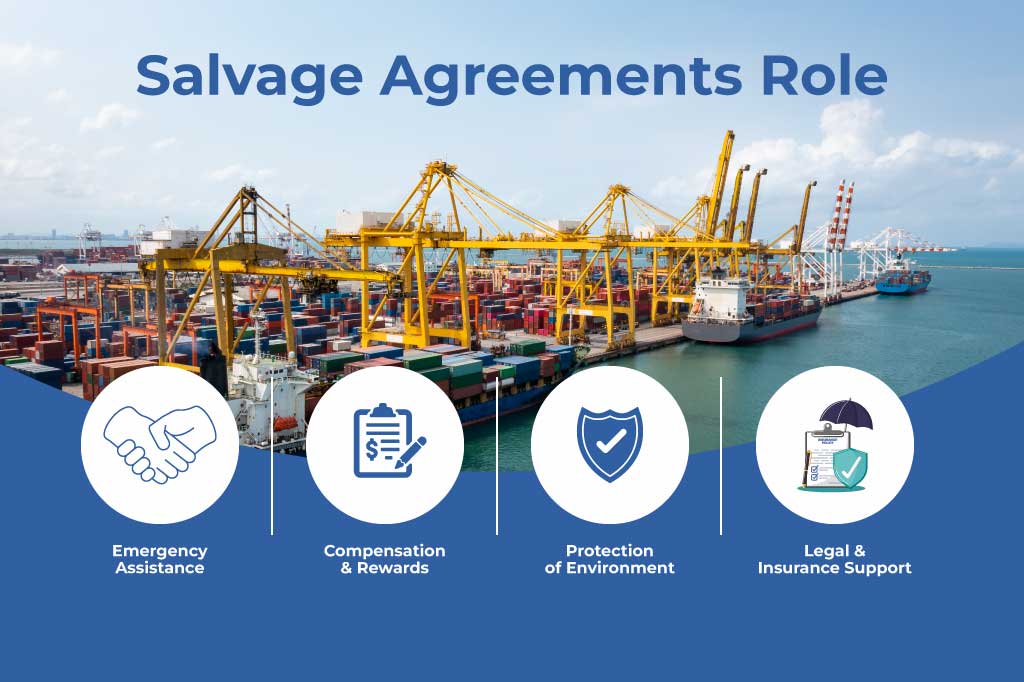
There are professional salvage operations that run on contracts. Formal agreements that spell out exactly who does what and who gets paid, along with what happens if something ends up going sideways. These two most common ones:
-
Lloyd's Open Form (LOF): The standard international salvage contract, operates on a "no cure, no pay" basis. Meaning the person or company salvaging only collects if the operation actually saves the property. Disputes are sent to arbitration.
-
SCOPIC (Special Compensation P&I Club Clause): Supplemental clause added to the LOF. It guarantees you'll get compensated even if the operation fails. Example of this: trying to prevent environmental damage from an oil spill.
The “no cure, no pay” principle is from the 1910 Brussels Convention. It worked for decades, but had a major issue. If a salvor actually prevents something like a huge oil spill by towing away a tanker that’s been damaged, but failed to save the actual ship, they got nothing. So they brought in the 1989 Salvage Convention. It created “enhanced salvage awards” and “special compensation” for salvagers who were making honest efforts to try to save the environment.
These these agreements do:
-
"No Cure, No Pay": Performance-based system. You only collect when you successfully save a vessel or cargo.
-
Rapid Response with no Red Tape: The LOF is standardized. This means salvors can get to work immediately during life-threatening emergencies. No wasting time negotiating complicated terms.
-
Guaranteed Lien on Saved Property: You hold a maritime lien. A legal claim to the rescued property, stays in place until the saved party pays.
-
Environmental Incentives: More modern agreements reward salvors who prevent pollution. Even when they can't save the ship. This was a direct response to more oil spills from tankers becoming damaged.
-
Structured Compensation Process: Arbitration determines the award amount. They look at things like the difficulty of the operation or the value of what they saved. Also, environmental factors.
How Maritime Law Calculates Salvage Awards?
There’s not a fixed formula. Usually, maritime salvage awards range anywhere between 10 to 25 percent of the total value of the property the salvagers save. Extreme cases sometimes go higher. Here’s what comes into play:
- Labor and time the rescue cost.
- How much skill and expertise was needed.
- Recovered property value.
- How dangerous the salvage mission was.
- How close it came to total loss.
- The steps needed to prevent damage to the environment.
Common Injuries of Maritime Salvage:
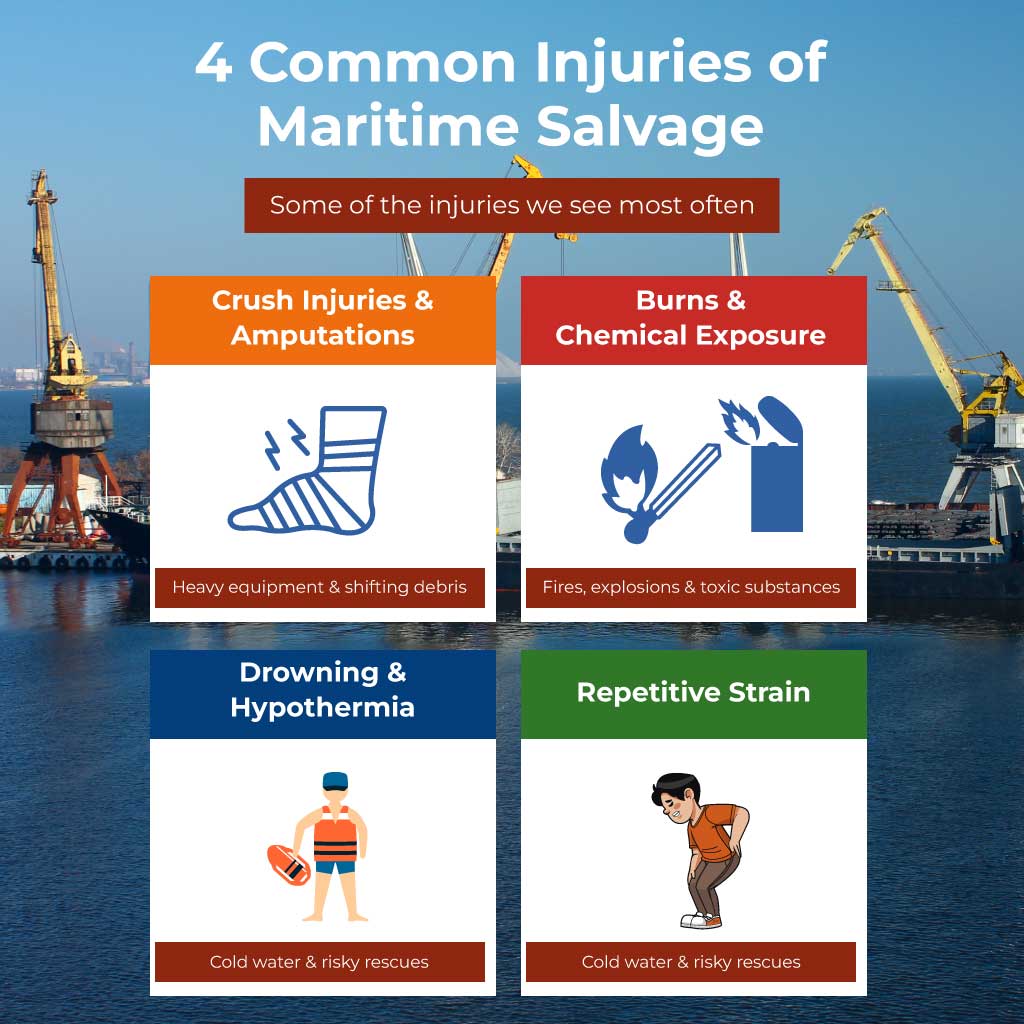
In salvage work, people are often in confined spaces and exposed to toxic fumes. Plus they’re on unstable structures. And often, lethal weather. Lots of things can go south quickly. Machinery failure, fires, explosions, falls and injuries. And all this happens in long hours of intense physical work. Which means exhaustion and loss of focus.
Some of the injuries we see most often:
-
Slips, trips, falls: It can be a broken limb, or something like a spinal injury or traumatic brain injuries.
-
Crush injuries and amputations: Things can crash into workers. Winches, chains, crane loads, shifting wreckage. All these can trap or even sever arms and legs.
-
Burns and chemical exposure: Fires, explosions, chemical leaks from damaged vessels cause thermal burns and damage to the throat and lungs.
-
Drowning and hypothermia: Drowning, plus cold-water shock.
-
Repetitive strain: Prolonged intense labor breaks down the body. Back, neck, legs, arms, shoulders, etc...
Jonesact.info Marine Salvage Attorneys:
Our attorneys are recognized leaders in admiralty and maritime injury laws. It’s not something we do on the side. It’s ALL we do.
And there’s our experience in this work. 30+ years. We’ve spent decades representing seamen, longshoremen, offshore workers, and more who have been injured on the job.
An attorney for marine salvage has seen it all. Every dirty tactic insurance companies and employers use to try to take advantage of workers and salvagers. We’ve got you.
Also, we don’t settle if it doesn’t benefit you. We’re not afraid to go to trial if we need to. Something other firms avoid at all costs.
FAQ
Frequently Asked Questions
This means a vessel or cargo that's in danger of loss or damage. Or any other property on navigable water.
Salvage claims aren't left to the state. They fall under federal admiralty jurisdiction. We protect your claim by asserting a maritime lien against the vessel you rescued.
Two main types:
- Pure salvage (merit salvage): Happens without a contract, a court decides your reward.
- Contract salvage: Operates under a formal agreement, like the Lloyd's Open Form.
You have to prove the boat was in peril and your help was voluntary. Also, your efforts have to have been at least somewhat successful. Your claim's filed in federal admiralty court.
You do, if you're the salvor. This can be individual boaters, but also commercial operators and professional salvage companies. Whoever performs the rescue owns the rights.
No set number. The rules create a legal right to an award if you meet the required conditions.
No. But the U.S. regulates salvage in its territorial waters. Usually requires U.S.-flagged vessels for those operations. The Navy's Supervisor of Salvage takes care of government salvage work.
Yes. Under U.S. federal law and international maritime law, salvage rights are recognized. In fact, they're codified. In the Salvage Convention of 1989 and U.S. admiralty statutes.
If you file a claim in federal court, it's public record. People can access it through the PACER system. Under Lloyd's Open Form, arbitration is usually private.
Salvage awards are considered taxable income by the IRS. A tax professional will need to help you with that.
Two years. And the clock starts ticking when your rescue operation ends. Miss that window, lose your right to collect.
These are costs that are covered by a marine insurance policy. They kick in when a 3rd party rescues a vessel or cargo.