Key Takeaways:
-
You may have heard of the Katmai. It’s a large boat operating in the Bering Sea.
-
The fishing vessel sank in October of 2008. Eleven people were on board. Just four survived the sinking.
-
The National Transportation Safety Board investigated with the Coast Guard to find out why the boat sank.
-
No vessel records survived, and no attempt has been made to find the wreck. Much of what is known comes from the four survivors and from e-mail and radio records.
-
The board’s final ruling involved a number of complicated matters. All contributed to the reason for the boat going down. The crew had left watertight doors open. The boat was carrying about 120,000 pounds of frozen cod, twice the most its 1996 stability report addressed. The master kept fishing as the storm approached, and the owner had not made sure the stability guidance was current and understood.
Someone didn’t shut the door. The National Transportation Safety Board said that’s one of the reasons the Katmai fishing vessel sank. The 92-foot fishing vessel was traveling through the Aleutian Islands on an October night in 2008. That’s when a massive storm blew in. The boat took on water. Watertight doors from the main deck to the processing space and the lazarette had been left open. That let water into the hull.
Four of the 11 people on board were alive after the incident. They testified before a Coast Guard Marine Board of Investigation, in which investigators from the National Transportation Safety Board (NTSB) took part. The NTSB later set out its findings in a marine accident brief.
National Transportation Safety Board NTSB Issues Final Report On FV Katmai Sinking:
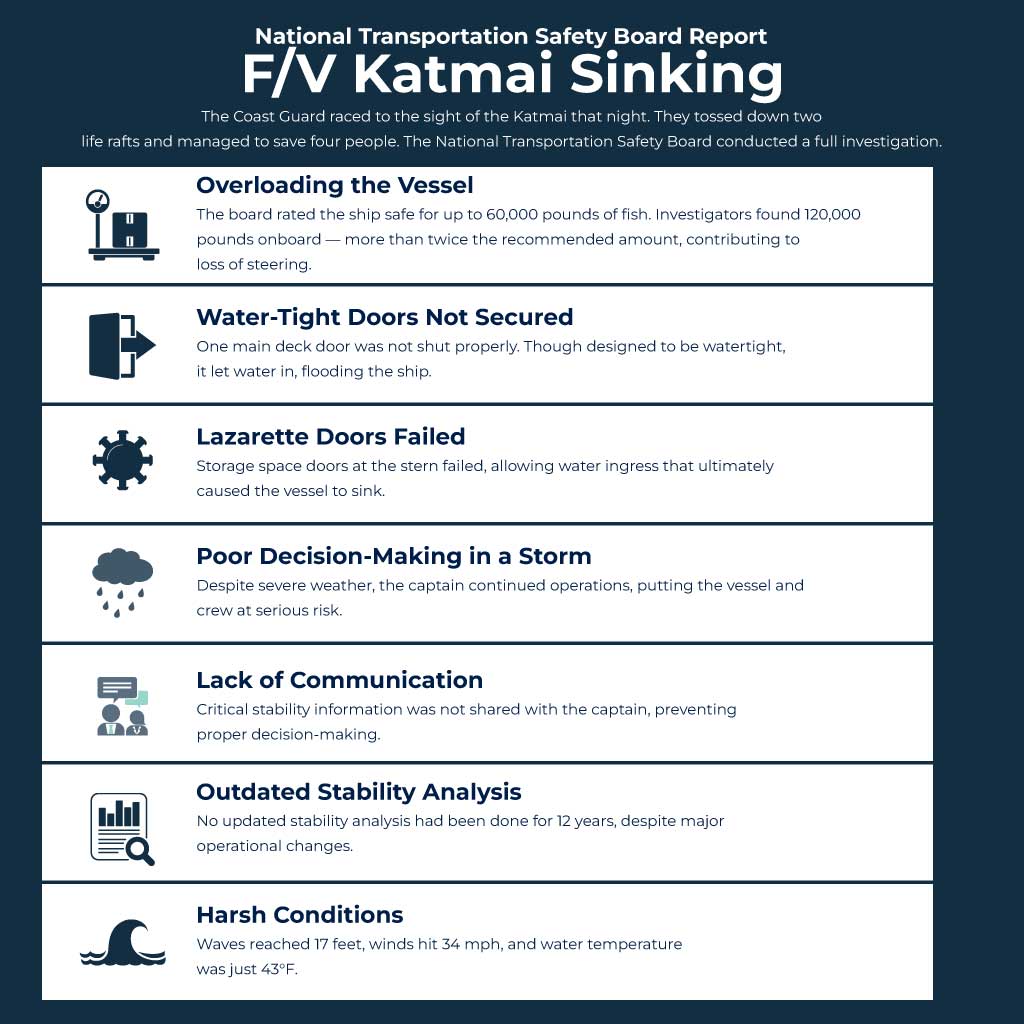
A Coast Guard airplane reached the scene at 7:20 the next morning and dropped two liferafts. That afternoon a Coast Guard helicopter rescued the four survivors from the Katmai’s liferaft. The other seven died. The National Transportation Safety Board had to find out why.
The Coast Guard has no authority to inspect fishing vessels like the Katmai. In December 2007, a Coast Guard examiner did a voluntary dockside safety examination, which checks safety equipment and does not address a vessel’s material condition or watertight integrity. No attempt has been made to locate the wreck. The water at its last reported position is about 9,200 feet deep. The board asked the four surviving crew members what happened.
What they learned was that a number of smaller things contributed to the loss of life. That starts with what was on board. The vessel’s 1996 stability report evaluated loads of frozen cargo up to 60,000 pounds. The master said the boat had about 120,000 pounds of frozen cod on board, twice that amount. The NTSB named the decision to load that much as a contributing factor in the sinking.
The board also found other interesting facts. A surviving crewmember testified that the aft watertight door into the processing space on the main deck was left open. The master said the engineer found the watertight door to the lazarette open when he went to check the steering. The lazarette is the aftmost compartment in the hull. On the Katmai it held the steering gear, and the engineer found it flooded. The NTSB found that water coming in through the open doors sank the vessel.
Another big factor was a lack of communication. The report found that the boat’s master didn’t make a safe decision. A storm was raging at the time of the accident. The boat’s master made the decision to continue the operation even as the boat approached the storm.
The board said that another factor was a failure of communication. The owner didn’t communicate critical information to the master of the ship. That includes information about keeping the boat stable. The owner failed to make sure the master understood critical information so that they could operate safely.
There are still other questions raised by the board. The Katmai’s latest stability analysis was done in July 1996, 12 years before the sinking. It did not account for changes made to the vessel in 1998 or later, or for its switch from shrimp to Pacific cod. The NTSB found that the loading guidance the master had was therefore inaccurate.
The sinking report on FV Katmai was telling. The deck boss testified that light could be seen through the processing space door when it was closed. There were questions about just how stable an overloaded boat could be under these conditions. The waves at the sinking were 20 to 30 feet high. Winds were from the east at 60 to 70 knots, according to National Weather Service data in the brief. The water was just 43 degrees.
Final Words:
There’s no doubt the FV report is tragic. The Katmai Boat Deadliest Catch saga will go on in the history of just how devastating this industry can be. The TV show The Deadliest Catch was receiving significant attention at the time of the accident. Note that the Katmai Deadliest Catch vessel never actually was on the show. It was just one of many stories told about it.
A combination of factors led to the death of 7 people. The NTSB tied the sinking to the open doors, the overloading, the decision to keep fishing in the storm, and stability guidance that was out of date. That’s what makes this such a devastating accident.