Key Takeaways:
-
A boatswain is the senior deck crew leader responsible for supervising maintenance, cargo, and safety operations.
-
The role requires strong leadership, seamanship skills, and the ability to coordinate deck activities efficiently.
-
Boatswains typically advance from deckhands after gaining sea service experience and certifications like STCW.
-
They oversee ship rigging, mooring, cargo handling, and emergency preparedness on various vessel types.
-
The position involves physically demanding work with significant safety risks and legal protections under maritime law.
-
Boatswains earn an average salary between $50,000 and $85,000 annually in the U.S., varying by vessel and contract.
-
Career progression can lead to licensed officer roles or shore-based maritime positions.
A boatswain (pronounced “bosun”) is the senior deck rating on a ship, responsible for supervising deck crews, maintaining the hull, rigging, and deck equipment, coordinating mooring and cargo operations, leading safety drills, and keeping daily deck work safe and efficient. Usually promoted from experienced deckhands, the boatswain serves as the front-line leader for seamanship, maintenance, and crew discipline on cargo ships, tankers, offshore supply vessels, cruise ships, Coast Guard cutters, and large yachts.
If you are a deck crewmember, an aspiring boatswain, a maritime student, or someone exploring maritime careers, this guide explains what the job involves, how people move into it, what training and certifications are typically required, which skills and working conditions come with the role, what pay and job prospects look like, and what legal protections may apply after an onboard injury. Because boatswains and deck crews do dangerous physical work that directly affects vessel safety and operations, they also hold specific rights under U.S. maritime law, including the Jones Act.
So what does a boatswain actually do day to day on a ship?
What Does a Boatswain Do?
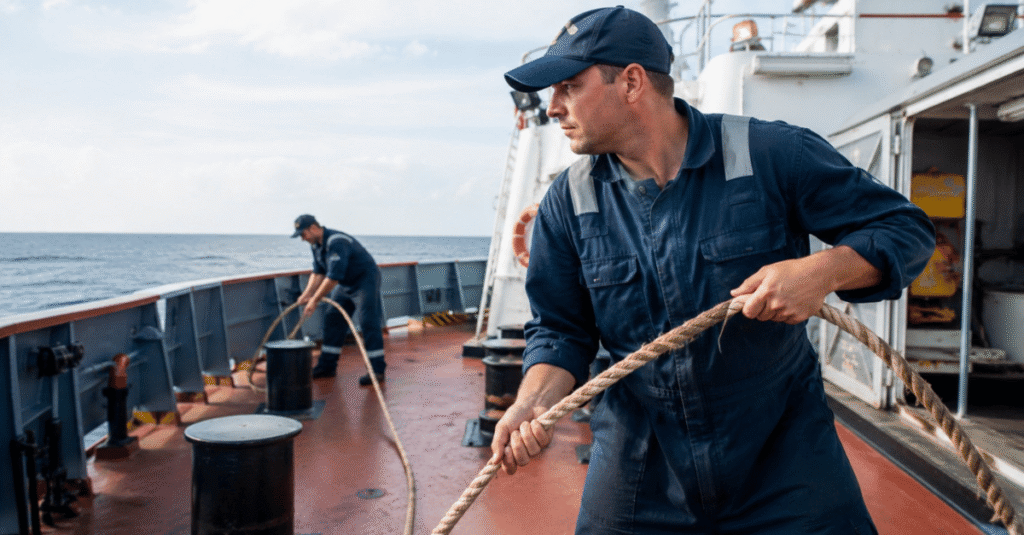
A boatswain is often considered the operational leader of the deck crew. The bosun supervises the deck crew and assigns daily tasks, translating officers’ plans into actionable work that keeps the vessel safe and efficient. Below are the major areas of responsibility.
Supervising Deck Crews and Boatswain’s Mates:
The boatswain reports to the chief mate and is responsible for organizing all deck crews and boatswain’s mates (sometimes abbreviated as BMs). Typical tasks under their supervision include chipping and painting, rust removal, line handling, cleaning, and minor repairs. On larger vessels, the bosun runs toolbox talks each morning, checks that crew members follow safety procedures, and monitors rest-hour compliance.
This is a hands-on leadership position-the bosun works alongside personnel on board during deck jobs, not just behind paperwork. The bosun also provides training to junior crew members in seamanship skills, from knot-tying to winch operation, ensuring development across the team.
Inspecting and Maintaining the Ship’s Exterior and Gear:
The bosun oversees the upkeep of the ship’s structure including rust removal and painting, and is responsible for ship’s rigging maintenance. Daily tasks include greasing winches, checking anchor windlass brakes, replacing mooring lines, and inspecting ladders and gangways. The bosun helps maintain equipment readiness through regular inspections and keeps maintenance logs for the chief mate.
Poor maintenance can lead to injuries or accidents, which may become Jones Act or unseaworthiness claims if the vessel is kept unsafe.
Cargo Handling, Mooring, and Small Boat Operations:
In port, the boatswain organizes mooring stations, leads line-handling teams, and ensures the vessel is secured safely. They perform docking, undocking, and anchoring duties on every arrival and departure. The bosun oversees the loading and unloading of cargo, rigging and inspecting cargo gear, supervising cranes and winches, and overseeing lashings. They also handle shipboard cargo and small arms safely when required.
On offshore vessels or Coast Guard cutters, the boatswain often runs small boat evolutions and launch-and-recovery operations, coordinating with the coxswain. Towing operations and fuel transfer also fall under deck crew supervision. The risk of crush injuries, line snap-backs, and falls during these tasks is significant.
Safety, Drills, and Emergency Response:
The bosun is responsible for the readiness of lifeboats and rescue equipment, and commonly leads emergency response teams for fire, rescue, and damage control. Before each voyage, they check survival craft, life rafts, immersion suits, and muster lists. The bosun ensures compliance with safety protocols among the deck crew, with proper regard for pollution and environmental rules, and maintains safety and cleanliness of deck work areas, including guardrails, fall-protection lines, and enclosed-space entry setups.
Recordkeeping and Communication with Officers:
The bosun serves as the link between ship officers and the deck crew, providing daily updates on completed work, crew performance, and needed repairs. Basic paperwork includes maintenance checklists, paint and supplies inventory, defect reports, and watch handover notes. Clear radio and verbal communication during mooring and cargo operations keeps everyone coordinated and safe.
Boatswain Job Settings: Merchant Ships, Navy, Coast Guard, and Yachts:
The title “boatswain” appears across military and civilian fleets, but duties and legal protections vary by ship type.
Boatswain on Merchant and Cargo Ships:
On tankers, container ships, and bulk carriers, the bosun focuses on cargo gear, mooring operations, and structural upkeep. Schedules range from 3–6 month contracts for international crews to 28/28 day rotations on U.S.-flagged offshore vessels, including weekends underway. These boatswains serve full time and are clearly covered by the Jones Act when injured due to employer negligence.
What a Boatswain Does in the Navy and Coast Guard:
In the U.S. Navy, “Boatswain’s Mate” is a formal military rating. What do boatswain’s mates do? They handle seamanship, small boat handling, deck weapons support, ammunition handling, and amphibious operations. The boatswain mate navy job description includes running anchor detail, supervising painting teams, and operating rigid-hull inflatable boats for boarding missions. Since Vietnam-era deployments, this rating has remained central to naval operations. While active-duty sailors fall under a different legal system, the practical seamanship skills mirror civilian roles.
Boatswain on Large Yachts and Cruise Ships:
On superyachts and cruise ships, the bosun blends maintenance with hospitality-managing tenders, water-sports equipment, and guest-facing presentation. These jobs often involve seasonal sailing in the Mediterranean and Caribbean, with both full time and rotational contracts available.
Qualifications, Training, and Certifications for Boatswains:
Becoming a boatswain requires a combination of sea-time, formal training, and relevant credentials that vary by flag state and company.
From Deckhand to Boatswain: Sea Service Requirements:
The typical career path runs: ordinary seaman → able seaman (AB) → boatswain. Under U.S. law, AB-Unlimited requires 18 months of documented deck service. Employers want proven experience in supervision, mooring, and cargo operations before offering a bosun’s role-usually 1–3 years at sea minimum.
Mandatory STCW and Safety Training:
Most international vessels require STCW Basic Training, covering personal survival, fire prevention, first aid, and social responsibilities. Companies often expect advanced courses in proficiency in survival craft, advanced firefighting, and security awareness. In practice, STCW certification is required for nearly all boatswain roles beyond small domestic boats.
National Licenses, Unions, and Company Requirements:
In the U.S., a Merchant Mariner Credential (MMC), TWIC card, and federal medical fitness certificates are standard. Some employers recruit through maritime unions with additional instruction standards and seniority-based promotion. Background checks, drug and alcohol testing, and school-based preparation programs round out the requirements for this occupation.
Skills, Working Conditions, and Leadership Responsibilities:
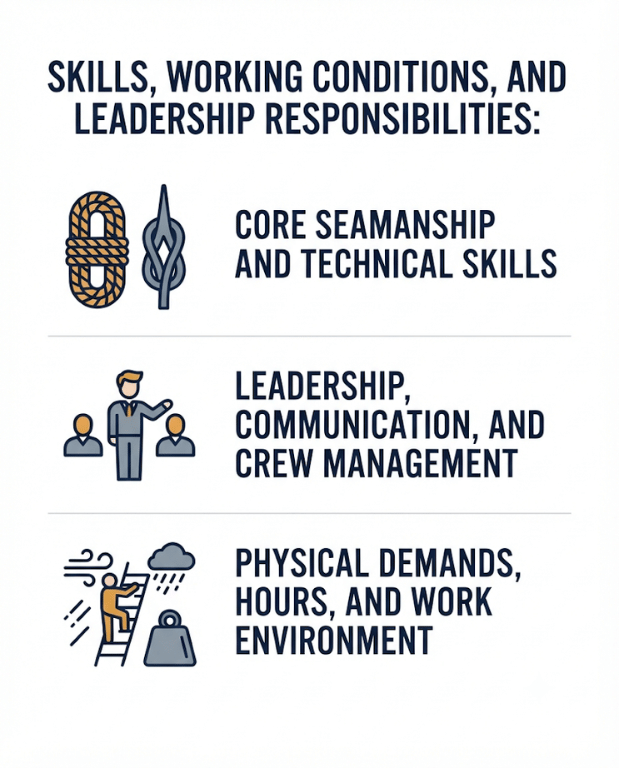
The boatswain is both a technical specialist and front-line leader. An experienced bosun has strong leadership and communication skills, and the bosun plays a pivotal role in improving operational efficiency on the ship.
Core Seamanship and Technical Skills:
Essential skills include line handling, splicing, rigging, knots, crane and winch operation, painting and surface preparation, and basic mechanical knowledge. Understanding weather and sea conditions is critical during mooring and cargo operations. Familiarity with power tools, high-pressure washers, and lifting equipment in compliance with safety procedures is expected.
Leadership, Communication, and Crew Management:
The bosun translates officers’ plans into actionable tasks for the deck crew, acting as the link between assigned orders and practical execution. Conflict resolution, fair task assignments, and mentoring of junior sailors are daily responsibilities. Good documentation of near-misses and hazards creates a safer working environment for all members aboard.
Physical Demands, Hours, and Work Environment:
This job involves heavy lifting, climbing, working in bad weather, and long hours on your feet. Watch systems and overtime during port calls mean irregular sleep. Common hazards include slips, line snap-back injuries, crush points near winches, and chemical exposure from paints-which is why strict safety procedures matter and why failures can give rise to injury claims.
Pay, Career Path, and Job Outlook for Boatswains:
Boatswain pay depends heavily on vessel type, trade route, and whether you’re working for a union company or private operator.
Average Boatswain Salary and U.S. Earnings:
U.S. boatswains typically earn between roughly $50,000 and $85,000+ per year including overtime. The Bureau of Labor Statistics reports a median of $66,490 for water transportation workers. Union contracts, hazard pay, and vessel type can push total compensation well above base figures.
Career Progression Beyond Boatswain:
Experienced boatswains can move into officer roles-third mate, chief mate, and eventually master-with additional education and licensing. Alternative paths ashore include port captain, marine superintendent, safety officer, or instructor at maritime training centers. The leadership and seamanship skills from a bosun job are a source of inspiration for many who transition into broader industrial careers.
Job Outlook and Stability in the Maritime Industry:
Employment growth is projected at 1–2% through 2034-slower than average, but steady demand from retirements and the growth of offshore wind and energy sectors keeps the mission-critical bosun role relevant. While some routine tasks are increasingly efficient through automation, supervision of deck crews, complex rigging, and emergency response still require experienced human boatswains who can operate under pressure.
Maritime Safety, Injuries, and Your Legal Rights as a Boatswain:
Boatswains work at the center of high-risk deck operations. Injuries are common, and understanding your rights matters.
Common Deck Injuries for Boatswains and Crew Members:
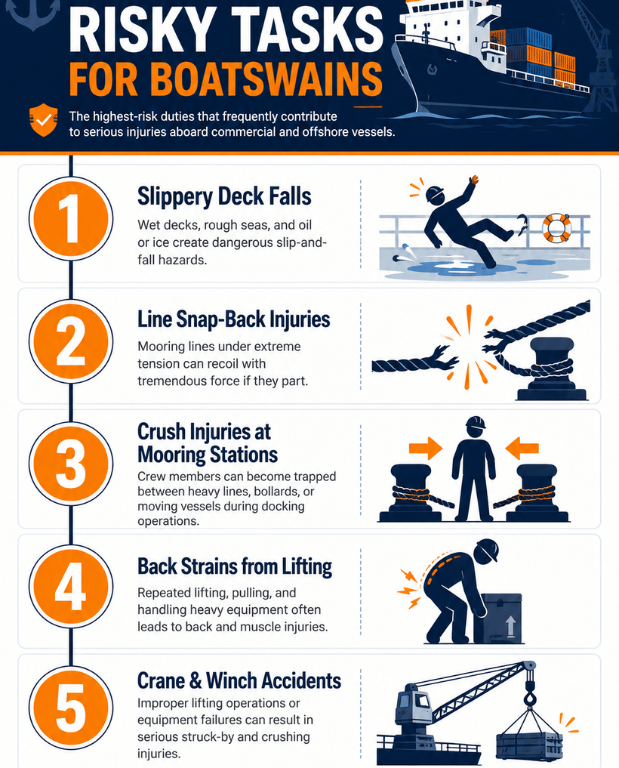
Typical incidents include falls on slippery decks, line snap-back injuries, crush injuries at mooring stations, back strains from lifting, and accidents involving cranes and winches. Inadequate maintenance, understaffing, poor training, or defective equipment can turn these into negligence or unseaworthiness issues. Even experienced boatswains can be hurt if pressured to rush jobs or work without proper protective gear.
Employer Duties and the Jones Act:
Employers must maintain safe decks and equipment, provide proper training and staffing, and enforce safety policies. The Jones Act allows injured seamen-including boatswains and boatswain’s mates to seek damages if employer negligence contributed to their injury. Maintenance and cure benefits cover basic living expenses and medical care during recovery regardless of fault, but may not fully account for long-term losses.
Top 5 Risky Tasks for Boatswains:
Contact JonesAct.info for Boatswain and Deck Crew Injury Help:
If you are a boatswain, boatswain’s mate, or deck crewmember injured on the job, do not sign any releases or accept quick settlements before speaking with a maritime attorney. JonesAct.info focuses on maritime and Jones Act issues, providing assistance to seafarers hurt by unsafe conditions or employer negligence. Contact JonesAct.info for a confidential, no-obligation discussion about your situation.
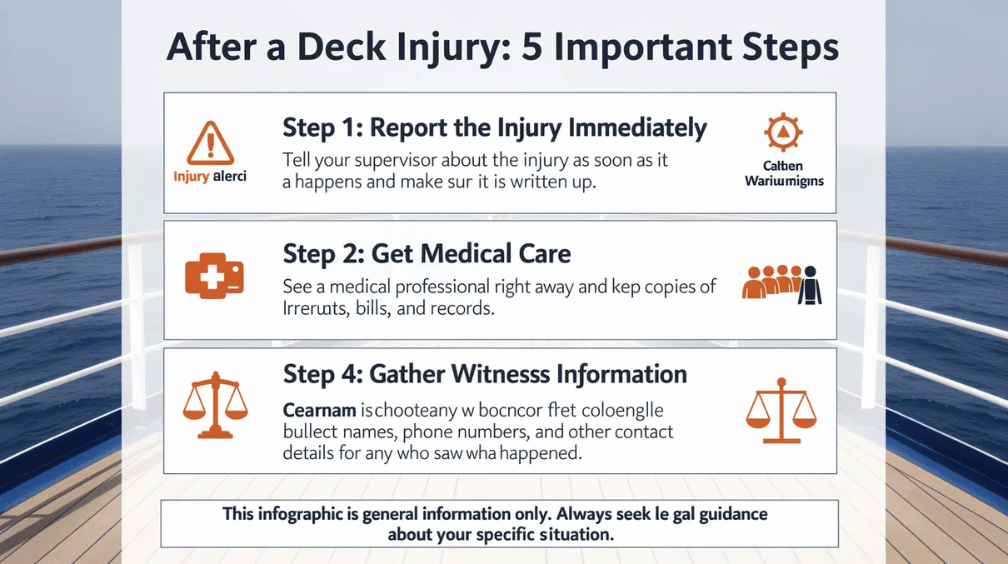
What to Do After a Deck Injury:
Conclusion: Is a Boatswain Career Right for You?
A boatswain career offers demanding physical work, real leadership responsibility, solid pay, and a clear progression from deckhand to senior roles at sea or ashore. Safety awareness and proper training are essential-boatswains stand at the center of every high-risk operation on deck.
If you pursue this career, know that important maritime laws protect you. And if something goes wrong, resources like JonesAct.info exist to help you understand your options and protect your future.
FAQ
Frequently Asked Questions

A boatswain supervises deck crews, maintains the ship's hull and rigging, coordinates mooring and cargo operations, and leads safety drills aboard the vessel.
The boatswain is the senior unlicensed deck rating who organizes all hands-on deck work under the direction of the chief mate.
You typically start as an ordinary seaman or deckhand, gain 1–3 years of documented sea service, earn an Able Seaman endorsement, and then get promoted based on experience and leadership ability.
Most boatswains need an Able Seaman endorsement, STCW Basic Training, a Merchant Mariner Credential, TWIC card, and medical fitness certification.
Yes, for virtually all international and most domestic commercial vessels, STCW certification is required or strongly preferred.
U.S. boatswain salaries average around $65,000 per year, with wide variation based on vessel type, overtime, and union contracts.
Typical annual earnings range from roughly $50,000 to over $85,000 depending on the sector and hours worked.
The standard path is ordinary seaman → able seaman → boatswain, with each step requiring additional sea time and demonstrated competence.
Boatswains can pursue officer licenses (third mate, chief mate, master) or move into shore-based roles like marine superintendent or safety officer.
Key skills include line handling, rigging, crane operation, painting, leadership, clear communication, and thorough knowledge of safety procedures.
Yes, it is the primary front-line leadership role in the deck department, bridging officers and working crew.
A boatswain is the senior civilian deck rating; "Boatswain's Mate" is a military rating in the U.S. Navy and Coast Guard held at various paygrades.
Navy Boatswain's Mates handle seamanship, small boat operations, deck weapons support, ammunition handling, and amphibious operations.
Coast Guard Boatswain's Mates perform similar duties-seamanship, small boat operations, law enforcement boarding support, and deck maintenance.
On yachts, the bosun focuses more on cosmetic upkeep and guest-facing tender operations; on cargo ships, the emphasis is on heavy cargo gear and structural maintenance.
Daily tasks include assigning crew work, inspecting deck equipment, overseeing painting and repairs, coordinating mooring, and conducting safety checks.
The bosun maintains anchors, chains, mooring lines, winches, windlasses, cranes, davits, lifeboats, deck surfaces, and all rigging components.
Yes, virtually all employers require at least 12–36 months of documented sea service as an ordinary or able seaman before promotion.
Employment growth is projected at 1–2% through 2034, with steady openings from retirements and expanding offshore energy sectors.
It is a stable career with modest growth; while some tasks are being automated, the supervisory, safety, and emergency response aspects of the role remain firmly human-dependent.