Key Takeaways:
-
Alcohol is the leading known contributing factor in fatal recreational boating accidents, accounting for 17% of boating deaths in 2023.
-
Boating under the influence carries criminal penalties including fines, jail time, and license suspension in all 50 states and under federal law.
-
A drunk boat driver can be sued for compensation by injured victims, and liability may extend to boat owners, rental companies, employers, and alcohol vendors.
-
Victims of alcohol-related boating accidents can recover compensation for medical bills, lost income, pain and suffering, property damage, and wrongful death.
-
Designating a sober skipper, wearing life jackets, and limiting alcohol consumption aboard are the most effective ways to prevent drunk boating tragedies.
-
Taking immediate steps after a crash-seeking medical help, documenting the scene, and filing a boating accident report-protects both safety and legal rights.
-
Environmental stressors like sun and wave motion magnify alcohol's impairing effects on boaters, making even moderate drinking extremely dangerous on the water.
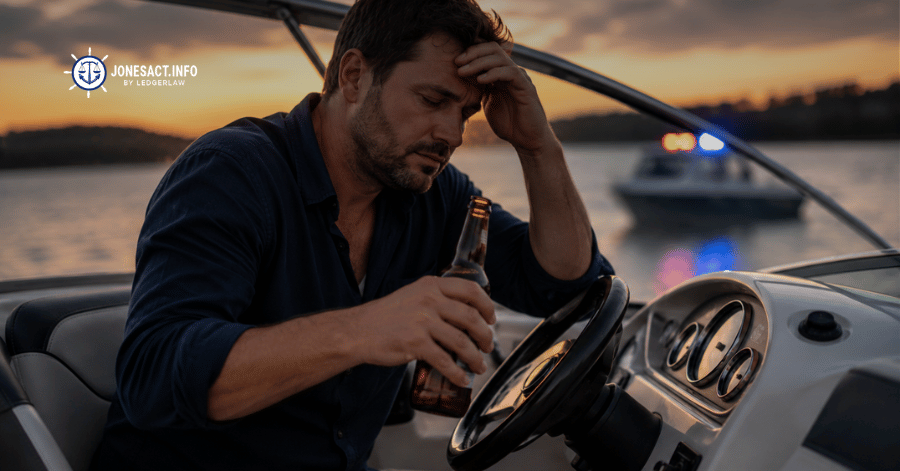
Every boating season, crowded lakes and rivers fill with friends, families, and fun-along with coolers of booze. Drunk boating accidents happen when someone operates a vessel while impaired by alcohol or drugs, sharply increasing the risk of collisions, capsizes, and drownings. On any given Fourth of July weekend, marine patrols across the country respond to crashes and fatalities tied directly to intoxicated operators, even though many people who would never drink and drive still underestimate how dangerous alcohol is on the water.
The numbers paint a stark picture. Alcohol is the leading known contributing factor in fatal recreational boating accidents, and the U.S. Coast Guard reports that alcohol was linked to 17% of boating deaths in 2023, including 79 fatalities on U.S. waterways. For boaters and passengers planning a day on the water, victims and families dealing with a serious crash, and legal professionals evaluating fault or claims, understanding these accidents can protect both lives and legal rights.
The legal charge is typically called boating under the influence, or BUI, and a drunk boat driver can face criminal prosecution much like a drunk driver on the highway, along with civil liability when someone is injured or killed. This article explains how alcohol affects boating safety, the state and federal BUI laws that apply, who may be held liable after a crash, what compensation may be available to victims, and the practical steps that help prevent alcohol-related boating accidents. It is educational in nature and not a substitute for personalized legal advice about a specific boating accident or BUI charge.
Drunk Boating Accidents: Causes, Laws, Liability, and Prevention:
This core section explains how and why drunk boating accidents happen, what laws apply, who may be held responsible, and how these crashes can be prevented. Each subsection below breaks down one of four pillars: causes and alcohol effects on the water, BUI laws and penalties, liability in civil claims, and prevention strategies.
This is the most detailed portion of the article because it directly addresses the “what, why, and how” behind alcohol-related boating accidents-and what boaters, passengers, and victims need to know to protect themselves.
Primary Causes of Drunk Boating Accidents:
According to U.S. Coast Guard data, there were 3,844 reported boating accidents and 564 fatalities in 2023. Alcohol use is the leading cause of boating accidents when fatal outcomes are involved, and the most common causes of non-fatal boating accidents include operator inattention and improper lookout-both of which alcohol worsens dramatically.
Alcohol consumption reduces balance and coordination, and drug use can further impair judgment and reaction time, making falls overboard, slips on wet decks, and missteps near spinning propellers far more likely. On a moving vessel, even a person who feels “fine” after a few drinks becomes a serious risk to themselves and other boaters.
Then there is what safety experts call “boater’s hypnosis.” The combined effect of sun, heat, glare, engine vibration, wind, and constant wave motion already fatigues a sober person. Adding alcohol accelerates dehydration, increases heat exhaustion, and deepens fatigue-all of which compound impaired judgement on the water.
Common recreational scenarios only raise the stakes: holiday parties on a lake, nighttime cruises, sandbar gatherings, and booze cruises all increase the temptation for drunk boating and reduce supervision of passengers. Inexperienced operators with limited hours at the helm are especially vulnerable when impaired.
How Alcohol Impairs Boat Operators and Passengers:
Alcohol impairs balance, judgment, and reaction time on boats. A boat operator who has been drinking processes visual information more slowly, loses peripheral vision, and struggles to judge wave height, distance to other boats, or closing speed on a channel marker at dusk.
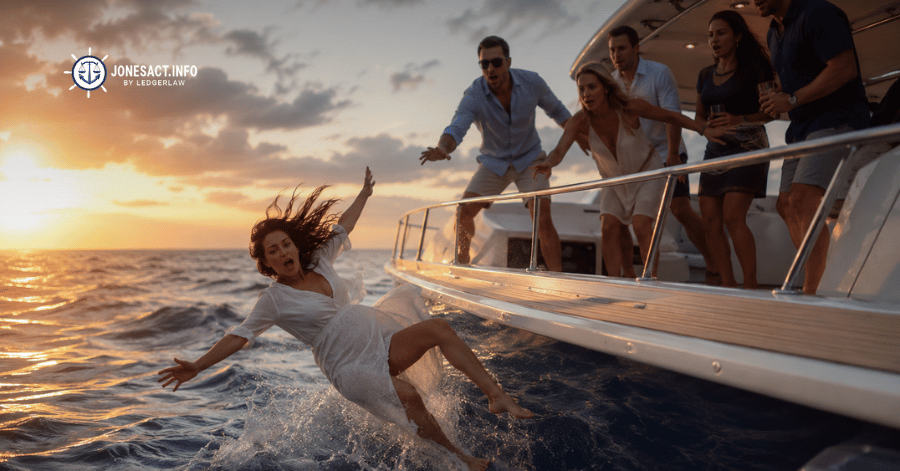
Physical impairments are equally dangerous. Unsteady footing on a moving deck, delayed responses to sudden wakes or swells, and weakened swimming ability after falling overboard can turn a minor incident into a fatal one. Drunk passengers can fall overboard and drown before anyone notices they are gone-especially at night.
Consider what makes a boat different from a car: there are no lane markings, traffic lights, or brakes. No seatbelts. No guardrails. Impairment can begin at one third of the legal limit. Even modest blood alcohol concentration levels are more dangerous on a vessel because there is nothing to compensate for poor judgment. A drunk boater who misjudges a turn near a jetty has no rumble strip to warn them-only rocks.
Mixing alcohol with the environmental stressors of boating creates a compounding effect that makes even a single drink more impairing than it would be on shore.
BUI and Drunk Boating Laws in the United States:
Boating under the influence is a crime in all 50 states and a federal offense. The federal legal limit for boating is .08% BAC-the same threshold used in drunk driving laws. A BAC over 0.08% is illegal for operating a boat on any state waters or federally navigable waterways, though BUI rules are separate from road DUI laws for a vehicle even when the legal threshold is similar.
Several states also impose lower thresholds. In California, operating a boat under the influence is illegal, with a 0.04% limit for commercial operators and 0.01% for minors. Arkansas law sets the BAC limit for boating at .08% for adults. Ohio law prohibits operating a boat with a BAC of .08% or higher. Federal regulations under 33 CFR §95.025 defer to state-defined BAC levels, meaning the Coast Guard enforces whatever standard the state has adopted.
The U.S. Coast Guard has broad enforcement authority: officers can stop vessels, conduct sobriety testing, terminate voyages, and refer impaired boat operators for criminal prosecution. BUI charges apply to motorboats, personal watercraft, sailboats under power, and in some states even kayaks or paddleboards.
Typical criminal penalties for a first offense include fines, jail time, probation, mandatory alcohol education, and suspension of boating privileges. A first BUI offense in Ohio can lead to six months in jail. A BUI conviction can lead to fines up to $1,000 in many jurisdictions, with enhancements for repeat offenses or accidents involving serious injury or even death.
Civil Liability After a Drunk Boating Accident:
Beyond criminal penalties, a drunk boat driver faces civil liability. You can sue a drunk boat driver for compensation if their intoxicated operation caused your injuries. Operating a vessel while intoxicated is considered negligence, and operators and owners owe reasonable care to passengers and others on the water; when a BUI statute is violated, courts often apply “negligence per se”-meaning the violation itself proves fault.
Negligence must be proven to recover compensation after an accident, but a BUI conviction makes that burden much lighter. Civil lawsuits differ from criminal cases: the prosecutor seeks punishment, while injured passengers, swimmers, or other boaters seek money to cover their losses.
Liability may extend well beyond the drunk boater:
-
Boat owners who negligently entrust a vessel to a visibly intoxicated person.
-
Employers of commercial operators (charter captains, tour boat companies).
-
Rental companies that ignore obvious signs of intoxication.
-
Bars and alcohol vendors under dram shop laws in states that recognize such claims.
Recoverable damages typically include emergency and long-term medical treatment, rehabilitation, lost wages, property damage to boats and docks, and pain and suffering. In fatal cases, surviving family members may file wrongful death claims for funeral costs, loss of financial support, and loss of companionship.
Preventing Alcohol-Related Boating Accidents:
Most alcohol-related boating accidents are preventable. The single most effective step is to designate a sober skipper before leaving the dock-one person who will not drink alcohol during the entire trip.
Practical prevention checklist:
-
Limit or ban alcohol on board, especially on shorter rides or in dangerous conditions.
-
Ensure every passenger has a life jacket accessible at all times.
-
Use a kill-switch lanyard so the engine stops if the operator falls.
-
Install proper navigation lights for any trip extending past daylight.
-
Keep throwable flotation devices within easy reach.
Behavioral strategies matter too. Plan to enjoy alcohol or drugs only after returning to shore. Drink plenty of water throughout the day to combat dehydration from sun and wind. Rotate operators on longer trips to avoid fatigue.
Social pressure is real. Boat owners should lead by example: decline to operate if they have been drinking, and refuse to ride with a drunk boater even if it means cutting a trip short. Friends don’t let friends drive boats drunk-the same principle applies on the water as on the highway.
National and State Statistics on Alcohol-Related Boating Accidents:
The Coast Guard’s 2023 Recreational Boating Statistics reported 564 fatalities from 3,844 incidents. Alcohol accounts for 17% of total boating fatalities in 2023 according to U.S. Coast Guard statistics-79 deaths where alcohol was the leading known factor. In 2020, alcohol was involved in 18% of boating deaths. Around 20% of boating fatalities in 2024 involved alcohol, suggesting the problem may be worsening again in recent years.
Seasonal patterns are clear: Memorial Day, Fourth of July, and Labor Day weekends see dramatic spikes in both boating activity and alcohol-related crashes. States with the highest volumes of recreational boating-Florida, California, Texas, and Great Lakes states including those bordering Lake Erie-consistently report the most alcohol-involved incidents.
Reporting standards and enforcement intensity vary widely, which means actual numbers of alcohol-related boating accidents are almost certainly higher than official figures suggest. Some states test operators after every serious crash; others rarely do. Underreporting makes it difficult to compare states directly, but the statistical patterns all point to the same conclusion: strict BUI enforcement and boater education about alcohol and boating safety remain urgently necessary.
How Alcohol and Boating Conditions Combine to Create Extreme Risk:
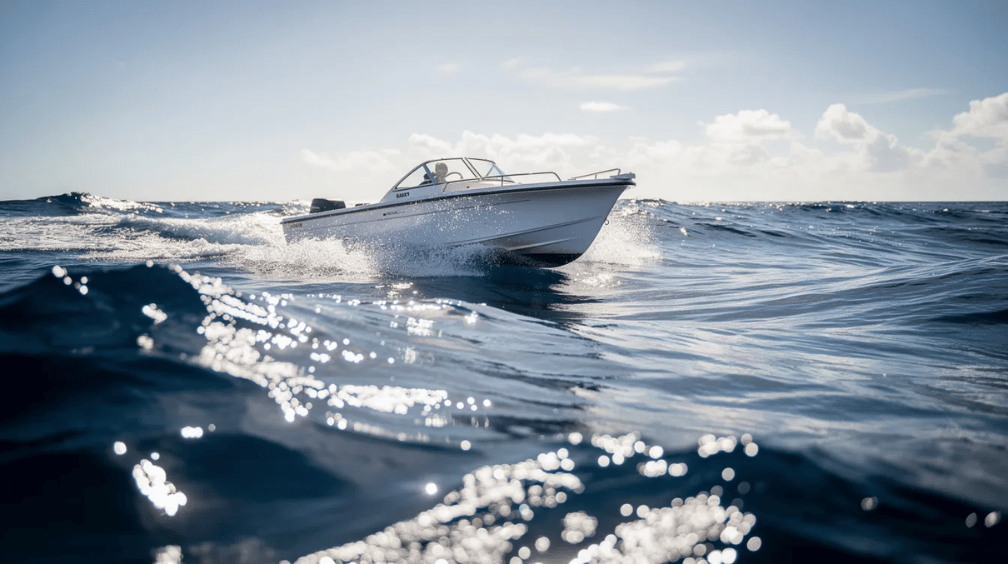
Alcohol does not act in isolation on the water. Environmental stressors like sun and wave motion magnify alcohol’s impairing effects on boaters, creating a danger level far beyond what the same amount of drinking would produce on land.
Prolonged exposure to sun and wind causes dehydration and fatigue, which lower the body’s tolerance for alcohol. A person who might feel fine after two beers at a backyard barbecue can be noticeably impaired after the same amount on a boat in the midday heat. Cold water presents its own hazard: falling into cold water while intoxicated can cause rapid loss of muscle control and accelerate drowning.
Wave action from wakes, currents, and other boaters demands constant fine motor adjustments and quick reactions from the operator-exactly the skills alcohol degrades first. At night, impaired depth perception makes it nearly impossible to read buoys, spot unlit obstacles, or see swimmers near the shore.
Consider a real scenario: a drunk boat driver misreads a current near a narrow channel, overcorrects, and strikes a dock. On land, the same lapse in judgment might result in a curb check. On the water, it results in serious injury or a capsized vessel with passengers in the water. The combination of alcohol and boating conditions is extremely dangerous by any measure.
Common Types of Drunk Boating Accidents:
Alcohol-related boating accidents take many forms, each creating different patterns of injury and liability.
Vessel-to-vessel collisions happen when an intoxicated operator misjudges right-of-way, fails to yield, or simply does not see another boat. On busy holiday weekends, crowded waterways become especially dangerous when multiple operators are drinking.
Single-vessel incidents are the most common type linked to alcohol: running aground, striking a pier or buoy, capsizing in rough water, or a passenger falling overboard from a moving boat. Impaired operators misjudge rudder responses, depth, drift, and proximity to fixed hazards.
Accidents involving swimmers and paddlers are particularly tragic. A drunk boat driver may fail to spot a person swimming near a marina or a kayaker hugging the shoreline. Small open motorboats under 21 feet are involved in 80% of drowning deaths in boating accidents-the same vessels most commonly used for casual lake outings where drinking is prevalent.
Even when the intoxicated person is a passenger rather than the operator, danger persists. Drunk passengers can fall overboard and drown, stand on the gunwale and tumble into a spinning propeller, or distract the operator at a critical moment. Everyone aboard a recreational vessel shares the risk when alcohol is present.
Injuries and Long-Term Consequences from Drunk Boating Crashes:
Boating accidents can result in serious injuries or death, and crashes involving alcohol tend to be especially severe because they often occur far from immediate medical help.
Common physical injuries include:
-
Traumatic brain injuries from impact with the hull, water surface, or other objects.
-
Spinal cord trauma and paralysis.
-
Broken bones and crush injuries.
-
Amputations from propeller strikes.
-
Severe lacerations and burns.
Drowning and near-drowning are among the most devastating outcomes. Drowning victims in boating accidents frequently do not wear life jackets-a preventable factor in nearly every fatal incident. Intoxication reduces a person’s ability to swim or stay afloat, even in relatively calm water. In 2016, 65% of boating accidents resulted in injuries, underscoring how much weight these incidents carry in terms of human cost.
Psychological effects often linger for years: post-traumatic stress disorder, anxiety around water, and depression after losing a family member. Financial consequences compound the emotional burden-repeated surgeries, long-term rehabilitation, lost income, and mounting bills can devastate families who were simply out for a day of fun on the water.
Boating Under the Influence Laws, Testing, and Criminal Penalties:
Law enforcement agencies use several methods to detect and prosecute drunk boating. On the water, marine patrol officers watch for erratic vessel operation-swerving, excessive speed, near-misses with other boaters, or failure to display navigation lights. A routine safety equipment inspection can quickly escalate into a BUI investigation if officers observe signs of intoxication.
Chemical testing is the primary method for determining blood alcohol concentration. Officers may administer breath tests dockside or request blood or urine samples. Many states have implied consent laws: by operating a vessel on state waters, you have already agreed to submit to testing. Refusing a test often triggers automatic license suspension or enhanced penalties.
Penalty ranges for BUI convictions vary by state but follow a general pattern:
Offense Level | Typical Penalties |
First offense | Fine up to $1,000, up to 6 months jail, mandatory alcohol education, boating license suspension. |
Repeat offense | Higher fines, longer jail time, extended suspension, possible felony charges. |
BUI causing injury or death | Felony charges, years of imprisonment, restitution to victims. |
A criminal BUI conviction provides powerful evidence in a related civil lawsuit. However, victims can still pursue compensation even if prosecutors decline to file charges or fail to secure a conviction-the standard of proof in civil court is lower.
How Alcohol Affects Boating Safety:
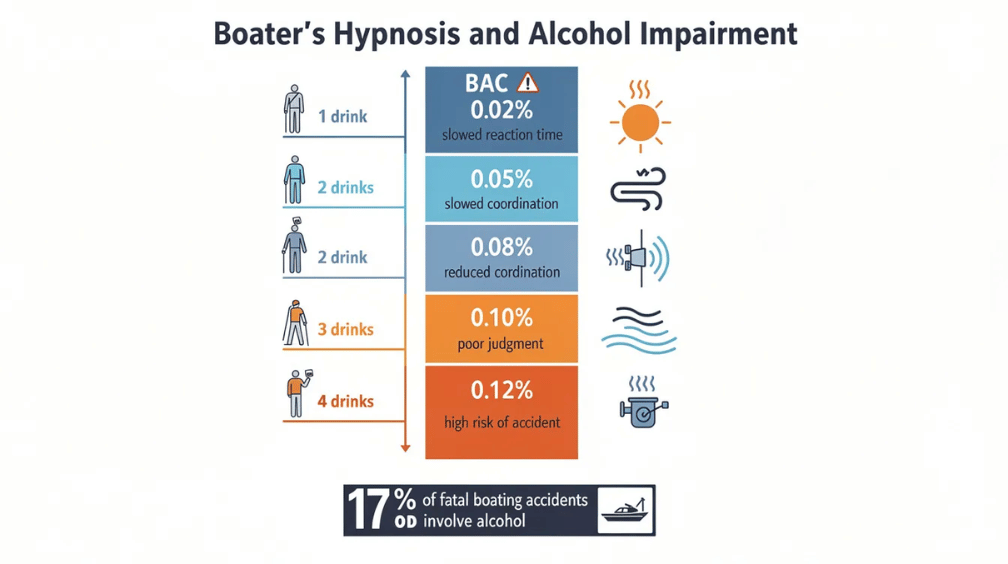
This infographic illustrates how boating under the influence impairs judgment, reaction time, and coordination at various BAC levels, alongside the environmental stressors that amplify alcohol’s effects during a typical day on the water.
Who Is Liable After a Drunk Boating Accident?
Determining boat accident liability after a drunk boating incident is often more complex than simply pointing at the intoxicated operator. Multiple parties may share responsibility.
The drunk boat driver bears primary liability for negligent operation-speeding, failing to keep a proper lookout, or ignoring navigation rules while under the influence of alcohol.
The boat owner can be liable even if they were not present. Under negligent entrustment theories, an owner who allows a visibly intoxicated or unqualified person to operate their vessel may be held responsible for the resulting damage.
Commercial employers such as tour operators, charter companies, and party boat businesses face vicarious liability if an employee was operating a boat while drunk within the scope of their employment.
Other potentially liable parties include:
-
Rental companies that hand over keys to a clearly impaired person.
-
Bars and alcohol vendors under dram shop laws in states that permit such claims.
-
Social hosts who provide alcohol to someone they know will be operating a vessel.
Each case requires a fact-specific legal analysis of how the boating accident occurred and who contributed to it.
Compensation and Legal Options for Victims of Drunk Boating Accidents:
Victims of boating accidents caused by a drunk boater may have strong legal claims to recover compensation under state tort law and, in some cases, federal maritime law.
Compensable damages typically fall into several categories:
-
Economic damages: current and future medical expenses, lost wages, diminished earning capacity, rehabilitation, assistive devices, and property damage.
-
Non-economic damages: pain and suffering, emotional distress, loss of enjoyment of life, and loss of consortium.
-
Wrongful death damages: funeral expenses, loss of financial support, and loss of companionship for surviving family members.
In egregious cases-such as an operator with an extremely high BAC or a repeat BUI offender-courts may award punitive damages where state law allows. These go beyond compensating the victim and serve to punish reckless conduct.
Time is critical. Statutes of limitations set firm deadlines for filing claims, and evidence on the water degrades quickly. Victims injured in an alcohol-related boating accident should consult an experienced maritime or boating accident attorney as soon as possible to preserve their rights.
Insurance Coverage Issues in Alcohol-Related Boating Accidents:
Many recreational boat owners carry liability insurance through standalone boat policies or endorsements on homeowner’s insurance, but coverage varies significantly. A standard policy may cover injuries, property damage, and legal defense costs-until alcohol enters the picture.
Some policies explicitly exclude coverage for accidents caused by illegal acts such as boating under the influence. If the operator is convicted of BUI, the insurer may deny the claim, refuse to defend the lawsuit, or cancel the policy entirely. This can leave a drunk boater personally responsible for judgments that reach hundreds of thousands of dollars.
For injured victims, the options when a drunk boat operator is uninsured or underinsured include:
-
Claims against the boat owner or their insurance.
-
Claims against an employer in commercial settings.
-
Claims against the rental company's policy.
-
Uninsured/underinsured boater coverage if available in the victim's own policy.
In commercial operations-tour boats, charter fishing, ferries-larger Protection & Indemnity (P&I) policies often provide broader coverage. Regardless of the situation, victims should have any settlement offer reviewed by counsel familiar with boat accident liability and policy exclusions before accepting.
What to Do Immediately After a Drunk Boating Accident:
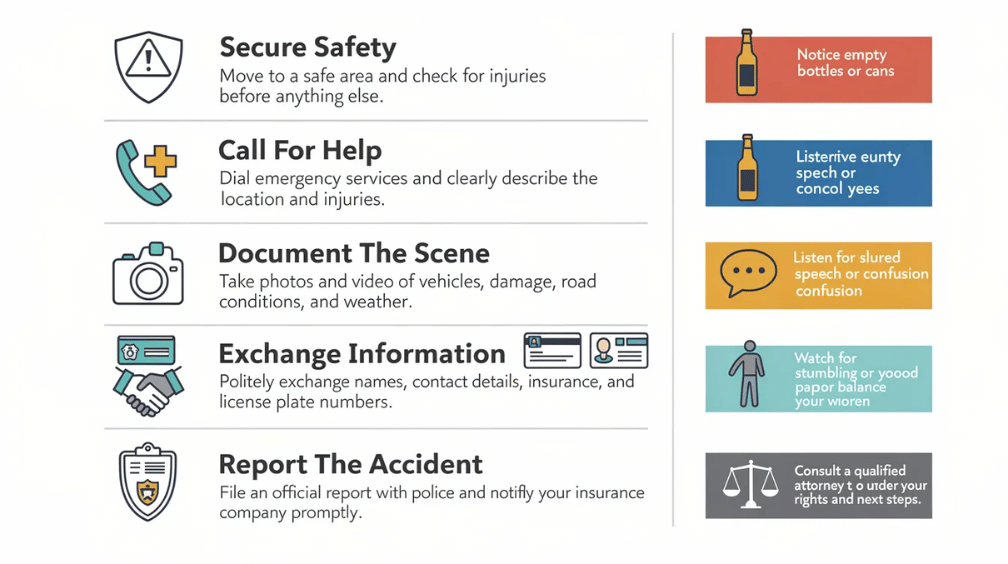
The minutes after a boating accident are critical. Here is a step-by-step approach:
- Secure safety first. Stop the vessel, help anyone who is hurt or in the water, distribute life jackets, and move away from immediate hazards like fuel spills or fire.
- Call for help. Issue a Mayday on VHF Channel 16, call 911, or contact the Coast Guard or local marine patrol. Report injuries, your GPS location, and the number of people aboard.
- Provide first aid. Address visible injuries, keep injured passengers still and warm, and watch for signs of shock or hypothermia-especially if someone fell into cold water.
- Document everything. Once everyone is safe, photograph vessel damage, injuries, the waterway, weather conditions, and any visible alcohol containers. Note GPS coordinates, time of day, and water conditions.
- Exchange information. Get names, contact details, and boat registration numbers from all parties involved. Collect witness contact information and responding officers’ names and agencies.
- Seek medical evaluation. Even if injuries seem minor, get checked. Shock and adrenaline can mask serious trauma, and medical records will be essential for any future claim.
If you suspect the other operator was intoxicated, document any signs: slurred speech, empty bottles, the smell of alcohol, or admissions of drinking. Do not confront an intoxicated person-let law enforcement handle the investigation.
Reporting Requirements and the Boating Accident Investigation Process:
Federal law and most state laws require written boating accident reports when incidents involve death, disappearance, serious injury requiring medical treatment beyond first aid, or property damage exceeding set dollar thresholds (typically $2,000).
Typical reporting deadlines:
Situation | Deadline |
Death or disappearance | 48 hours |
Injury requiring medical treatment | 48 hours |
Property damage only | 10 days |
Reports are filed with the state boating agency, which forwards data to the Coast Guard for national statistics compilation.
Law enforcement officers investigate suspected drunk boating accidents by interviewing witnesses, reconstructing vessel movements using GPS data and physical evidence, and requesting toxicology reports. Statements made in official reports can be used in later civil litigation, so operators and victims should be truthful and factual but cautious about speculating or accepting blame.
Prompt, accurate reporting establishes that the boating accident occurred the way victims describe. Delayed or incomplete reports can undermine both insurance claims and lawsuits.
Steps to Take After a Drunk Boating Crash:
How JonesAct.info Can Help After a Drunk Boating Accident:
JonesAct.info is a resource for people hurt in accidents on the water-including drunk boating accidents, maritime workplace injuries, and other vessel-related incidents. Whether you were an injured passenger, a swimmer struck by a boat, or a crew member harmed by an intoxicated operator, the team can help you understand your options.
The legal landscape after a boating accident can involve overlapping jurisdictions: state recreational boating laws, federal maritime statutes like the Jones Act, and admiralty law. JonesAct.info evaluates which laws apply to your specific situation and identifies all potentially liable parties-from the drunk boat driver to the boat owner, rental company, employer, or alcohol vendor.
Their assistance includes:
-
Investigating the crash and preserving critical evidence.
-
Dealing with insurers and vessel owners on your behalf.
-
Pursuing compensation for medical bills, lost income, pain and suffering, and wrongful death.
Whether your accident occurred on an inland lake, a river, or coastal waters, prompt legal guidance can make the difference between a full recovery and a missed opportunity. Contact JonesAct.info for a free, no-obligation consultation about your legal rights.
Conclusion: Staying Sober and Safe on the Water
Drunk boating accidents are both tragically common and overwhelmingly preventable. Year after year, alcohol ranks as a leading contributing factor in fatal boating accidents-a pattern that shows no sign of disappearing without sustained effort from every person who steps onto a vessel.
The consequences are severe on every front. Criminal penalties for boating under the influence include jail time, heavy fines, and license suspension. Civil liability can extend beyond the operator to boat owners, employers, and even the bars that served them. And for victims, the physical, emotional, and financial toll of a serious boating accident can last a lifetime.
The path forward is straightforward: use life jackets, assign a sober skipper, plan around weather and daylight, and never operate a vessel under the influence of alcohol or drugs. Save the drinking for the shore.
If you or someone you love has been hurt by an intoxicated boat operator, you have legal rights worth protecting. Evidence fades, deadlines pass, and insurance companies move quickly to minimize payouts. Reach out to an experienced maritime attorney or contact JonesAct.info-to understand your options before it is too late.
Choosing safety over alcohol on the water protects not just your passengers but every swimmer, kayaker, and family sharing the same waterway.
FAQ
Frequently Asked Questions

Alcohol is consistently among the top known contributing factors in fatal recreational boating accidents, with hundreds of reported incidents involving alcohol use each year across U.S. waterways.
In recent years, alcohol has been cited as a primary contributing factor in approximately 17–20% of fatal boating accidents, though underreporting means the true percentage may be higher.
In 2023, at least 79 boating deaths were attributed to alcohol as the leading known cause, and in 2020, alcohol was involved in 18% of boating deaths nationwide.
Beyond alcohol use, the leading causes include operator inattention, improper lookout, excessive speed, operator inexperience, and mechanical failure.
Yes-injured victims and families of those killed can file civil lawsuits against a drunk boat driver, and a criminal conviction is helpful but not required to pursue compensation in civil court.
Liability typically starts with the intoxicated operator but may extend to boat owners, employers, rental companies, and alcohol vendors depending on the facts and applicable state laws.
Victims may recover medical expenses, lost income, rehabilitation costs, property damage, pain and suffering, and in fatal cases, wrongful death damages including funeral costs and loss of support.
Yes-a BUI conviction establishes that the operator violated the law, which simplifies proving negligence in civil court through the doctrine of negligence per se.
Seek immediate medical care, report the accident to authorities, photograph the scene and collect witness information, and contact a boating accident attorney before speaking with insurers.
In most jurisdictions, a written report is mandatory if someone dies, disappears, requires medical treatment beyond first aid, or if property damage exceeds a set dollar amount-check your state's specific rules and file promptly.
Many states use comparative negligence rules, allowing injured people to recover reduced compensation even if they share some blame, as long as their percentage of fault does not exceed the state's threshold. An attorney can evaluate how shared fault might affect your claim.
Some policies cover victims even when the operator was drunk, but many contain exclusions for illegal acts like BUI, which can leave the operator personally liable. Have any claim reviewed by an attorney who understands policy exclusions.
Victims may pursue claims against the boat owner, employer, or rental company, or use their own uninsured/underinsured boater coverage if available in their policy.
Alcohol slows brain processing, lengthens reaction times, and impairs split-second decisions, making it harder for an operator to avoid hazards. These effects begin at low BAC levels and become far worse when combined with sun, heat, and fatigue on the water.
Designate a sober operator, limit or ban alcohol on board, ensure all passengers wear life jackets, and plan trips around daylight and favorable weather. Carrying water, shade, and snacks reduces fatigue that makes even small amounts of alcohol more dangerous.