Key Takeaway Section:
-
Expansive Scope: Maritime law governs almost all activity that happens on the water. Personal injury, commercial shipping, global trade, and environmental protection.
-
Protection for Workers: Laws through the LHWCA and the Jones Act give maritime workers protection from legal and financial issues.
-
Security for the Global Economy: Solid maritime law helps keep the international shipping industry going thanks to a stable and predictable legal framework.
-
Accident Prevention: Rules and regulations help prevent accidents from happening while also protecting crewmembers and passengers, along with the vessels involved.
-
National Security: Maritime law makes the nation's domestic fleet stronger. It also gives federal agencies the legal authority to patrol U.S. waters to enforce the laws.
In the chaotic moments after a boat crash, your instincts will pull you in a lot of different directions. Is my boat sinking? What about the legal mess? During such moments, people must know, “What is the first action required after a boating accident?” It’s crucial since the things you do after a boating accident, it will determine the legal outcome.
Push all of that aside. Your first and only job is to check on the people. It’s not just a moral imperative. It’s a legal one. Before you spare a single thought for fiberglass or finances, you’re legally required to account for every single person on your vessel and any others involved.
Navigating the aftermath of an on-water accident can be absolutely treacherous. This guide maps out the critical steps to protect yourself, your passengers, and your future.
What Is The First Action Required After Boating Accident – 6 Things:
An accident scene is pure chaos. Adrenaline is high and people are scared. Plus, the environment is inherently dangerous. Your actions in these first few minutes are critical. They impact not only the immediate safety of everyone involved but also the strength of any future legal case.
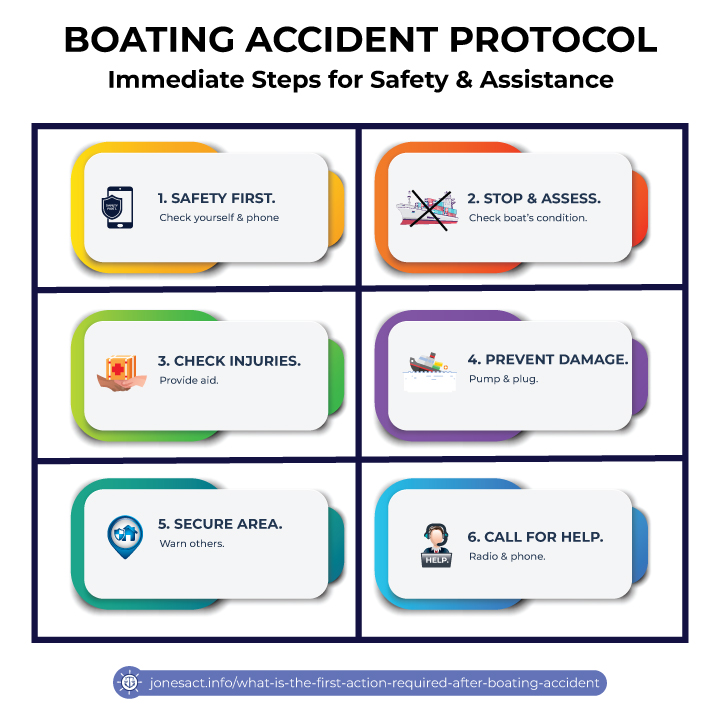
1. First, Ensure Personal Safety
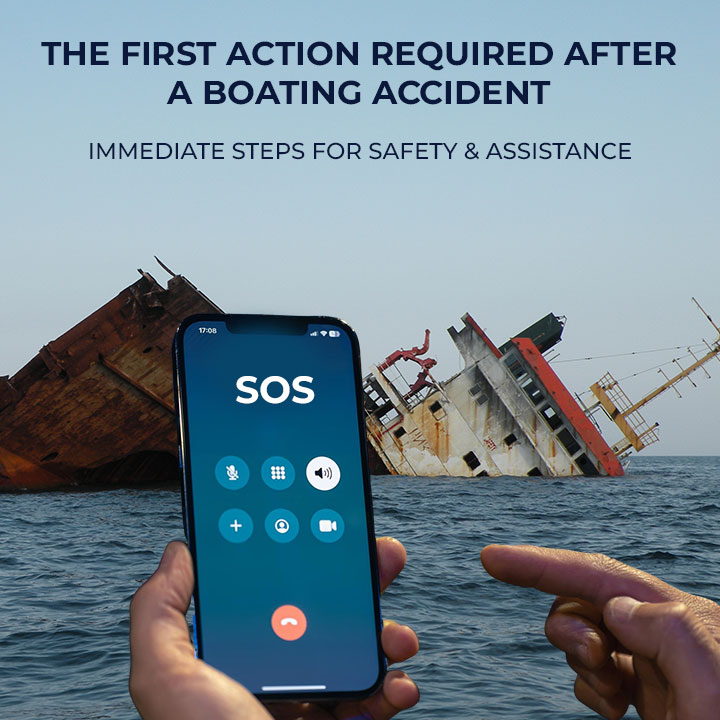
It sounds counterintuitive, but your first priority is you. You’re no good to anyone if you’re seriously injured, so do a quick, honest self-assessment before trying to play hero. Check for cuts and bruises. Also, ensure your valuable items are safe. Particularly, if your smartphone is in good condition, try contacting the nearby people on land. A SOS message can be a life savior when your boat is sinking.
2. Stop Your Vessel and Assess Its Condition
If it’s safe, stop your boat’s engine right away. This will help keep you from having more collisions during these crucial first minutes. Try to move the boat to a safe spot that doesn’t obstruct traffic. See if your boat is taking on water or at risk of sinking.
Also, when you stop the vessel, don’t hustle. Keep calm and follow the manual for stopping the boat at ease. Check the current of the water and ensure your boat is stable. Often after accidents, boats lose stability and can go upside down once you stop it. This happens if the engine loses its power and the current is too strong to be handled for the boat.
3. Check the Injuries
Once you’re stable, methodically check your passengers and the occupants of the other boat for injuries. The law mandates that you provide “reasonable assistance,” so if you have first-aid training, now’s the time to use it.
4. Try to Prevent Further Damage
Once people are safe, you can turn your attention to your boat to protect it from becoming more damaged. If it’s taking on water, start the bilge pumps. Your boat is vulnerable. If you can safely plug holes to stop taking on water, that’s your first move. Next, drop anchor to stop the vessel from drifting helplessly into a rocky shore or, even worse, directly into a busy channel.
Also, check the engine and other parts of the boat. Often, vessels take up minor damages that later can become dangerous. When you anchor the vessel, ensure it doesn’t drift away. Make sure the current of the water is tolerable for the boat since after an accident the boat can become unstable.
5. Must Secure the Area
An accident scene on the water can create a dangerous situation for other boaters. Warn them about what’s happened if you can. Turn your vessel into an unmistakable beacon of distress. Blast the horn, launch flares, fly distress flags. Whatever you have to signal an emergency. A clear warning is the only thing that can keep an already bad situation from getting worse.
Also, seek help from nearby boaters, if possible. If you are close to the shore, try to reach the land. And if you are in high-traffic waterways, safely move to a less busy area of the waterway.
6. Send Signal for Help
Don’t delay. Get on your VHF radio. If there’s grave and imminent danger to life or vessel, it’s a “Mayday” on Channel 16. For less dire emergencies, a “Pan-Pan” call will suffice. No radio? Use your phone to call 911 or the Coast Guard.
3 Things Boat Operators First Do When Involved in an Accident
As a boat operator, the law specifies your specific duties and accident protocols. Your actions can protect you legally, along with protecting life and preventing your boat from sustaining further damage. The 46 U.S. Code § 2304 defines the duty of a boat operator after an accident.
1. Stop Boat and Assist
Under federal law, you must stop your vessel. Period. Fleeing the scene of an accident, especially one with injuries, transforms a bad situation into a potential felony. Render aid where you can.
It’s crucial because boat operators have the duty to provide assistance after the accident. Or else, they can be held liable for neglecting their duty of care and will have to compensate the suffering people.
2. Exchange Information to Other Operators
It’s crucial to exchange information with the operator of the other boat. Get their name and address. Write down their boat’s registration number. Ask for their insurance information. And give them all of your information as well.
3. Don’t Admit Fault
State the facts, and only the facts. Never, ever admit fault. An impulsive “I’m so sorry, this was my fault” can and will be used against you by insurance companies and opposing counsel. Stick to the script: Exchange information and document the scene.
Type of Reports You Should File For Boating Accidents
Filing an official report isn’t optional. In many cases, it’s the law. This document becomes the undisputed official record of the incident. Federal maritime law mandates that, a boat operator must file a report to the Coast Guard or State authority, for:
-
Someone dies.
-
Suffers injury beyond first aid.
-
Someone disappears.
-
Property damage exceeds a certain threshold ($500 and $1000 respectively for California and New York).
Requirements for Accident Reporting
Federal law requires that the operator of any vessel files a formal report when a boating accident happens. This report is especially necessary if there’s a death. But also, it’s required if a person is injured and needs medical treatment that goes beyond basic first aid. You must also file a report if someone disappears from the boat. Finally, a report is required if there’s damage to vessels and other property in excess of $2,000.
Where to File a Boating Accident Report
You’ll file your report with the state authority where the accident happened. Usually, this is the state boating agency, or the fish and wildlife commission. But sometimes it may be the state police. When an accident occurs in coastal waters, the state authority isn’t your only call. The U.S. Coast Guard must also be notified.
Information Required for Filing Boat Accident Claims
Your documentation is your arsenal when you file your claim. Every photo, every note, every witness statement. All of these are important pieces of ammo that strengthen your position and make the entire process as smooth as possible.
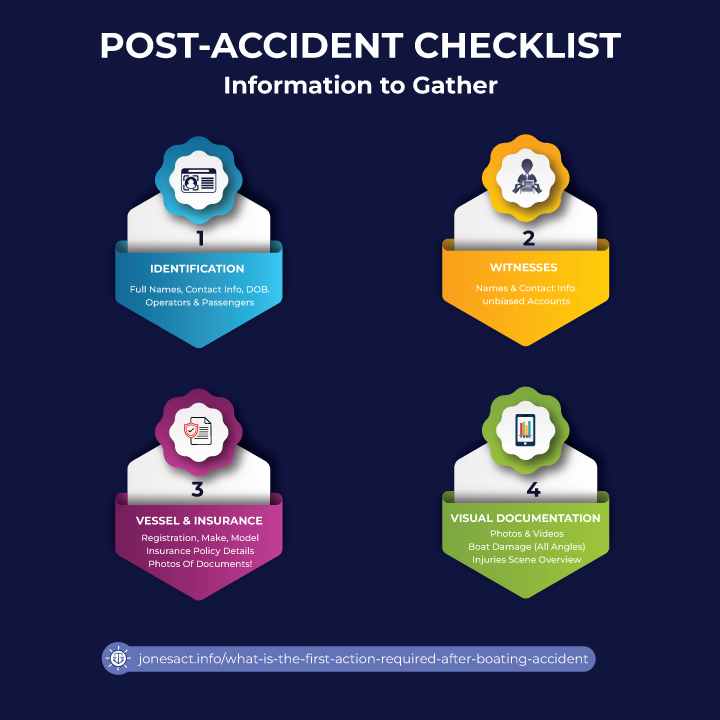
Start gathering all this essential data right away:
-
Identification information: You need to create a complete census of the event. Full names, contact info, and date of birth for everyone involved. Operators and passengers.
-
Witness details: Are there witnesses? An unbiased third-party account can be super powerful.
-
Vessel specifics: Registration number, make, and model for all boats involved.
-
Insurance details: You'll need to exchange insurance information with the other boat operator. Take photos of policies, don't just write down policy numbers.
-
Visual documentation: Your smartphone is your best friend here. Go overboard with photos and videos. Document boat damage from every conceivable angle, capture any visible injuries, and record the overall scene, weather, and water conditions. You can't have too much evidence.
Legal Requirements of a Boating Accident
In maritime law, the burden of safety and accountability is squarely on your shoulders if you were operating the boat. Neglecting these duties is more treacherous than the most beastly waterway. You could face fines, or even criminal prosecution. The rules are there to protect lives.
Report to Authorities
The clock is ticking the moment an accident occurs. And the legal clock starts ticking immediately. A severe injury or death immediately triggers a 48-hour deadline for you to file a formal report. Just dealing with property damage exceeding $2,000? You’ve got 10 days. And keep in mind, these aren’t suggestions. A missed deadline can cripple your case.
Document the Event
Your documentation is your proof of how things went down. The notes and photos you take, witness statements, all of these are invaluable. Humans are forgetful even in the best situations. And for sure, in all of the chaos that follows an accident, it’s all too easy to forget stuff that can have a huge impact on your case. So write down everything you remember about what happened as soon as you can while you still remember all the details.
Contact Jones Act Right Away to Get the Compensation You Deserve
As we’ve explained, your first priority after a boating accident is always making sure everyone involved is safe. Then you can secure the scene and file a report with the authorities.
As you’re trying to recover from injuries, you’re also probably worried about your boat if it’s damaged. On top of all that, you’re facing complicated insurance claims. Navigating through the dicey waters of a maritime claim can be ruthless. But having a team with experience behind you can help. At Jones Act Marine Law Firm, you’ll find the kind of expertise you need to get you every dollar you deserve.
Our expert maritime attorneys will provide free case evaluation. With it, you can assess your case and proceed for further actions.
FAQ
Frequently Asked Questions

If someone has died, disappeared, or has an injury that's clearly beyond basic first aid, you need to report the accident right away. But also report it if there has been significant property damage.
A written report has to be filed within 48 hours if a person is injured beyond what first aid can handle. Most important, in the event of a death or disappearance, the 48-hour timeline applies. If there's no injury or death and an accident only involves property damage of more than $2,000, you have 10 days to get your report filed.
9% in 2023, according to the Coast Guard. Out of 3,847 accidents in total, 357 of them were caused by faulty equipment, which often means poor maintenance. The numbers vary from year to year.
In 2023, 3,847. And the toll was staggering when it comes to how it affected people: 2,126 people injured, and 564 deaths.
As a witness, you're legally protected by Good Samaritan laws. Your duty is to render aid as long as doing so doesn't endanger you or your own boat. Report the incident immediately by calling 911 or issuing a call on VHF Channel 16 to alert authorities.