Key Takeaways
-
Maritime law governs all activities taking place on the water, e.g., injured crew members, global trade and environmental effects.
-
The Longshore and Harbor Workers' Compensation Act (LHWCA) offers no-fault coverage for harbor workers and longshoremen injured while working in maritime industries, while the Jones Act covers injured workers due to negligence at sea.
-
Both are essential for our global shipping industry and create safe and stable legal pathways to justice. They prioritize worker safety with navigation and safety rules that also protect passengers and vessels from harm at sea.
-
These sets of laws also enhance national security by maintaining a strong defensive fleet while authorizing federal agencies to enforce their laws.
Ammonia is a toxic substance used in refrigeration systems on fishing vessels and cargo ships. Ammonia leak on a boat is one of the most serious incidents in the maritime environment. It often leads to severe injuries and complex legal challenges. It can create respiratory damage, chemical burns, and long-term health complications too. So, it needs immediate response and proper safety measures. Here, in the writing, we will discuss ammonia, injuries, damages, laws and status related to its leaks and so on.
What is Ammonia and Ammonia Leak On A Boat?
Ammonia is a volatile inorganic compound that is frequently used in the refrigeration systems on commercial fishing vessels. This toxic gas is both effective and inexpensive.
Problems occur if a leak occurs in the refrigeration system due to improper maintenance, accidents and equipment failures. Leaks expose crews to serious health risks, and consequences of an ammonia release on a ship can also include damaging environmental hazards.
10 Types Of Ammonia Leak Injuries on Ships and Fishing Boats:
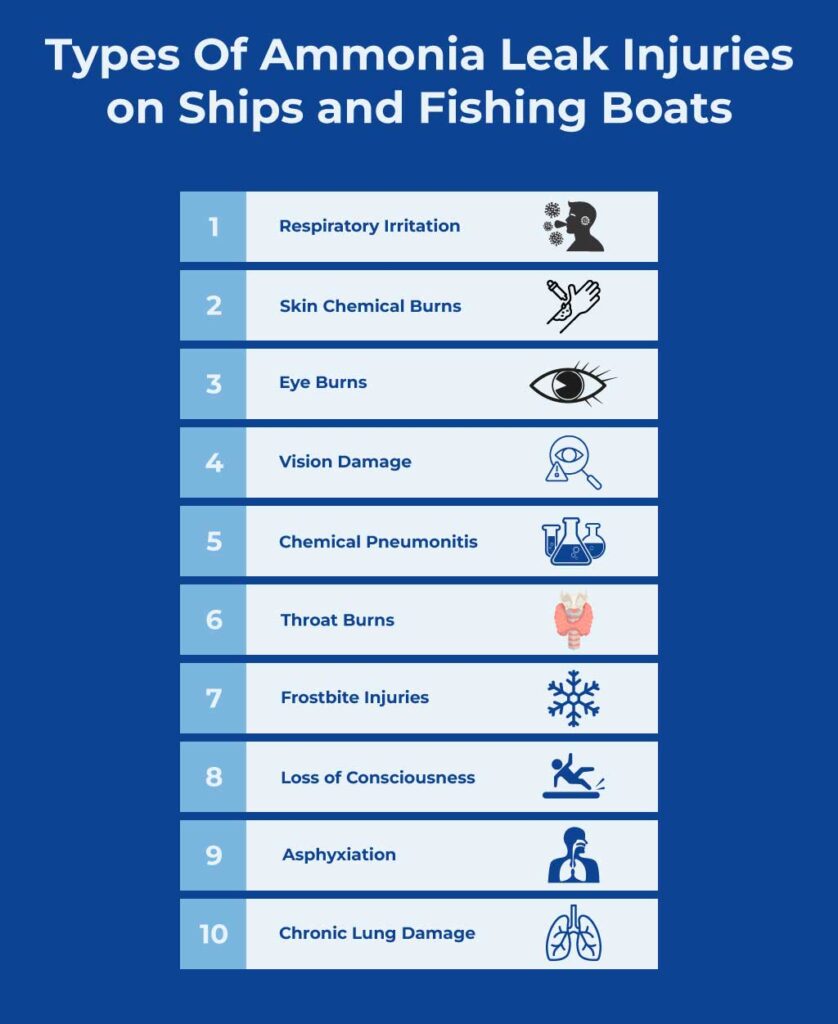
While most people understand that ammonia exposures can be deadly, they may not realize the myriad ways that ammonia can adversely affect those exposed to it.
Below are some of the health risks of ammonia leaks aboard sea-faring vessels.
Respiratory irritation:
Burning throats, coughing, respiratory distress and permanent lung damage can arise from an ammonia leak exposure. The longer the exposure, the worse the symptoms.
Skin chemical burns:
Highly corrosive liquid ammonia causes permanent damage to the skin. Immediate damage includes:
-
Redness.
-
Itching.
-
Blisters.
Victims may also suffer from scarring, tissue death and chronic skin conditions.
Eye burns:
Ammonia exposure is an ophthalmic emergency, especially in a remote location at sea. Failure to promptly flush and treat the eyes can cause permanent damage, including loss of sight.
Vision damage:
Permanent damage to the cornea and other eye structures from an ammonia leak is possible. Fast treatment can mitigate the damage caused by exposure to the toxic chemical.
Chemical pneumonitis:
Chemical pneumonitis is an acute condition characterized by lung inflammation and other breathing difficulties from inhaling chemical fumes after a toxic leak or release.
Throat burns:
The irritating properties of ammonia often cause throat burns. Symptoms can manifest in the throat, causing tissue to swell and narrow. Swift treatment can save injured crew members’ lives.
Frostbite injuries:
As ammonia is a corrosive alkaline gas stored at -28º Fahrenheit, even brief exposures from a leak at sea can lead to liquefaction necrosis of the skin and underlying tissue and other frostbite injuries.
Loss of consciousness:
Ammonia is toxic to the delicate brain tissue and can cause unconsciousness and other neurological damage, seizures and even death. Someone exposed to toxic levels of ammonia can even appear to have dementia.
Asphyxiation:
As a corrosive gas in poorly ventilated areas or enclosed spaces, ammonia can asphyxiate its victims. Asphyxia causes hypoxia, a frequently lethal condition.
Chronic lung damage:
Pulmonary edema, i.e., fluid accumulation in the lungs, is a potentially fatal condition stemming from ammonia leaks on fishing boats. Acute respiratory distress syndrome (ARDS) from chemical burns may return as chronic bronchitis.
Damages for Ammonia Leak Injuries:
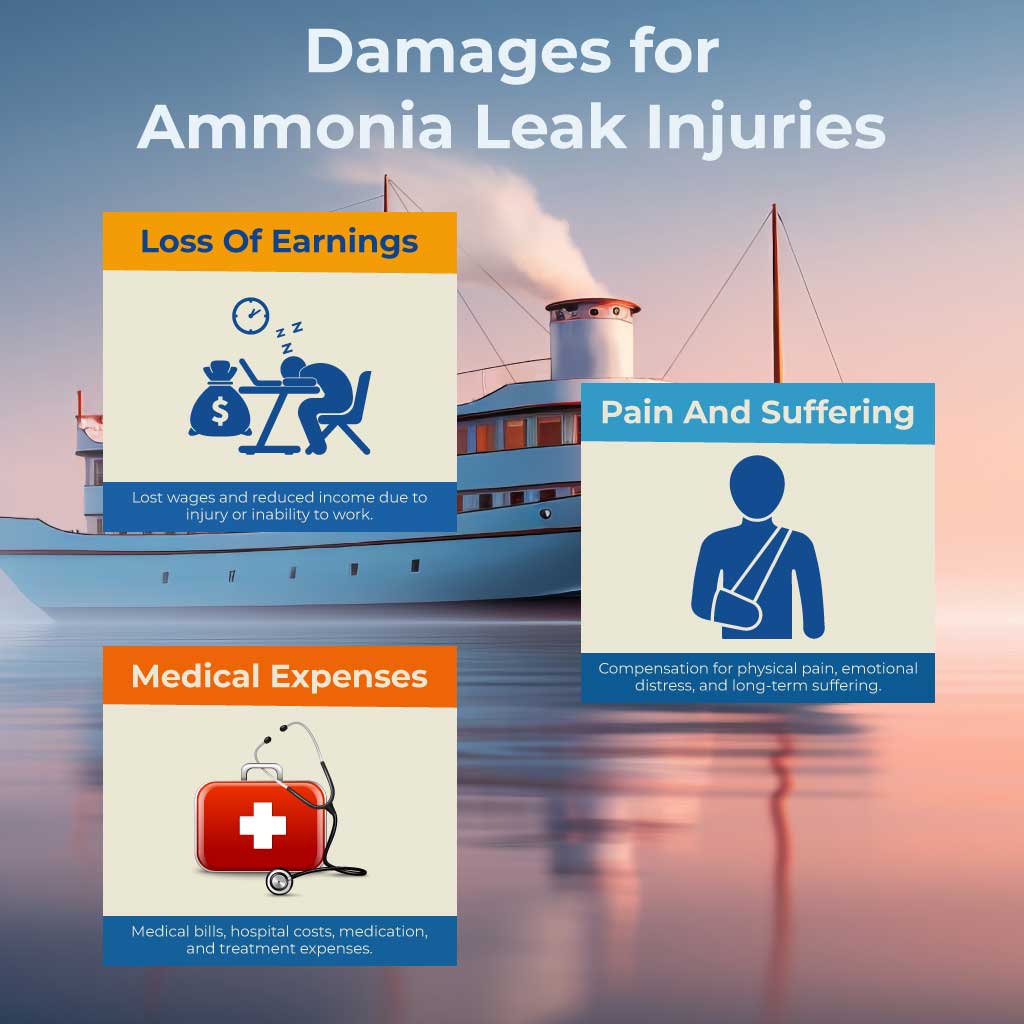
Fishing boat crew injuries from accidental ammonia exposures deserve compensation. Depending on the circumstances of their injuries, exposed crew members may be able to seek damages from the persons or entities deemed liable for the exposure.
Loss Of Earnings:
One type of economic damage is the lost wages from injured workers being unable to work after an on-the-job accident. This type of damage is easily quantifiable when negotiating for a settlement.
Medical Expenses:
The other type of economic damage plaintiffs seek to recover is their medical expenses, both past and future. This can be important if the injured party used their private health insurance policy during treatment. Insurers may also file their own claims of subrogation to the defendant(s) for reimbursement.
Pain And Suffering:
These claims are less quantifiable but frequently enhance settlements. Non-economic damages are calculated using formulas that consider the extent of the damage, its duration and the changed lifestyle of the injured plaintiff, along with other pertinent factors. In some cases, spouses of injured fishermen may even be able to file their own claims for damage.
Laws And Statutes Of Ammonia Leak:
Those suffering from on-the-job ammonia exposures may wonder what the law says about filing claims for damages. It’s important to understand that these claims are filed under maritime law regulations, which are different from damage claims filed on land.
The Jones Act Impact On Ammonia Leak:
The Jones Act offers protection and a path to justice for injured maritime workers. Ammonia leak on fishing boat due to an employer’s negligence may qualify injured seamen to pursue additional damages under the Jones Act.
The Seaman Manslaughter Statute:
The Seaman’s Manslaughter Statute (18 U.S.C. § 1115) holds corporate executives and holding officers criminally responsible for deaths aboard vessels that are linked to misconduct and//or neglect. Those convicted face fines and up to 10 years in prison.
OSHA and EPA Guidelines:
The Occupational Safety and Health Administration (OSHA) regulates the storage and handling of ammonia. It dictates the design, location, construction, installation, maintenance and operation of ammonia coolant systems.
The Environmental Agency (EPA) monitors operators for compliance with environmental laws put in place to protect fishermen at sea from death or debilitation caused by ammonia exposures. Operators must inspect the vessels’ ammonia systems and maintain safe working conditions.
Compensation Claims Of Workers:
Workers injured by an ammonia leak can file for compensation for their injuries and other damages, but they must promptly report the incident. For best results when filing a claim, prompt medical treatment is also necessary to mitigate the damage and document the injuries.
Third-Party and Product Liability Claim:
Sometimes, the injuries suffered from exposure to ammonia leaks can be attributed to other factors. Then, third party claims may be appropriate.
Malfunctioning parts of the ammonia coolant system can cause the gas to escape and/or ignite, opening the door to product liability claims for damages.
Negligence Claims:
Boat captains may face liability for negligence if they are lax about equipment inspections and the handling and monitoring of volatile ammonia.
Contact Ammonia Leak Injury Lawyers for Free Case Evaluation in Washington, Alaska, California and Oregon:
Were you injured due to an ammonia leak on a fishing vessel off the coasts of the above states? If so, we can help you figure out your next move. Contact us for your free case evaluation.
Final Thought:
Ammonia is a deadly gas that must be handled, transported and used with the utmost caution to avoid injury to crew members on fishing vessels. Learning more about your rights and responsibilities after a workplace accident can add clarity to the claims process.
FAQ
Frequently Asked Questions
Improper storage of volatile substances like ammonia can lead to catastrophic injuries to and deaths of fishing crew members. The same is true of malfunctioning components in ammonia coolant systems.
Workers in the vicinity of the leak can suffer from serious chemical burns, develop respiratory distress and be diagnosed with permanent neurological damage.
The volume and duration of the exposure can dictate how serious the injuries are to the victims. But even brief, intermittent exposures over time can lead to chronic organ damage.
Unlike many deadly but odorless gasses, ammonia has a distinctive and pungent odor often described as acrid and similar to urine.
Leaks on fishing vessels are usually linked to the boats' ammonia-based refrigeration and coolant systems.
their coolant systems. Alternatively, malfunctioning equipment can cause or contribute to the problem.
Fishing boats are like crab boats; both need effective cooling systems to bring their catch safely back to the dock — or risk millions. When something goes wrong with these systems, leaks occur.
Yes. On the popular series, Deadliest Catch, Season 21 premiered with Captain Jake Anderson's Titan Explorer springing a leak in the vessel's chilling area, prompting the captain to order the crew to abandon ship.
The leak was caused by an equipment failure in the vessel's chilling room.
Yes. This dangerous inorganic compound must be stored, maintained and used with caution.