Key Takeaways:
-
Definition: According to the Jones Act, only U.S.-built ships can carry goods transported between U.S. ports. The ships must be U.S.-built, U.S.-owned, and U.S.-crewed.
-
National Security: It ensures the military has access to a fleet of merchant ships during wartime or national emergencies.
-
Labor Protection: The Jones Act provides legal protections and job security for American maritime workers. They can claim compensation under the law for their injuries.
-
Economic Impact: The act has increased shipping costs to non-contiguous areas. It has increased the product price in Hawaii, Alaska, and Puerto Rico.
-
Longevity: The Jones Act has been serving the American maritime policy for more than 100 years. It has helped the US ship industry flourish.
Maritime trade is both the lifeline of the economy and a symbol of sovereignty for the US. So, the federal government brought the Jones Act. So, what was the purpose of the Jones Act? Also, what is the impact of the Jones Act? It ensures better management of the ocean shipment.
Since 1920, the Jones Act has governed maritime law. It dictates how all barges, tankers, and cargo ships will operate within the U.S. border. The seamen must understand the history and purpose of the Jones Act for their smooth work on the ocean.
It ensures their compensation during injuries and governs the ship owner and operators. Also, it has differences with the Puerto Rico Jones Act that you must know.
What Is the Jones Act: Its Origins and Purpose?
The primary purpose of the Jones Act is to govern the ship owner, operator, and seamen in the US waterway. We must look back to the Great War to understand the origin of the Jones Act.
During World War I, the United States lacked enough transport ships. So, it faced difficulty in moving troops and supplies overseas. It had become overly reliant on foreign fleets. But the home countries soon recalled their ships for the war effort. As a result, the U.S. economy and military found themselves in a tough position.
This scenario during the Great War quickly changed the outlook of the US government and military. They realized that they could no longer depend on the foreign ships for their military movements.
So, Senator Wesley Jones introduced the legislation after World War I. It prevented the same scene of ship-shortage from happening again. The Act created a permanent merchant marine. The act was named after Senator Wesley Jones, the “Jones Act.”
The purpose of the Jones Act is tied to the idea of self-reliance of the US. It mandated that the ships must be built in American shipyards. Also, the ship staff must be American citizens. The act ensured that the nation’s Merchant Marine is always ready to serve the military. It strengthened their military and commercial capacity.
Summary of Jones Act Requirements:
The Jones Act ensures four things:
Requirement | Description | Purpose |
U.S. Built | The vessel must be constructed in a United States shipyard. | It supports the domestic industrial base and shipbuilding jobs. |
U.S. Owned | US citizens must own and operate at least 75% of the company | Prevents foreign entities from controlling domestic supply chains. |
U.S. Flagged | The ship must be registered under the laws of the United States. | Ensures the vessel is subject to U.S. safety and environmental laws. |
U.S. Crewed | 100% of officers and at least 75% of the crew must be U.S. citizens. | Maintains a pool of trained mariners for national defense needs. |
The Two “Jones Acts”: 1917 vs. 1920:
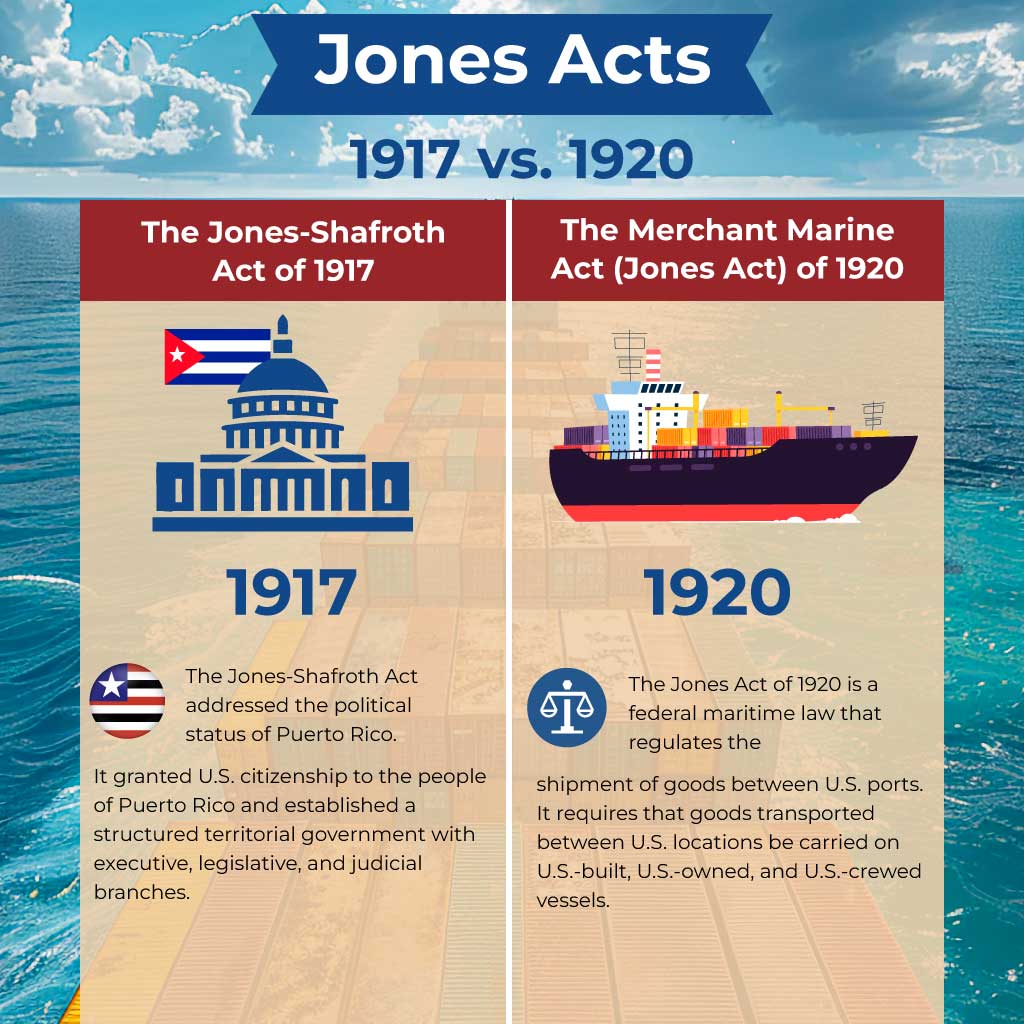
Many people are often confused between the 1917 and 1920 Jones Acts. Although their name appears similar, these two acts have different purposes and legislation. Senator William Jones indeed introduced both acts. But they have different aims.
The Jones-Shafroth Act of 1917:
The Jones-Shafroth Act deals with the political status of Puerto Rico. It granted U.S. citizenship to the people of Puerto Rico. Also, it arranged the island’s government into three branches. It was similar to the U.S. federal model. The act ensures civil rights and territorial governance of the Puerto Rico people.
The Merchant Marine Act of 1920 (The Jones Act):
The Jones Act of 1920 is a general maritime law. The 1917 Act granted Puerto Ricans citizenship. But the 1920 Act regulated the shipment of goods to the island. Because Puerto Rico is a U.S. territory, it falls under the jurisdiction of the 1920 Jones Act.
It brought three rules for shipping goods from the US mainland to Puerto Rico and vice versa. The protectionist law mandated that the goods-carrying ships must be:
-
U.S.-flagged
-
U.S.-built
-
U.S.-owned
-
At least 75% American crew
Feature | Jones-Shafroth Act (1917) | Merchant Marine Act (1920) |
Primary Focus | Civil Rights & Governance | Maritime Trade & Commerce |
Key Outcome | Granted U.S. Citizenship to Puerto Ricans | Regulated “Coastwise” shipping between U.S. ports |
Jurisdiction | Specifically, Puerto Rico | The entire U.S. and its territories (including PR) |
Impact on PR | Defined the island’s political relationship with the U.S. | Dictates shipping costs and logistics for the island |
What Was the Purpose of the Jones Act?
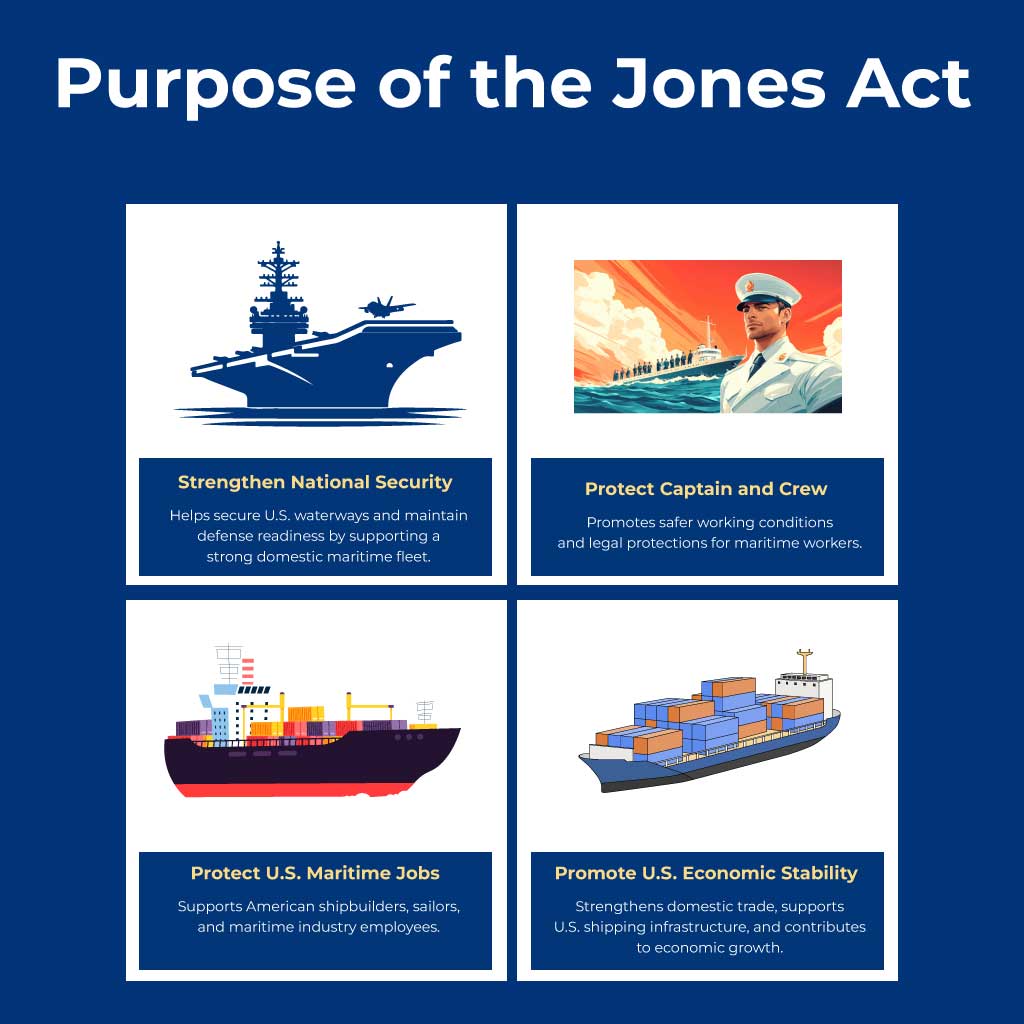
The purpose of the Jones Act isn’t a single one. It is a comprehensive strategy to strengthen the nation’s maritime infrastructure. Also, it protects the captain and crew’s rights during injuries.
Strengthen National Security:
The Jones Act ensures national defense. During World War I, the US found itself in a tough position. It lacked enough ships to carry its goods and military. So, the law was introduced to ensure that the US Navy could get assistance from the merchant ships during wartime.
It requires a sealift capacity. The cargo ships should carry tanks, fuel, and food to soldiers abroad. So, the law ensured that domestic trade stays on U.S. ships. Thus, there is always a ready-to-use fleet. Also, the military can call the US skilled sailors to service whenever required. The Jones Act makes the U.S. self-reliant. It doesn’t have to depend on foreign-flagged ships during war.
Protect Captain and Crew:
Before the Jones Act, maritime workers had very few rights. An injured sailor had little legal recourse. Even if the ship operators’ negligence caused the injury, they couldn’t do much. The Jones Act changed the scenario.
It granted seamen the right to sue their employers for their personal injury damages. So, the Jones Act protects the American mariners. Thus, they can work in safer conditions. It also makes the mariners’ profession more attractive to the domestic workforce.
Protect U.S. Maritime Jobs:
The Jones Act brings a “Buy American” policy for the sea. It reduces foreign competition on the domestic routes. So, people from shipbuilders in Mississippi to deckhands on the Great Lakes get better employment opportunities.
The ship, its owner, and control remain in the hands of U.S. citizens. As a result, low-wage foreign labor couldn’t underbid American workers. Also, the Jones Act ensured that the US maritime industry could flourish.
Promote U.S. Economic Stability:
The Jones Act also maintains a stable and reliable supply chain for the US. It doesn’t depend on the whims of international politics. Since 1920, the act has helped flourish the domestic shipbuilding industry.
So, the U.S. can build and repair ships without depending on foreign countries. The infrastructure keeps inland waterways foreign competition-free. So, national marine ships can move smoothly without. It brings economic stability to the US. It saves them from problems of international interests and policies.
The Jones Act Impact on U.S. Shipping:
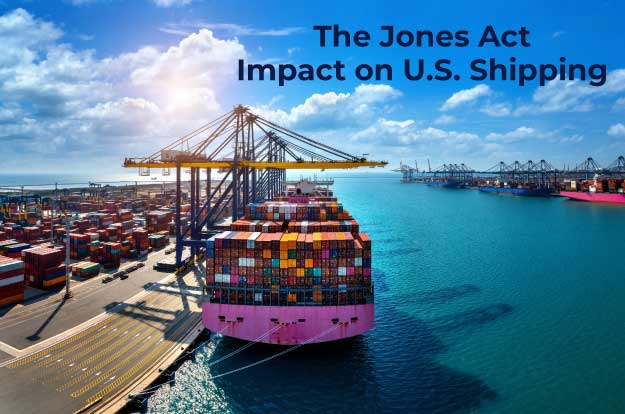
The supporters of the Jones Act argue that it keeps the U.S. maritime industry alive. Without it, the U.S. would lose its ability to build ships. Also, foreign ships would have captured the domestic waterways. These ships won’t follow U.S. tax, labor, or environmental laws. It would make US waterways and the economy vulnerable.
However, the Jones Act has significant disadvantages. US ships are more expensive to build and operate than Chinese or South Korean ships. So, the shipping costs between U.S. ports are higher than international rates.
The “Jones Act Premium” has become a burden for Puerto Rico, Hawaii, and Alaska. The cost of carrying oil from West Africa to Puerto Rico is cheaper than carrying it from the US. As a result, energy and product pricing are much higher in Puerto Rico than in the mainland US.
Conclusion:
The Jones Act is a protective law for the US shipping industry. It gives sovereign protection to the US shipbuilding, good carrying, and merchant ship industry. Also, it protects the seamen against the ship owners’ and operators’ negligence. They can claim compensation for their injuries under the Jones Act.
The tradeoff of the Jones Act is minimal. But it frees the US military and shipping industry from foreign dependency.
FAQ
Frequently Asked Questions

The Jones Act regulates all waterborne transport between two U.S. points. The vessels must meet specific "U.S.-made" criteria. So, the Jones Act has created a closed market. Also, it protects the domestic shipping companies from international competition. But, in some places like Puerto Rico and Hawaii, the legislature has increased the product price.
The Jones Act covers cargo ship operators’ and seamen’s rights. The 1886 Passenger Vessel Services Act (PVSA) protects travelers on cruise ships. It mandates that most "U.S. cruises" must stop in a foreign port if the ship is foreign-built.
The Jones Act has rare waivers. Also, the federal government usually grants waivers during emergencies, like hurricanes or fuel shortages. These waivers stay for 10 to 14 days only. Also, it is issued if there aren’t enough US ships to meet the requirement during an emergency.
Yes, the Jones Act is actually Section 27 of the Merchant Marine Act of 1920. The Merchant Marine bill covers all maritime issues. But Section 27, or the Jones Act, covers a specific part, the goods-carrying ships.
Yes, the Jones Act also applies to all coastwise trade. It includes the Great Lakes and inland river systems like the Mississippi and Ohio Rivers. Also, all the barge-moving goods between two U.S. river ports must be Jones Act-compliant.
The Jones Act in Puerto Rico forces its people to pay higher prices for food and energy. They cannot use cheaper foreign vessels to bring in supplies from the U.S. mainland. So, the pricing is higher.
Yes, the Jones Act applies to oil and gas transportation, too. Companies must use American vessels to transport liquefied natural gas (LNG) or oil between U.S. ports.
Generally, no. According to the Jones Act, 100% of the ship's officers and at least 75% of the crew must be U.S. citizens or permanent residents.