Key Takeaways:
-
You may have heard of the Katmai. It’s a large boat operating in the Bering Sea.
-
The fishing vessel sank in October of 2008. Eleven people were on board. Just four survived the sinking.
-
The National Transportation Safety Board investigated. Their goal? To determine why a seemingly well-maintained boat failed.
-
Lots of investigating was necessary. Little actual evidence was available. THe information from four people was used to determine what really happened.
-
The board’s final ruling involved a number of complicated matters. All contributed to the reason for the boat going down. The boat was carrying twice the amount of frozen cod on board that it should have been. Plus, there were miscommunications about the proper steering of the ship. A third factor was a door that someone failed to close.
Someone didn’t shut the door. The National Transportation Safety Board said that’s one of the reasons the Katmai fishing vessel sank. The 93-foot fishing vessel was traveling through the Aleutian Islands on an October night in 2008. That’s when a massive storm blew in. The boat took on water. A watertight door wasn’t properly shut. Someone didn’t do their job. That lets water get deep into the hull.
Four of the 11 people on board were alive after the incident. The victims told their story to the National Transportation Safety Board (NSTB) during an investigation. That’s when the board issued its decision on what really happened that night.
National Transportation Safety Board NTSB Issues Final Report On FV Katmai Sinking:
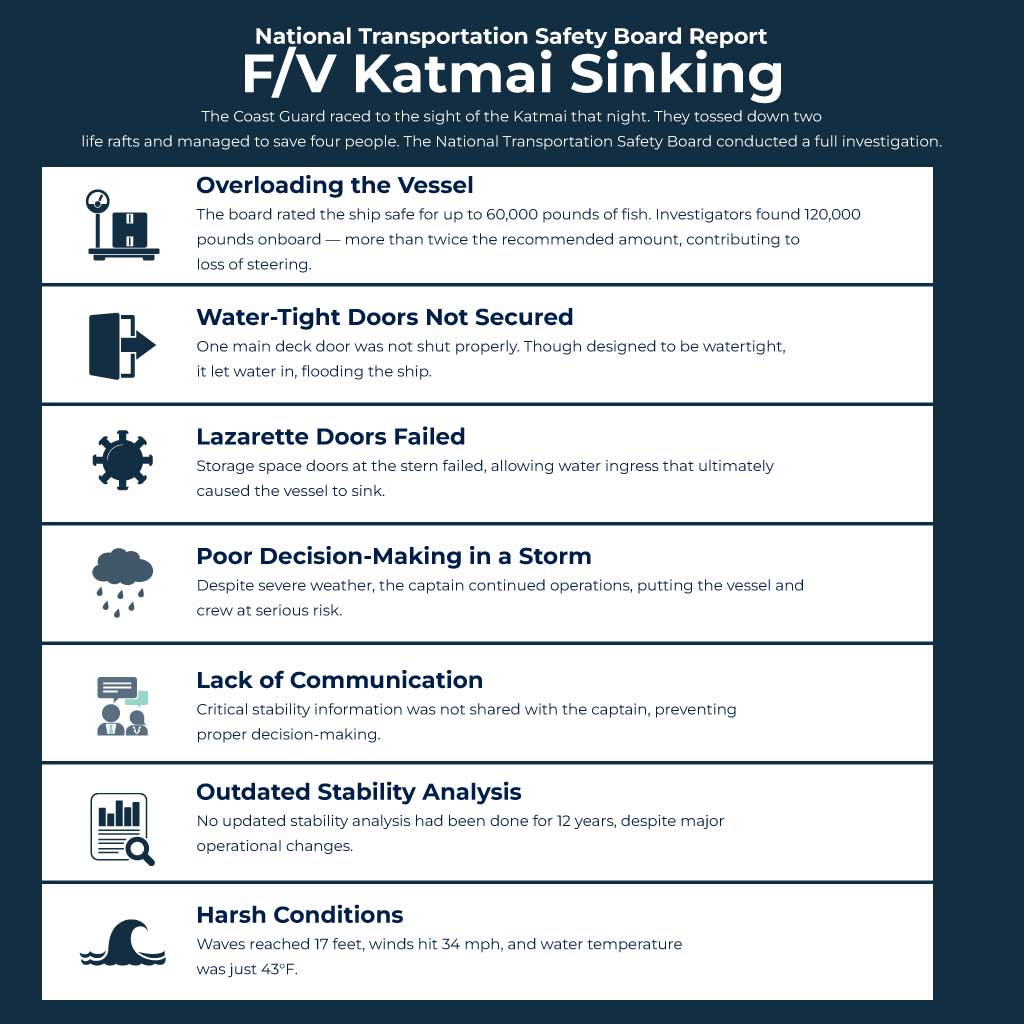
The Coast Guard raced to the sight of the Katmai that night. They tossed down two life rafts and managed to save four people. The other seven died. The National Transportation Safety Board had to find out why.
Records showed the board had inspected the vessel within the last two years. It didn’t inspect the hull in those visits. It wasn’t possible to bring the boat up for an investigation. And sending divers into the water wasn’t an option. The board asked the four surviving crew members what happened.
What they learned was that a number of smaller things contributed to the loss of life. That starts with what was on board. The board rated the ship stable for as much as 60,000 pounds of fish. That many fish wouldn’t have caused a concern. Investigators found that the boat had 120,000 pounds of frozen cod on board. That’s more than two times the amount recommended. That overloading could be a contributing factor to the loss of steering.
The board also found other interesting facts. That includes that one of the main deck doors wasn’t shut properly. The doors led to a processing space. Those doors were supposed to block out water. They were supposed to be water-tight doors. But they let water in. That led to the flooding of the ship. The lazarette is a storage space located under the deck at the stern of the boat. The doors failed. And water made it into this area. That eventually caused the ship to sink.
Another big factor was a lack of communication. The report found that the boat’s master didn’t make a safe decision. A storm was raging at the time of the accident. The boat’s master made the decision to continue the operation even as the boat approached the storm.
The board said that another factor was a failure of communication. The owner didn’t communicate critical information to the master of the ship. That includes information about keeping the boat stable. The owner failed to make sure the master understood critical information so that they could operate safely.
There are still other questions raised by the board. The board hadn’t completed a stability analysis on the ship since 1996. That was 12 years from the time of the accident. The board also didn’t take into account the change in what the fishery boat was doing. Previous efforts were to catch shrimp. That switched to fishing for code. No analysis was done. It wasn’t clear if the ship was stable.
The sinking report on FV Katmai was telling. The boat wasn’t properly maintained. There were questions about just how stable an overloaded boat could be under these conditions. The waves at the sinking reached 17 feet high. It was windy with 34 miles per hour winds blowing in. The water was just 43 degrees.
Final Words:
There’s no doubt the FV report is tragic. The Katmai Boat Deadliest Catch saga will go on in the history of just how devastating this industry can be. The TV show The Deadliest Catch was receiving significant attention at the time of the accident. Note that the Katmai Deadliest Catch vessel never actually was on the show. It was just one of many stories told about it.
A combination of factors led to the death of 7 people. Many of them could have been reported. That’s what makes this such a devastating accident.