Key Takeaways:
-
More than 32,000 Federal employees work outside the United States (This includes U.S. territories and possessions).
-
Working at a U.S. embassy is usually a pretty safe job. Unless you work in a country with lots of political upheaval (think Yemen, Afghanistan, Egypt, Uzbekistan).
-
There are no stats showing how many civilian contractors on U.S. bases abroad have gotten hurt or died on the job.
Dealing with paperwork after an on-the-job accident is hard enough in the “Land of the Free”.
Dealing with the aftermath of an accident while you work for the U.S. outside the country is even harder.
What Is the DBA (Defense Base Act)?
The Defense Base Act (DBA) is actually a division of the Longshore and Harbor Workers’ Compensation Act. Even though it has absolutely nothing to do with port and dock workers.
The DBA covers people who work for the United States but not in one of the 50 U.S. states.
It covers:
-
Medical payments.
-
Disability compensation.
-
Lost wages.
-
Death benefits.
Who Qualifies For A DBA Claim?
-
Civilian contractors on U.S. bases.
-
Embassy workers.
-
Anyone who works for a private employer on a U.S. base or on land the U.S. military uses.
-
U.S. government agency employees.
-
Employees doing contract work funded by the Foreign Assistance Act.
You don’t have to be an American citizen to benefit from the DBA. It also covers:
-
Local employees.
-
Employees from third countries.
What are the Injuries Covered Under the DBA?
-
Traumatic injuries (think broken bones and concussions).
-
Occupational disease (ranges from breathing in harmful chemicals to loss of hearing).
-
Psychological illness.
-
Repetitive stress injuries (such as carpal tunnel syndrome).
Step By Step Defense Base Act Claims Process:
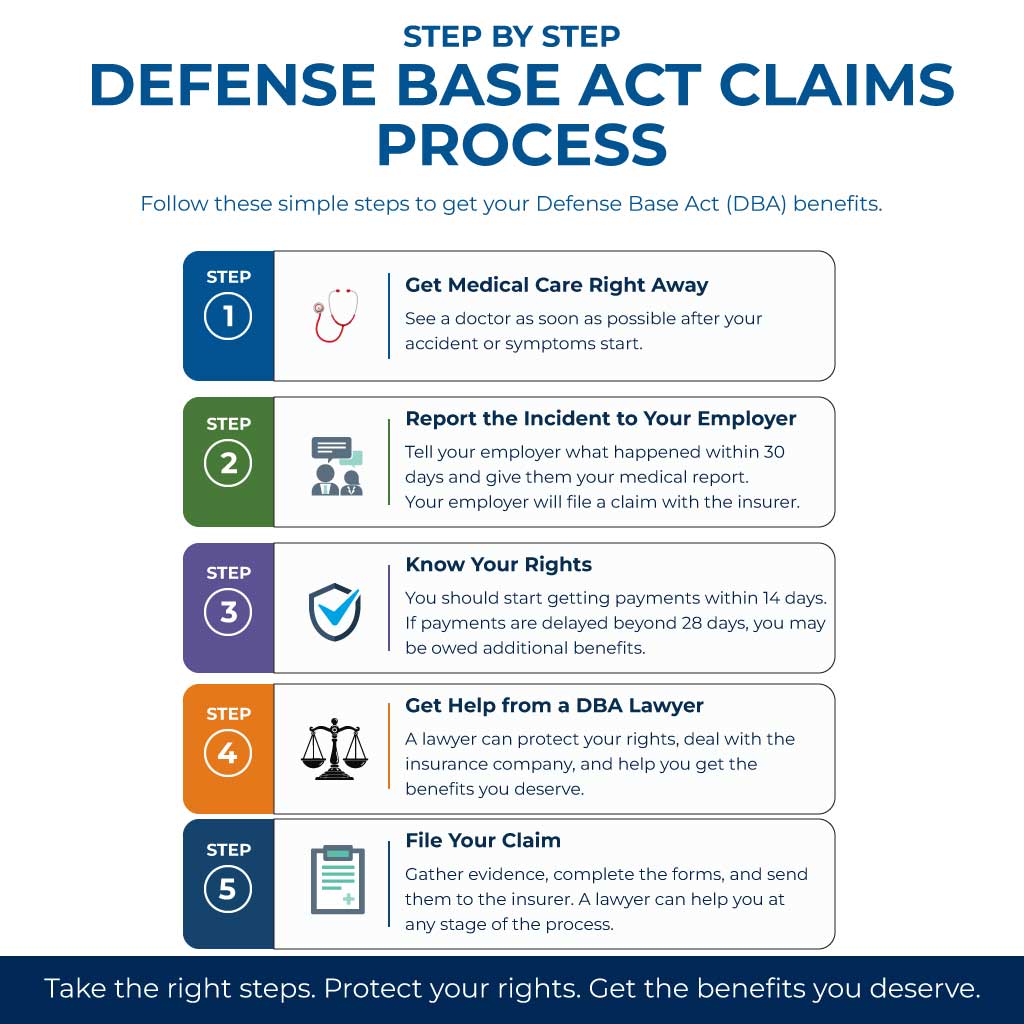
If you need DBA money, make sure your claim gets processed right.
Seek Immediate Medical Attention
See a doctor immediately after your accident or at the first sign of symptoms.
A doctor will:
-
Document your complaints.
-
Run tests to determine what the problem is and what caused it.
-
Tell you what kinds of treatments you need and how much they'll cost.
-
Tell you how your problems will affect your ability to work. And if so, for how long.
Report the Incident to Your Employer:
Tell your boss what happened. You have thirty days to do this from the date of your accident.
Give your boss copies of your medical report.
Your boss will file a claim with the DBA insurance company.
Understand Your Rights Under the Defense Base Act:
-
You should start getting payments within 14 days of telling your employer about your injury.
-
If your employer doesn't pay up within 28 days (from the time you first told him/her about your injury) you could be able to claim additional compensation.
-
You should get payments bi-weekly once they're approved.
-
You can pick your doctor (although it's best to choose one that's familiar with the DBA).
-
Payments include compensation for the cost of traveling to/from the doctor.
-
Compensation should also cover the cost of having to return to the U.S. for treatment.
Consult a Defense Base Act Attorney
Unfortunately, insurers won’t always automatically recognize your rights. They’ll try to get out of paying by:
-
Claiming your line of work isn't covered by the DBA.
-
Claiming your injuries aren't as serious as you say.
-
Claiming your injuries aren't job-related.
Dealing with insurers and an injury/sickness at the same time is very, very hard. Especially since insurance adjusters are experts in getting people to say or do something that could cost them benefits.
A good DBA lawyer can help you by:
-
Proving you're covered by the DBA.
-
Collecting evidence that shows how, where, and when the accident happened.
-
Collecting evidence (and getting expert testimony) to provide you need the medical help you're claiming.
File Your Defense Base Act Claim:
-
Collect as much evidence as you can to back up your claim.
-
Tell your employer about your claim. Your employer will contact the insurance company.
-
Fill out the forms relevant to your claim. Send them to the insurer.
It’s best to hire a lawyer as soon as you know that you need to file a DBA claim. But you can also hire one in the middle of the claims process.
An Overview On Defense Base Act Settlements:
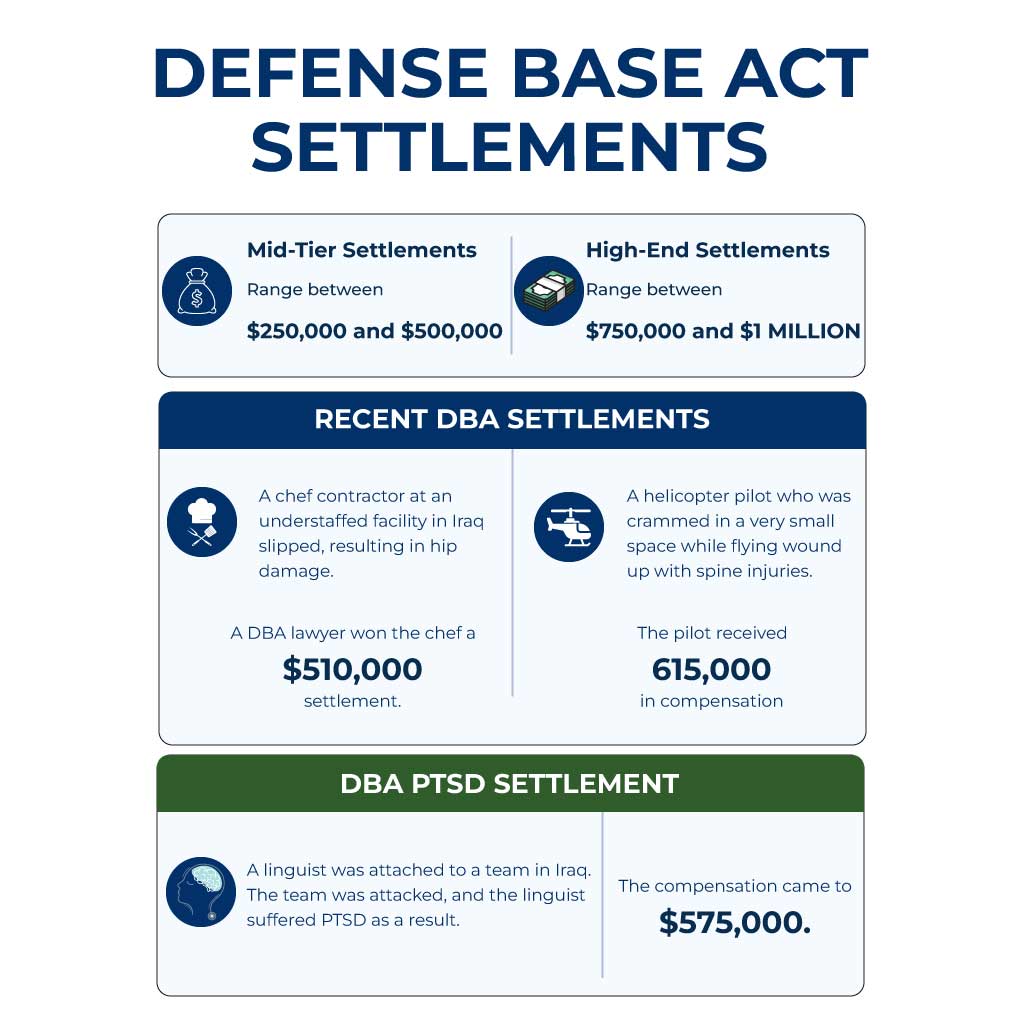
“Mid-tier” settlements range between $250,000 and $500,000.
“High-end” settlements range between $750,000 and $1 million.
Recent DBA Settlements:
A chef contractor at an understaffed facility in Iraq slipped, resulting in hip damage. A DBA lawyer won the chef a $510,000 settlement.
A helicopter pilot who was crammed in a very small space while flying wound up with spine injuries. The pilot wound up with $615,000 in compensation.
DBA PTSD Settlements:
A linguist was attached to a team in Iraq. The team was attacked, and the linguist suffered PTSD as a result. The compensation came to $575,000.
Defense Base Act Wage Benefits Calculation Process:
How much money you get will depend on:
-
How serious your injury is.
-
How long it will last.
-
How it affects your ability to work.
Permanent Total Disability(PTD):
People with a PTD are eligible to receive lifetime payments.
Temporary Total Disability(TTD):
You should get up to 66.6% of your average weekly wage until you’re better.
Permanent Partial Disability(PPD):
How much you get depends on:
-
The impairment rating you're given.
-
Which body part was injured/disabled.
Temporary Partial Disability(TPD):
It depends on:
-
Which part of your body is hurt.
-
How long you'll be injured.
-
Your average weekly wage.
Contact Jonesact.Info For The Best DBA Lawyer for Maritime Workers:
Are you DBA-covered and need to file a claim?
Are you a maritime worker who’s covered by the Jones Act?
If the answer to either of these is yes, we can help you.
Our team specializes in DBA claims. We have a winning track record. Plus:
-
We offer a free initial consultation.
-
We operate on a "no win = no fee" basis.
Conclusion:
If you work for the U.S. government outside the United States, the odds are you’re covered by the DBA
But that doesn’t mean claiming compensation under it will be a walk in the park.
Get medical help right after your injury. Tell your employer about it right away. And hire a good lawyer who can help you file a winning claim.
FAQ
Frequently Asked Questions


The DBA is for Federal government workers outside the United States.
The U.S. government and contractors working for it must buy DBA insurance for employees who work outside the nation.
The Department of Labor may allow some workers to be exempt from DBA coverage. Exemptions depend on:
- The worker's nationality
- How much work he/she does for the U.S. government
- Local worker's compensation laws
- See a doctor
- Report the injury/sickness to your employer
- Fill out the required forms
A simple claim can take as little as six months.
Complicated claims can take a couple of years.
- DBA coverage eligibility
- Assessments of "average weekly wages"
- Disputes over how much medical work is needed
- Disputes over the duration or severity of the injury or sickness
- Disputes over the root cause of the injury/sickness
A good DBA lawyer will help you get expert medical opinions that back up your doctor's claims.
Mediation shortens the length of time you have to wait for compensation.
But it can also leave you with less money than you'd hoped for.
DBA trials can take a long, long time.
Both sides will need to collect evidence.
It takes time for a case to work its way through court.
Plus, the other side can appeal any compensation you get.
Your lawyer will negotiate with the DBA insurance company.
There will be a lot of back-and-forth communications.
In the end, you decide if you want to approve the settlement or take the case to court.
- Collect as much evidence as you can
- Organize your evidence
- Don't talk with the insurance company without your lawyer present
- Don't put up posts on social media that appear to contradict your claims
Not usually.
Yes.
- The government will see how much the person earned in gross earnings for the year and then divide this by 52. This is the average weekly wage (AWW)
- A surviving spouse or surviving child can get up to 50% of the AWW
- A dependent grandchild or brother/sister can get up to 20% of the AWW
- A dependent grandparent or parent can get up to 25% of the AWW
You can file a DBA claim for PTSD. Your settlement will be based on:
- How long you were employed
- What type of work you did
- How severe your PTSD is
- Your average weekly wage
DBA insurance is an insurance policy that covers Defense Base Act claims. If you're eligible, your employer is responsible to buy it.