Key Takeaways:
-
Maritime law does apply to some lakes, but not all.
-
There is a two-part test that determines if maritime law applies to a particular lake.
-
The judicial system set the standard for what's covered by maritime law in 1870.
-
A lake must connect with multiple states or countries and be navigable to fall under maritime law.
-
The liability of accidents in lakes will be shared by all involved parties responsible for the accident.
If you don’t spend much time on a ship or boat, chances are you aren’t familiar with the important differences between maritime laws and state laws. However, these differences are huge. They affect anyone who works on the water because:
-
Injured seamen covered by maritime law can get compensation for injuries even if they are to blame for the injuries.
-
Injured seamen have a lower standard for proving that the other party was responsible for the injury than workers injured on land.
-
You can file your case in federal court or state court.
What Is the Maritime Law?
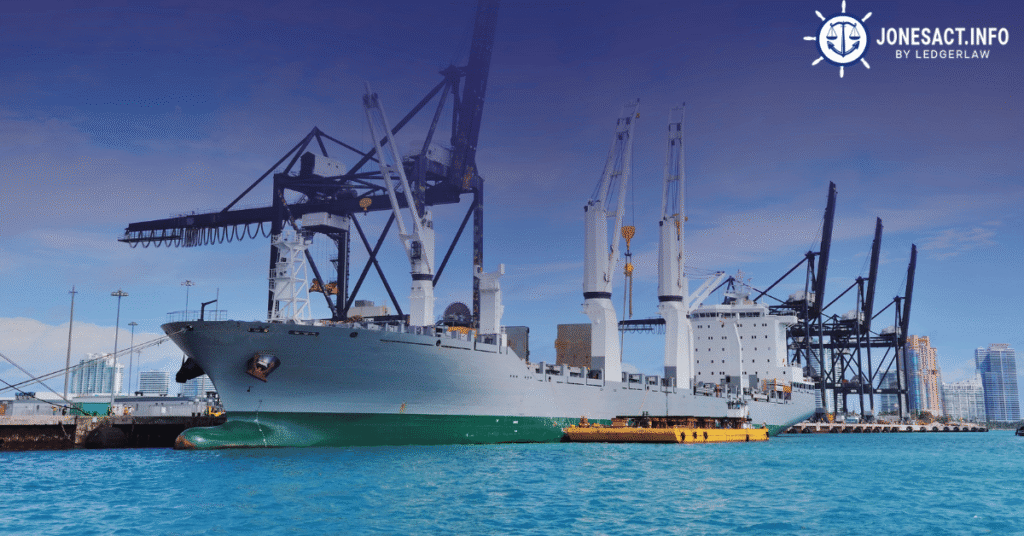
Maritime law is a collection of laws that apply to waterway commerce and transportation. This set of laws:
-
Regulates shipping.
-
Determines what type of insurance and how much insurance ships need.
-
Determines the rules by which ships can travel on the open seas and in waters governed by different countries.
-
Outlines the rights of people traveling on covered waterways.
Body of Water | Definition | Covered by Maritime Law |
Lakes | A stagnant body of either salt or fresh water | Sometimes |
Rivers | Flows into a lake, sea, or ocean | Sometimes |
Seas | Deeper than a lake Always has salt water Connects to an ocean | Always |
Does Maritime Law Apply to Lakes?
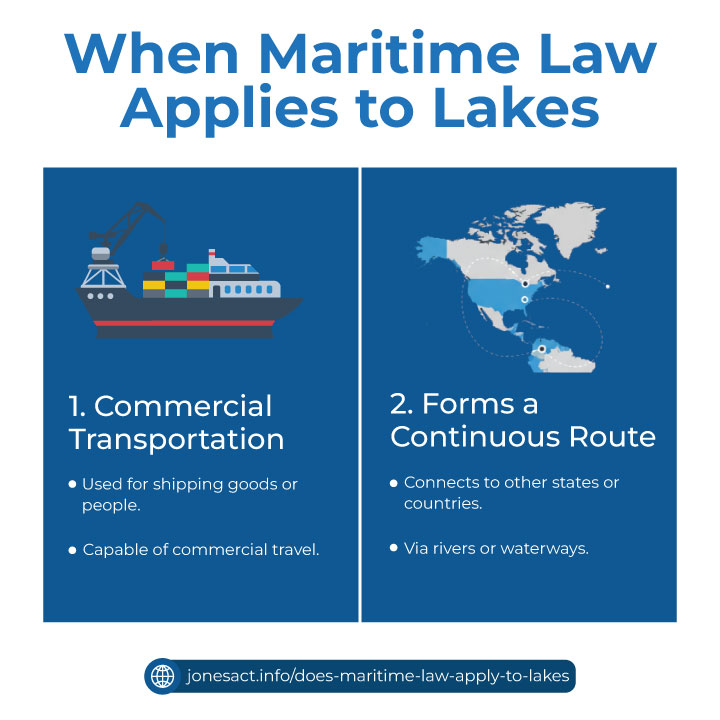
There are two criteria that a lake must meet to fall under maritime law jurisdiction. These are:
- It must be possible to use the lake for commercial transportation.
- The waterway has to form a continuous route with other states or nations. This applies even if the “route” is formed by a river flowing out from a lake, rather than just the lake itself.
Any lake that ships and/or boats can use to transport people or goods between states or countries is covered by maritime law.
Lake Distinctions:
Lakes in the U.S. can fall under several categories:
- It’s used for recreation and transport by people in two or more states (or between the U.S. and another country).
- It’s used for recreation and transport, but it’s enclosed in a single state.
- It can’t be used for transportation.
What Makes a Lake a Navigable Waterway?
Legally, a lake is considered “navigable” if it’s used or could be used for travel or transport between states and/or countries.
A state can make laws governing bodies of water in its jurisdiction. However, if the body of water is covered by maritime law, the state can’t make laws that contravene maritime law.
Examples of Water Bodies Subject to Maritime Law:
- All the Great Lakes and their tributaries.
- St. Mary’s River and its tributaries.
- St. Clair River and its tributaries.
- Detroit River and its tributaries.
How Do Laws Differ Between Lakes and Seas?
The size of the water body doesn’t matter. What matters is:
- Is it navigable for traffic or recreation between states and countries?
- Did the incident happen close to one country’s coast?
- Is it an open sea governed by international law?
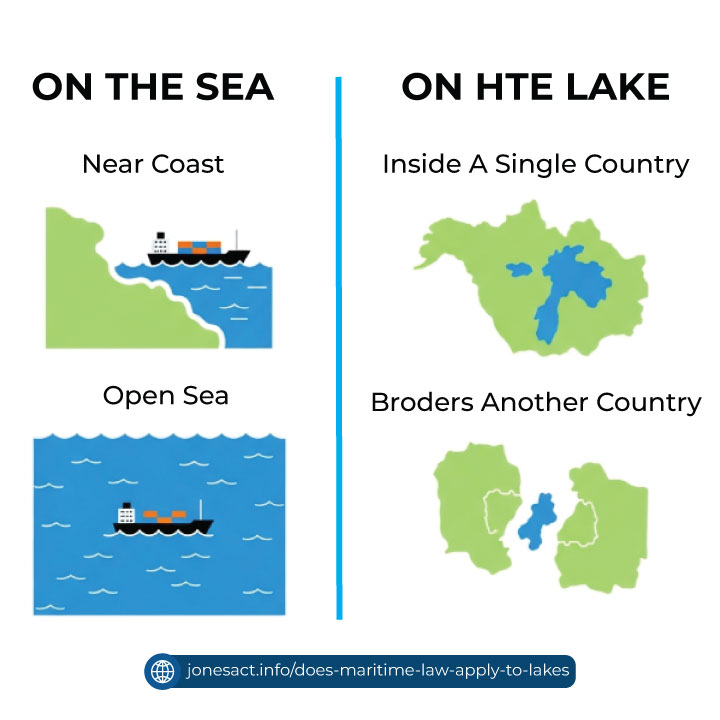
Can Maritime Law Apply to Cases Arising on Lakes?
Can watercraft travel or sail between states or countries on the river or lake? If so, then maritime law applies.
Liability in Boat Accidents on Navigable Lakes and Rivers:
If someone is hurt while working on a navigable lake or river, the company that hired the person is responsible for covering bills, even if the person was totally at fault.
In some cases, more than one party or company can be responsible for the accident. Joint and Several Liability under maritime law has rules in place dictating how each party should pay the injured person if held responsible. What’s more, other parties can be held liable even if they were barely responsible.

Common Incidents that Fall Under Maritime Law:
There are many types of incidents that are covered by maritime law.
- Personal injury.
- Lost wages.
- Emotional pain and suffering.
- Wrongful death.
- Property damage.
Recreational Activities and Their Legal Implications:

Maritime law isn’t just for people traveling by water or working on a commercial ship or boat. It also applies to any type of recreational boating. If the body of water is covered by maritime law, it covers anyone on that body of water, for any reason.
FAQ
Frequently Asked Questions

Yes. It doesn't matter why you're on the lake. What matters is whether the law says the lake is navigable for travel between states and/or countries.
Maritime law affects your standard of proof. If you're injured on navigable waters, the standard of proof is lower than for an accident on land.
Any incident that occurs on a body of water covered by maritime law falls under maritime law coverage.
States can make laws governing any of their lakes. However, these laws can replace or go against maritime law.
Maritime law applies to any inland lake that can transport people or goods to and from states or countries.
Legal Recourse for Victims of Maritime Accidents on Lakes:
What to Do After an Accident on a Navigable Lake or River?
-
See a doctor.
-
Collect evidence.
-
Find a maritime lawyer to get specific information about your case.
The process for filing a claim under maritime law isn’t easy. It involves:
-
Your lawyer will help you determine who is at fault.
-
Your lawyer will help you identify the best place to file your lawsuit.
-
You and your lawyer will collect evidence to be presented to the court.
-
You and your lawyer will decide if you want to start settlement negotiations with the other party.
-
If a settlement doesn't work out, both parties take the case to court. Getting compensation could take a long time, as either side can appeal a ruling it doesn't like.
Can You Sue for Personal Injury on a Navigable Lake?
Yes, you can sue for personal injury on a navigable lake. If you work on a watercraft, you don’t necessarily have to sue to get compensation, as your employer is responsible for covering bills related to your daily expenses and medical treatment. However, you can still take your employer or other responsible parties to court if you can claim:
-
Negligence.
-
Unseaworthiness of the boat or ship.
-
Punitive damage.
Important Maritime Acts:
Important maritime laws include:
-
The Carriage of Goods by Sea Act.
-
The Death on the High Seas Act.
-
The Limitation of Liability Act of 1851.
-
The Passenger Vessel Services Act of 1886.
-
Merchant Marine Act of 1920 (Better known as the Jones Act).
-
The Longshore and Harbor Workers’ Compensation Act.
-
The Public Vessels Act & the Suits in Admiralty Act.
Contact an Experienced Maritime Attorney for Your Free Consultation:
If you’ve been hurt when traveling on any body of water that could be covered under maritime law, get in touch with a maritime lawyer as soon as you can after your accident. A good lawyer can help you determine:
- What type of claim to file?
- Where to file your claim?
- Who to sue?
Your lawyer will likely start the conversation by asking you to tell what happened and show any evidence you have. However, don’t expect your attorney to tell you exactly how much compensation you’ll get. A lawyer can give a ballpark figure, but an honest attorney will never promise a set sum.
Conclusion:
Maritime law governs waterways that facilitate the transportation of goods and/or people between states and countries. Sometimes accidents happen on these waterways, and if one happens to you, you have options for obtaining compensation. Getting a good maritime lawyer is a must; however, as maritime law can be complicated, you’ll need an expert to boost your odds of getting as much compensation as possible.