Key Takeaways
-
Riskiest Job: Underwater welding is one of the world's most dangerous jobs.
-
Higher Fatality Rate: Fatality rates are 4 to 5 times higher due to unique underwater risks.
-
Death Reasons: Major causes of death include drowning, electrocution, and explosions.
-
Safety Standards: Proper training and safety protocols are essential for survival.
-
Use of Technology: ROVs and new equipment can improve welder safety.
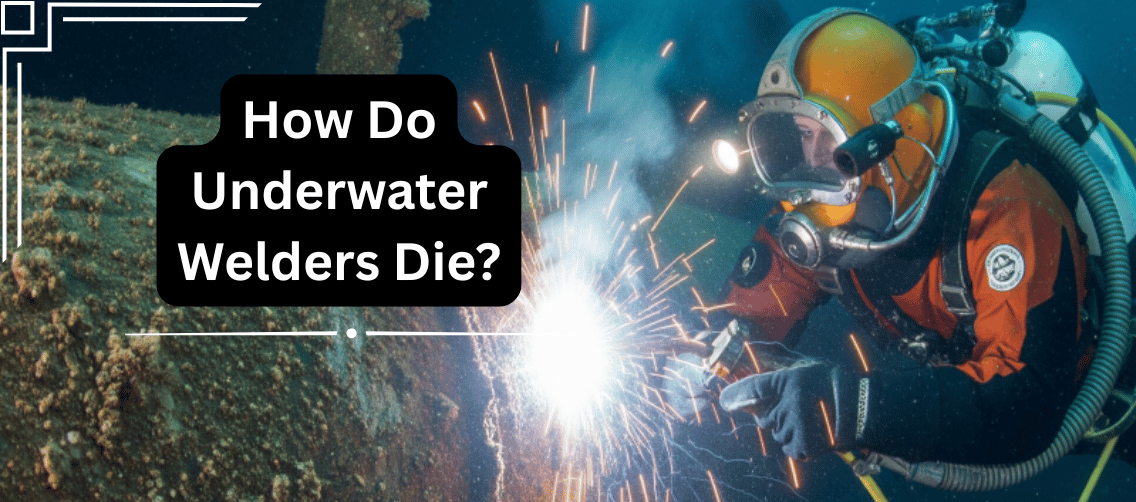
The US Bureau of Labor Statistics listed underwater welding and commercial diving as high-paying jobs. At the same time, underwater welding is one of the riskiest jobs around. With an average death rate of 15%, underwater welding sees almost 5X more death rate. So, how do underwater welders die? Why is this job so risky?
Commercial divers repair ships, vessels, and underwater gas and electric lines. So, they are often exposed to a dangerous work environment, including drowning, electrocution, decompression sickness, etc. Industry standards such as AWS D3.6 Underwater Welding Code and ISO 14164 Standards protect the rights of underwater welders.
What is Underwater Welding?
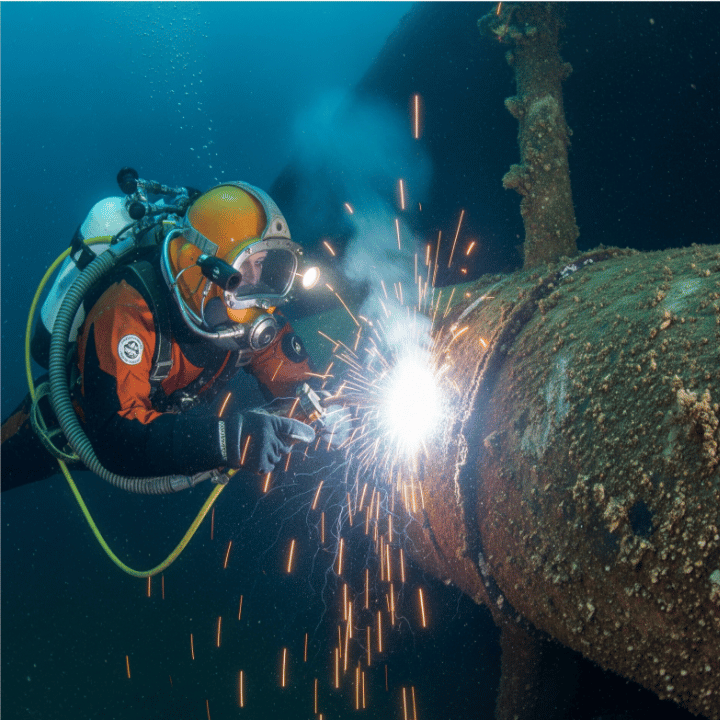
Underwater welding is the process of joining metals underwater. It is also known as hyperbaric welding. The divers use surface-supplied water to inspect, install, repair, and remove equipment and structures
Underwater welders perform different tasks:
- Repairing ships.
- Subsea pipelines.
- Offshore oil and gas platforms.
- Underwater structures.
There are two primary types: wet welding and dry welding.
Wet welding:
The commercial diver performs the welding directly in the water. The diver sways deep underwater and works against gravity. Also, wet welding is more cost-effective than the dry welding process.
Dry Welding:
In dry welding, there is a watertight habitat around the workpiece. It allows welders to work in a dry, pressurized environment. The work is physically and mentally demanding. The pressurized environment causes decompression of the workers.
Why is underwater welding essential in Various Industries?
The maritime sector uses commercial divers for emergency repairs on ship hulls and propellers. It prevents costly and time-consuming dry-docking. A few key importance of underwater welding includes:
- Maintains structural integrity of offshore oil rigs and platforms.
- Repairs marine vessels without dry-docking.
- Installs and maintains the foundations of renewable energy farms.
- Repairs critical subsea pipelines and communication cables.
- Maintains and repairs submerged components of dams and power plants.
The Fatal Risks of Underwater Welding:
Underwater welding is among the riskiest jobs worldwide. It has higher death rates than most jobs in the US.
How Dangerous is Underwater Welding?
According to industry reports, the fatality rate of underwater welding is between 15% and 20%. It is 1000X the mortality rate of police professionals. The average lifespan of an American commercial driver is around 50 to 55 years. It’s way below the national life expectancy of 78 years in the USA.
The Importance of Addressing Underwater Welding Deaths:
The high death rate for underwater welding shows the risks and lack of standard protection features in the industry. Their lives depend on protocols, training, and equipment available to them.
It’s crucial to address the underwater welding death rate first. Only with it, government and industry experts take preventive measures and improve the safety standards. Or else, the death rate will continue increasing.
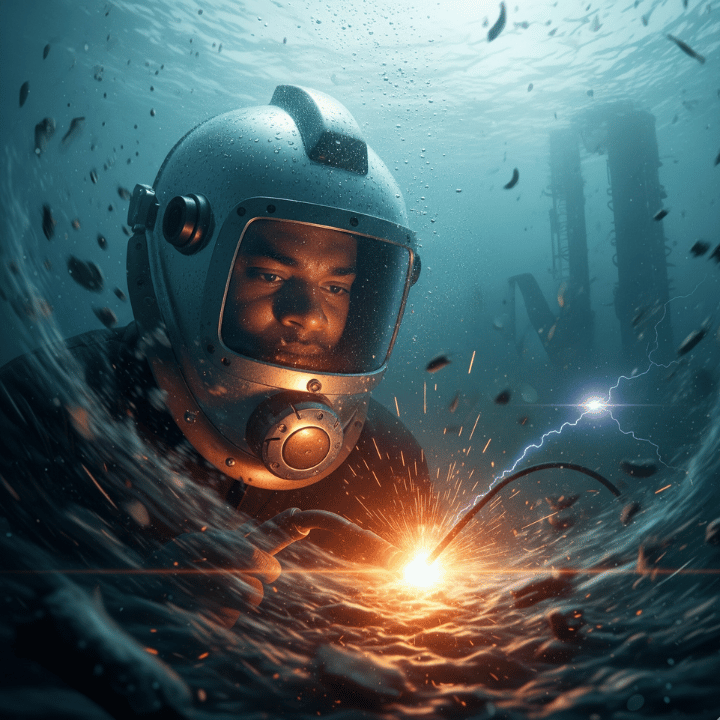
Common Causes of Death in Underwater Welding:
Underwater welders work in high-pressure environments. They often face electrical hazards and the unpredictable nature of marine conditions.
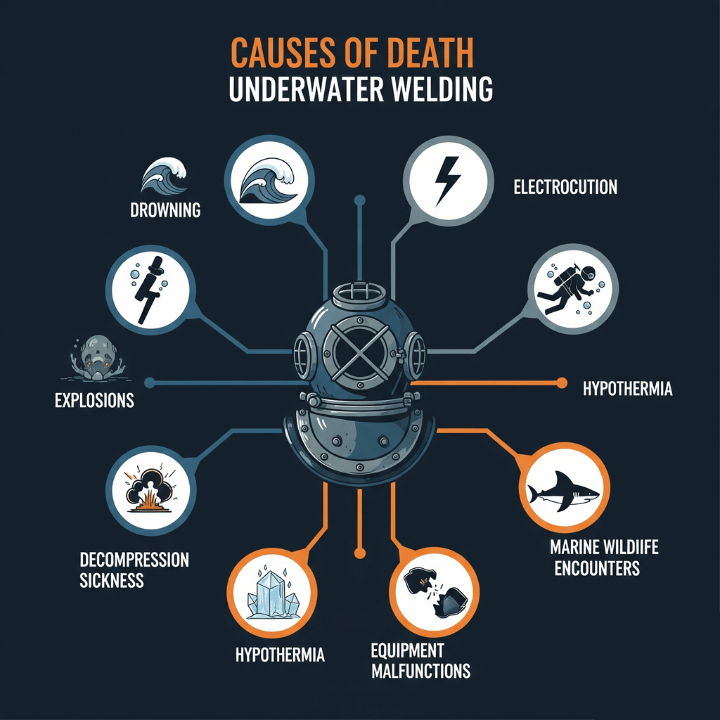
Drowning:
Drowning is the leading cause of underwater welding deaths. From equipment failure to loss of control, there are several reasons for commercial divers’ drowning.
How Drowning Occurs in Underwater Welding?
Drowning occurs in numerous ways. The most common reasons include:
- A malfunctioning air supply
- A ruptured hose
- A suit tear
So, buoyancy and air are lost rapidly. So, the welder becomes disoriented and unable to reach the surface. Also, the welder might get entangled in submerged cables, debris, or the structure. So, it becomes impossible for them to come out of the water.
Preventive Measures to Avoid Drowning:
- Inspect welders’ air supply systems, diving suits, and all associated gear.
- Use of backup air tanks, known as bailout bottles,
- Always follow the buddy system so that no welder works alone.
- A surface-to-diver communication system to receive immediate assistance.
Electrocution:
Underwater welders deal with high-voltage electricity. So, they are often at risk of electrocution. It is another leading cause of commercial diver deaths.
How Electric Shock Leads to Fatal Injuries?
Underwater welding uses direct current (DC) to minimize the risk of electric shock. Yet, a small breach in insulation causes fatalities. Electric shock also causes involuntary muscle contractions. So, the welder might fail to release the welding torch. It causes rapid injury or death. It can also cause:
- Cardiac arrest.
- Losing consciousness.
- Drowning.
Role of Electrical Safety Measures:
The driver must use standard welding equipment, from the welding machine to the cables and electrodes. Also, they must use ground fault circuit interrupters (GFCIs). It detects a ground fault and instantly shuts off the power.
Decompression Sickness (The Bends):
Many times, the welder ascends from the water too quickly. This can lead to decompression sickness with an imbalanced nitrogen gas inside the body.
Understanding Decompression and Its Effects:
Decompression sickness, or “the bends,” occurs if a welder ascends too quickly from deep water.
Underwater, nitrogen gas dissolves in human body tissue at high pressure. When the human ascends from water, the pressure decreases rapidly and creates bubbles. The bubbles cause extreme pain in the joints. It can damage the tissues and even cause paralysis and brain damage.
Importance of Proper Decompression Procedures:
- Controlled stops at specific depths during the ascent.
- Allow the body to off-gas nitrogen safely.
- Use specialized decompression chambers.
- Use a mixed-gas diving system to substitute helium.
Explosions:
Underwater explosions are rare. Yet, it can injure the welder heavily and, in the worst case, cause his death.
Causes of Explosions Underwater:
The common causes of underwater explosions are the reaction of hydrogen and oxygen. It is a by-product of the wet welding process. At times, the gas is trapped in a pocket or an enclosed area. With a fire, it can ignite and lead to a violent and destructive explosion.
Hypothermia:
If the welder works in cold water for too long, it could cause hypothermia. The body temperature falls rapidly, causing organ failure.
How Cold Water Causes Fatal Health Issues?
When body temperature drops dangerously, an underwater welder experiences hypothermia. If they work too long in cold water, it can cause:
- Loss of dexterity
- Poor judgment
- Confusion
- Organ failure and death
Prevention of Hypothermia in Underwater Welders:
Welders must wear thermally insulated suits, such as hot water suits. It circulates heated water to keep them warm. Also, they should take warming breaks.
Equipment Malfunctions:
Faulty equipment can make the hazardous environment of underwater welding even worse. It includes:
- A malfunctioning air regulator,
- Cut welding cable.
- Short circuit.
Underwater Welding Accidents and Fatality Rates:
In 2022, four underwater divers in Trinidad died after being sucked into the oil pipeline. It shows the high-risk and fatality rate of commercial divers.
Underwater Welding Deaths Statistics:
The fatality rate of underwater welders is estimated to be 15%, or 15 fatalities for every 1000 welders. The mortality rate is higher than the average for most other professions. In comparison, the average fatality rate for all private industry workers in the United States is around 3.5 deaths per 100,000 workers.
So, on average underwater welder mortality rate is 4X higher than other professions.
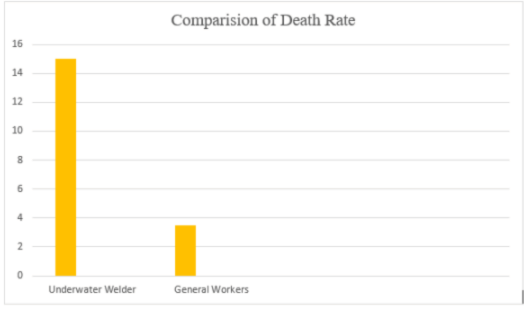
Frequency of Deaths in Underwater Welding:
Commercial divers in Washington experience more deaths than any other job, comparatively. For instance, logging workers have only 135.9 deaths annually.
Comparison of Underwater Welding Death Rates with Other Professions:
Profession | Annual Fatality Rate (per 100,000 workers) |
Underwater Welding | ~15,000 |
Logging Workers | 135.9 |
Fishing Workers | 77.4 |
Aircraft Pilots & Flight Engineers | 61.8 |
Roofers | 51.5 |
Electrical Power-Line Installers | 23.5 |
Police Officers | 15.6 |
All U.S. Workers (Average) | 3.5 |
Why Are Death Rates for Underwater Welding So High?
The underwater welding death rate is higher because of improper safety regulations. Also, they don’t have immediate access to emergency medical help. It also increases the mortality rate of commercial divers.
Lack of Safety Regulations:
Underwater welding lacks international and national safety regulations. It is especially true for third-world countries. The vastness of the ocean and the isolation of many projects make strict oversight difficult.
Limited Access to Immediate Medical Assistance:
Unlike on land, medical emergencies in underwater and offshore areas are limited. However, injured welders need complex and time-sensitive responses. For them, it takes time to reach the surface.
As a result of the wasted time, even minor injuries to the welder can turn fatal.
Harsh Work Environments:
The deep-sea environment is unforgiving. Welders often work in:
- High pressures
- Low visibility
- Strong currents
- Extreme temperatures
It puts physical and mental stress on the welder. So, the chances of accidents rise.
Stress and Fatigue:
Underwater welding needs extreme physical and psychological fitness. It causes high levels of stress and fatigue. A tired or stressed welder is more prone to making a mistake. Unfortunately, small errors can be fatal while working 20 to 100 feet deep in the sea. It becomes worse in remote locations, such as off the coast of Washington state.
Preventing Underwater Welding Fatalities:
Almost 4000 commercial divers work in the ship, marine, and underwater welding sector in the USA. So, for their safety, it’s essential to prevent fatalities.
Safety Procedures and Regulations:
Appropriate safety procedures and regulations will reduce the underwater welding death rate. The government must apply high standards of safety procedures.
Importance of Proper Training and Certification:
Extensive, high-quality training is more than important. Welders must be certified in welding and commercial diving. So, they know the techniques to dive deep underwater. It improves their quality, reduces blood-pressure fluctuations, and reduces injury chances.
Safety Standards and Protocols:
Over the past few decades, both international and federal authorities have developed safety standards for underwater welders. However, the implementation of these protocols is questionable.
AWS D3.6 Underwater Welding Code:
The American Welding Society (AWS) has developed the AWS D3.6 underwater welding code. It was first established to regulate the works in offshore & inland pipelines. It has different requirements for welder qualification and welding procedures. Also, it sets three different qualifications and working criteria for the welders:
- Class A
- Class B
- Class C
ISO 14164 Standard:
The ISO 14164 Standard was established in 1999. It guides the selection, training, and assessment process of the underwater welders. It focuses on:
- Specifies criteria for welder qualification.
- Sets standards for welding procedures.
- Ensures quality control in underwater welding.
DNV GL Standards:
The DNV GL Standards have criteria for underwater welding on marine and offshore structures. It focuses on oil platforms and offshore wind farms. Its strict supervision has improved the control mechanisms. Also, regular monitoring ensures compliance with safety standards.
Ensuring Proper Equipment Maintenance:
Regular and meticulous equipment maintenance is non-negotiable. It’s crucial to check all the gear, from the diving suit to the welding torch. Also, after every use, a qualified equipment inspector must recheck the equipment for quality assurance.
New Technological Innovations for Safety:
Thankfully, new technological innovations in the welding and diving industry have improved the safety standards. From the use of advanced welding techniques to the use of ROVs, it has significantly reduced the death rate.
Advanced Welding Techniques:
The welding industry has new techniques, including friction stir welding and laser welding. It could reduce some of the electrical and gas-related risks. Also, it will replace traditional arc welding. So, the chances of explosions during underwater welding.
Use of Remote Operated Vehicles (ROVs) for Safety:
Many welders now use remotely operated vehicles (ROVs). It can inspect and maintain different welding tasks. In the future, fully automated ROVs will handle more welding tasks. So, human welders won’t have to work in a risky marine environment.
Enhanced Underwater Welding Gear:
Modern diving suits and life support systems have improved a lot. They have become more robust and reliable. Welding equipment manufacturers now use new materials, better insulation, and more sophisticated communication systems. It has made the welding gear more reliable and safer for the welders.
Legal Rights and Support for Injured Welders:
Underwater welders can file personal injury and work-site injury claims. They may be covered under the general maritime law and the Longshore and Harbor Workers’ Compensation Act (LHWCA).
Legal Protections for Underwater Welders:
The maritime law, workplace safety regulations, and various safety protocols provide legal protection to underwater welders. Ledger Law Firm ensures your rights are protected and you get maximum compensation for injuries, stress, and fatigue.
Workers’ Compensation for Injured Welders:
In many jurisdictions, commercial divers are protected by different laws. The workers’ compensation law offers a safety net for injured welders. It provides medical care and wage replacement benefits to workers injured, regardless of fault.
Wrongful Death Lawsuits for Families of Deceased Welders:
For wrongful death during underwater welding, you can file lawsuits. The negligence of an employer or equipment manufacturer could be the cause of their wrongful death. In such cases, the families of deceased welders may file a wrongful death lawsuit to seek compensation for their loss.
FAQ
Frequently Asked Questions

Underwater welding combines commercial diving and welding hazards. The high-pressure environment, electrocution, and decompression sickness are responsible for the high mortality rate.
The average life expectancy of an underwater welder is around 50 to 55 years. It is almost 25 to 30 years less than the average lifespan of an American person.
Welders must receive extensive, certified training, check their equipment before every dive, and follow all safety protocols. Also, ensure a reliable surface support team for emergency medical moments.
Maritime laws, such as the Jones Act and Longshore and Harbor Workers' Compensation Act (LHWCA) protect the rights of the injured underwater welders. They can seek compensation for injuries and sue the employer for their negligence.
Conclusion:
How do underwater welders die? Electrocution, decompression sickness, and explosions are the main causes of death among commercial divers. Ledger Law Firm, with deep knowledge of maritime law and workers’ safety law, ensures your deserved claim.
We will fight for your rights against the vessel owner or the faulty equipment manufacturers. For your free case evaluation, contact us now.