Key Takeaways
-
Broad jurisdiction: Covers incidents on all navigable waterways.
-
Unique worker rights: The Jones Act and maintenance and cure protect seamen.
-
Beyond injury claims: Regulates commerce, safety, and marine environment protection.
-
Two-part test: Location and activity determine if maritime law applies.
-
Protects many people: Covers seamen, boaters, dock workers, and passengers.
Maritime law protects maritime workers, passengers, and even the goods transported through the water bodies. But when does maritime law apply, and how does it protect you?
Maritime law covers the events occurring in navigable water, including seas, oceans, and lakes. It protects the seamen’s cruise ship passengers, works in and around vessels, etc. A few of the important maritime laws include the Jones Act, the limitation of liability of 1851, etc.
If you are hurt or injured on a vessel due to the employer’s or owner’s negligence, you can file a lawsuit. You are then entitled to both economic and non-economic damages.
What Is Maritime Law?
Maritime law is the law of the seas. It regulates marine commerce, navigation, shipping, and the transportation of people and goods. The law is also known as the admiralty law.
It covers the legal matters that occur on the high seas, in port, or on U.S. navigable waterways, including rivers, wetlands, and lakes. Maritime law defines clear rules for all maritime activity to improve safety at sea and protect the environment. It also standardizes contractual agreements and facilitates global trade.
Important Historical Maritime Acts – United States
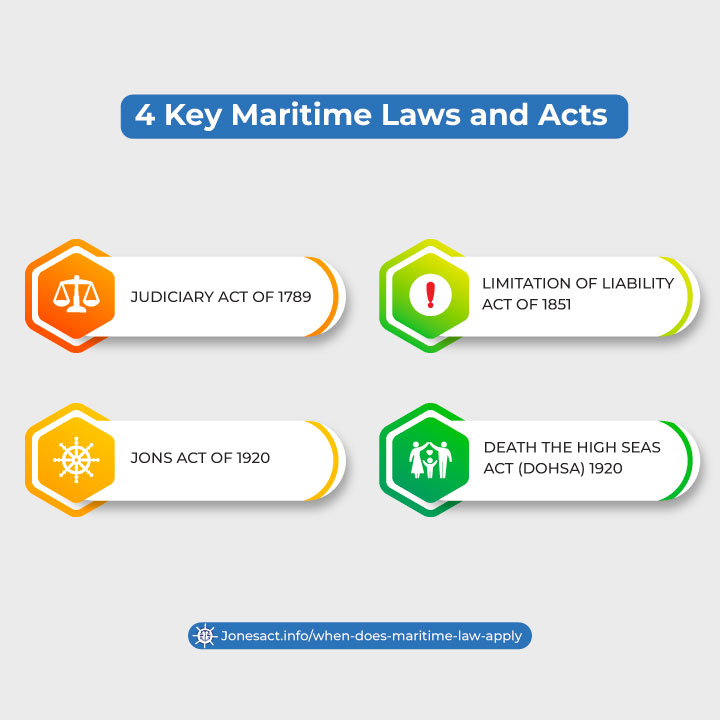
Judiciary Act of 1789
It grants federal courts exclusive jurisdiction over admiralty and maritime law cases.
Limitation of Liability Act of 1851
It limits the liability of shipowners for losses from unforeseeable events to the value of the vessel.
Merchant Marine Act of 1920 (Jones Act)
It gives seamen the right to sue employers for injuries for their negligence.
Death on the High Seas Act (DOHSA)
Surviving family members can pursue wrongful death claims for seamen killed on the high seas.
Longshore and Harbor Workers' Compensation Act (LHWCA)
It covers offshore and maritime occupations like longshoremen and shipbuilders.
International:
- SOLAS (Safety of Life at Sea) Convention: Sets minimum safety standards for the construction, equipment, and operation of merchant ships.
- MARPOL (International Convention for the Prevention of Pollution from Ships): It regulates the discharge of harmful substances from ships. The convention prevents marine pollution.
- Maritime Labor Convention (MLC): Establishes minimum working and living standards for seafarers on merchant ships.
Key Features of Maritime Law:
Maritime law governs marine commerce and shipping. It also sets health and safety standards. Maritime law jurisdictions include commercial accidents, recreational boating incidents, piracy, and insurance claims for vessels or cargo.
Its key areas are:
- Comprehensive Jurisdiction: Applies to all activities on navigable waters, from oceans to rivers and lakes.
- Specialized Rules: Governs marine commerce, shipping, and navigation.
- Broad Coverage: Addresses commercial accidents, recreational boating incidents, piracy, and insurance claims.
- Safety and Health Focus: Sets specific health and safety standards for marine operations.
When Does Maritime Law Apply?
Maritime law applies to activities in navigable waters. It also covers the operations related to marine activities. Consider the location and nature of the accident. Also, consider the activity details of the maritime law.
- To commercial vessels and activities, such as cargo ships and towing operations.
- For accidents involving recreational boats and water sports like jet-skiing.
- To protect offshore and dock workers through specific compensation acts.
- In cases of piracy, cargo disputes, and marine insurance claims.
Navigable Waters:
Maritime law deals primarily with activities in navigable waters. A navigable water body supports interstate or international trade. It includes waterways that span over state or national borders.
Lakes and rivers can also be navigable. They must connect to another water body that crosses state or national borders. Also, it can facilitate interstate or international trade. Examples of situations where maritime law applies include:
- Commercial accidents resulting in seaman injuries.
- Injuries on a jet ski or fishing boat.
- Piracy and other criminal activities on ocean vessels.
- Insurance claims for ships or cargo lost during a storm.
Commercial Vessels and Maritime Activities:
Maritime law sets rules for vessels such as cargo ships, tankers, and freight vessels. It also governs various maritime activities, including:
- Loading/unloading cargo
- Shipbuilding and repair
- Harbor operations
- Salvage activities
- Towing
Recreational Boating Accidents:
Maritime law covers recreational boating accidents and incidents. Its jurisdiction includes water sports like jet skiing and scuba diving. Legal protections are available for professionals and service-takers of the recreational boating events.
However, there’s a difference between commercial versus recreational incidents.
Feature | Commercial Boating Accidents | Recreational Boating Accidents |
Jurisdiction | Federal maritime law governs it | Either federal maritime law or state law governs it |
Applicable Law | The Jones Act for seamen; LHWCA for longshoremen; DOHSA for wrongful death. | General maritime law principles, but state negligence laws may also be used. |
Key Differentiator | The relationship between the injured party and the vessel (e.g., employee, seaman). | The “navigable waters” test and the nature of the incident are the primary factors. |
Offshore and Dock Workers:
The Longshore and Harbor Workers’ Compensation Act (LHWCA) protects offshore workers, longshoremen, and others working on docks. It provides the workers with compensation and medical benefits for job-related injuries.
Most Important Maritime Law You Should Know:
Maritime law has developed federal and state laws to protect vessels, marine workers, and passengers. From the Jones Act to maintenance and cure, different maritime laws cover various sectors.
The Jones Act:
The Jones Act was formally known as the Merchant Marine Act of 1920. The federal law grants various rights for injured or killed seamen during their employment aboard a sea vessel. They can claim damages against their employer for their negligence.

Eligibility:
To be eligible for a Jones Act claim, an injured worker must meet the legal definition of a “seaman”.
-
1Connection to a Vessel: The person must have a connection to a vessel or a fleet. The 30% rule means the worker must spend at least 30% of their working time on the vessel.
-
2Contribution to the Vessel's Mission: The worker's duties must contribute to the function of the vessel. It includes cooks, deckhands, and even musicians on cruise ships, not just those involved in navigation.
Additionally, the injury must occur on a “vessel in navigation”. It means the vessel is afloat, operational, and capable of moving on navigable waters.
Requirements for a Claim:
The seamen must prove that the negligence caused the injury. The negligent party could be their employer, the vessel owner, or a coworker. Negligence can include:
-
1Failure to provide a safe workplace or a seaworthy vessel.
-
2Not performing regular maintenance on equipment.
-
2Absence of proper training or safety gear.
-
2Assigning a seaman to a task they were not trained.
Seamen’s Rights Under the Jones Act:
The Jones Act gives the seamen the legal right to sue their employer for negligence. It covers an injury or death that occurs due to an unsafe work environment or a negligent act. The rule covers recovery of various damages, including pain and suffering.
Maintenance and Cure:
Maintenance and cure is a fundamental principle of maritime law. It covers the living expenses and medical care of an injured seafarer. The law is applicable regardless of who was at fault for the injury.
- Maintenance: Daily living stipend for an injured seaman during their recovery time. It covers essential living expenses, including food and lodging.
- Cure: Covers all reasonable and necessary medical expenses for the injured seaman. It includes costs for medical treatment, hospital stays, medication, and rehabilitation.
Death on the High Seas Act (DOHSA):
The Death on the High Seas Act (DOHSA) is under the 46 U.S.C. §§ 30301–30308. It covers the families of passengers and non-Jones Act workers. Its provision includes those killed outside the three-mile territorial coast of the U.S. A key requirement for this act is to prove negligence by the boat owner or company.
Common Law vs. Maritime Law vs. Admiralty Law:
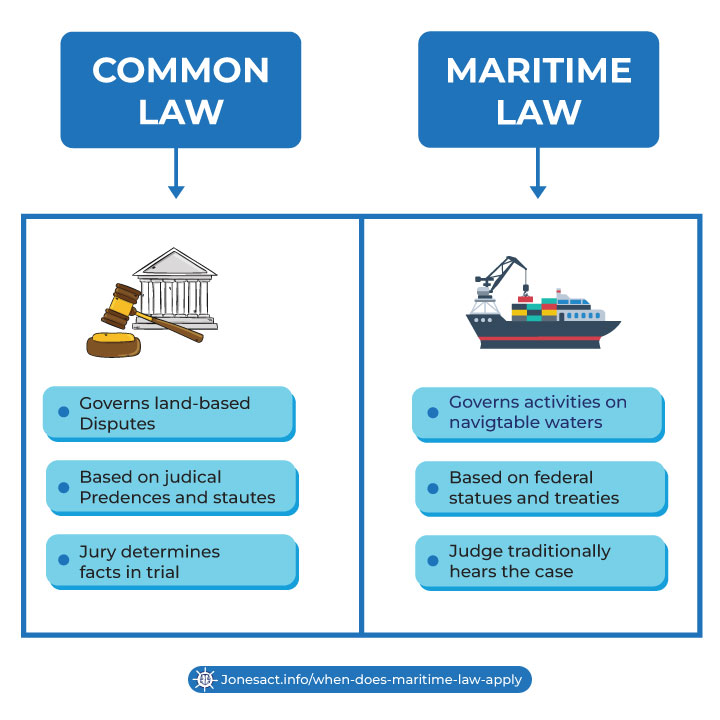
Common law and maritime law have different coverage and jurisdiction. Also, their origin, governing laws, and trial process differ.
Feature | Common Law | Maritime Law (Admiralty Law) |
Origin | Judicial precedents in medieval England, based on “judge-made law.” | Ancient legal traditions dating back to seagoing civilizations as early as 900BC. |
Jurisdiction | Governs disputes on land, such as personal injury, contracts, and property disputes. | Governs incidents and activities on navigable waters, including oceans, rivers, and certain lakes. |
Governing Laws | Based on case law and statutes of the state and federal legislatures for land-based matters. | Based on federal statutes (Jones Act, LHWCA), international treaties, and maritime legal principles. |
Legal Protections | Provides remedies like workers’ compensation and tort claims for land-based injuries. | Provides maintenance and cure for seafarers and allows negligence claims under the Jones Act. |
Trial Process | The jury determines questions of fact. | Traditionally, a judge with deep knowledge of maritime law hears the case on a “bench trial.” There’s no right to a jury trial for certain claims. |
Maritime Personal Injury Jurisdiction and Venue:
Maritime personal injury cases are typically heard in federal court. However, state courts can sometimes have concurrent jurisdiction. The outcome of your personal injury claims depends on the court and its jurisdiction.
So, it’s crucial to consult a maritime lawyer. The maritime law attorney will hear your case details and give suggestions on where it applies the most.
Determining Whether Maritime Law Applies to Your Injury:
Does the maritime law apply to your injury? The determination includes a two-pronged test: location and nature of the activity.
- Location: The incident must have occurred on a navigable waterway.
- Nature of the Activity: The cause of the injury must be related to traditional maritime activity. It could be commerce, navigation, or shipping.
Example: A dock worker slipped on a vessel while loading cargo. Maritime law would likely cover the worker. It’s because the location and activity are maritime in nature. In contrast, if the same worker slipped and fell in the company’s parking lot, the case would fall under standard land-based personal injury law.
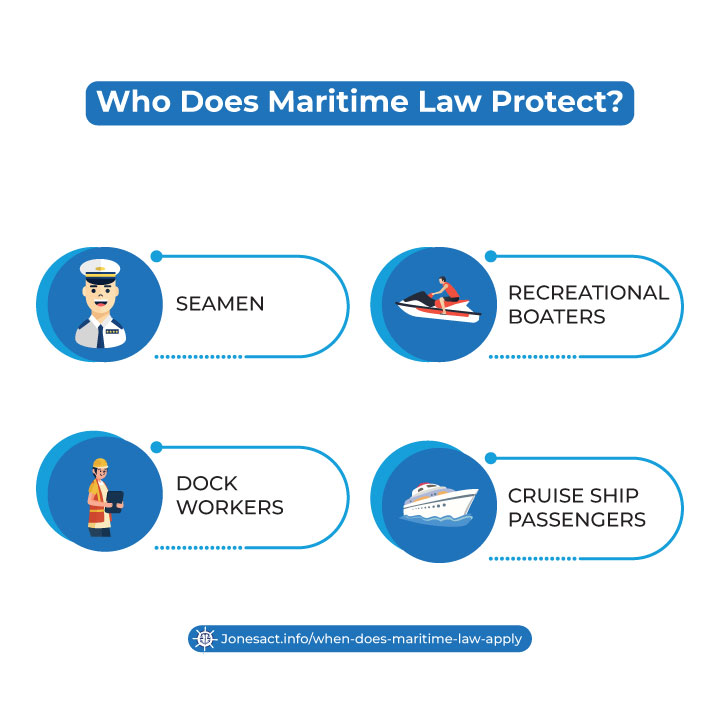
Who Does Maritime Law Protect?
Maritime law protects all maritime workers. Whether you are a seaman or a recreational boater, maritime law has provisions for compensation for all.
Seamen (Jones Act Seafarers):
The Jones Act protects the seamen working on commercial vessels. It provides them with the legal right to sue their employer for negligence for injury. To be eligible for the Jones Act, the seamen must spend at least 30% of their time on vessels.
Recreational Boaters:
Legal protections are available for recreational boaters. If recreational boaters suffer from accidents on navigable waters, maritime law will protect them. There’s a provision to compensate their injuries, including professionals and service-takers.

Dock Workers and Longshoremen:
The Longshore and Harbor Workers’ Compensation Act offers appropriate damage claims for various workers. It includes workers on docks, shipbuilders, and other maritime-related employees.
Passengers on Cruise Ships:
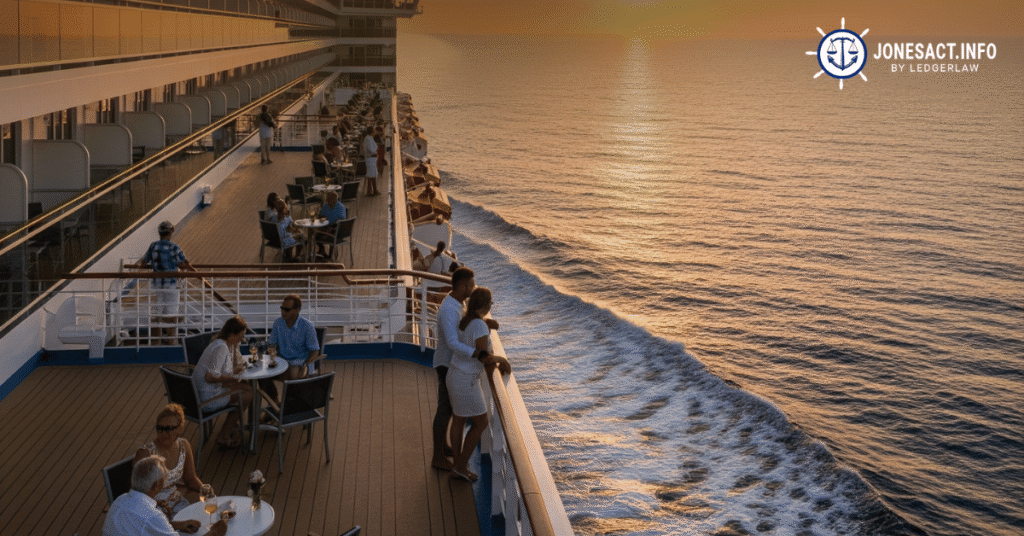
Maritime law also protects the passengers on cruise ships. According to maritime law, cruise lines must ensure passenger safety. It is their responsibility. The rights include a safe environment, medical care, sick compensation, and appropriate information. It also includes the rights of the disabled.
Maritime Injury Lawsuits:
When you sustain an injury in a maritime setting, you can file a lawsuit to recover financial damages. Contact an experienced maritime attorney to deal with your maritime injury lawsuit. He will help you with the compensation claims.
Joint and Several Liability in Maritime Law Cases:
The federal maritime law developed the doctrine of joint and several liability to distribute the liability after injuries. According to it, each party is equally liable for the injuries that they contributed to.
The liability is regardless of the degree of their contribution. So, all at-fault parties are fully responsible for compensating the plaintiff’s damages. If one party is unable to pay their portion, the other party must cover the difference. The idea is that the plaintiff receives the full amount.
Does Maritime Law Apply to Lakes and Rivers?
Yes, maritime law can apply to lakes and rivers. The key determinant is whether the body of water is “navigable.”
A waterway is deemed navigable if:
-
1It is used.
-
2Capable of being used.
-
2Usable for interstate or international commerce.
Title 33 and Title 46 of the United States Code defined navigable water. A river entirely within one state can still be navigable. However, it must connect to a larger body of water that crosses state lines.
Potential Recoverable Damages in a Maritime Injury Lawsuit:
In a maritime injury lawsuit, you can recover financial relief for economic and non-economic damages. The compensations include:
-
Reasonable past and future medical expenses.
-
Lost earning capacity (past and future lost wages).
-
Pain and suffering.
-
Emotional distress.
-
Loss of enjoyment of life.
-
Scarring and disfigurement.
-
Permanent disability.
-
Loss of consortium and support.
-
Maintenance and cure.
The Process for Filing a Maritime Injury Claim:
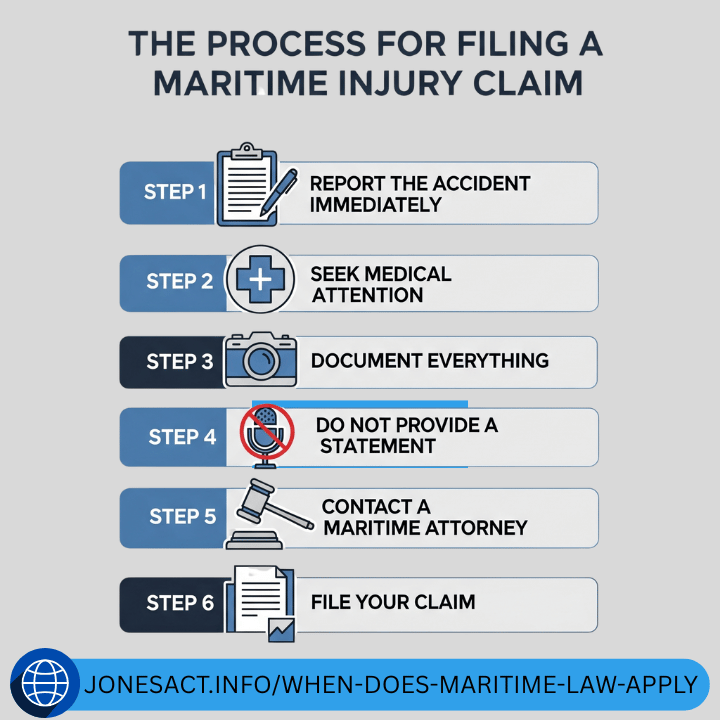
The process for filing a personal injury claim under maritime law is complex. So, you must contact a skilled maritime lawyer for it. The steps include:
- Report the Accident Immediately: Notify your supervisor as soon as the accident happens. It creates an official record.
- Seek Medical Attention: Get immediate medical care. Also, document your injuries once a professional thoroughly checks them.
- Document Everything: Gather photos, witness contact information, and medical records to support your case.
- Do Not Provide a Statement: Don’t give a recorded statement to your employer or their insurance company without legal counsel.
- Contact a Maritime Attorney: Consult with a skilled maritime lawyer. It will help you understand your rights and legal options.
- File Your Claim: Work with your attorney to file the claim within the strict legal deadlines.
Seeking Legal Help After a Maritime Accident:
Consult with an experienced maritime attorney. He will navigate the complex legal process of maritime law for you. Also, they can determine whether maritime law applies to your specific injury.
The determination of the maritime law will ensure your claim is processed correctly. They can calculate your lost wages, medical bills, and file the compensation claim.
Don’t Settle for Less Than an Expert Maritime Attorney:
Choose an expert maritime law attorney because these cases are highly specialized. An experienced attorney will determine whether you are a Jones Act Seaman, a Longshoreman, or a passenger. It ensures you pursue the correct legal claims.
FAQ
Frequently Asked Questions

Consider the following things to determine where your case applies maritime law:
- The location of the accident,
- The nature of the activity,
- Is the injury connected to a maritime-related activity?
A maritime lawyer can help you make this determination.
The Jones Act is a federal law for seamen injured or killed on the job. The seamen can sue their employers for negligence under the Jones Act. It provides compensation for seafarers beyond traditional workers' compensation.
Yes, you can sue for injuries on a cruise ship. You can hold the cruise ship and cruise line responsible for your injuries. However, you must prove that their negligence caused the injury.
Yes, the Death on the High Seas Act (DOHSA) applies to wrongful death cases in international waters.
You can seek compensation for lost wages, medical bills, pain and suffering, and other economic and non-economic damages.
Conclusion:
Maritime law is a legal framework to protect those who work and travel on the water. So, you must know when does maritime law apply to your case? It covers seamen, harbor workers, and maritime travelers.
Consult with a skilled maritime lawyer to ensure your rights and compensation. Ledger Law Firm is ready to help you with maritime law cases in both federal and state courts.