
Key Takeaways:
-
Most Jones Act and maritime injury cases use contingency fees of about 33.3% to 40% of the financial compensation recovered.
-
“No win, no fee” usually means no attorney’s fee is owed without a settlement or verdict, but case costs depend on the written agreement.
-
Maritime law is specialized, so fees can be higher than in a routine car crash or workers compensation claim.
-
A fee agreement should explain whether filing fees, experts, court costs, and deposition costs are separate from contingency fees.
-
Do not choose a maritime injury attorney based only on price; experience with Jones Act claims in state or federal court matters.
-
A free case evaluation lets injured maritime workers ask about legal fees, timelines, and likely case value before hiring a law firm.
When you are injured on the job offshore, on a vessel, or at a dock, bills can arrive before answers do. Maritime workers may face lost wages, medical treatment delays, medical bills, and rules that are different from ordinary workers compensation. This guide explains the amount of fees in maritime cases injured on job situations, including how contingency fees work, what costs may be deducted, and what happens if a maritime injury claim is lost.
Briefly Explain – What Is The Amount Of Fees In Maritime Case Injured On Job?
Most maritime attorneys work on a contingency fee basis, meaning the lawyer is paid only if the injury claim produces money. Maritime cases typically carry a 33.3% to 40% contingency fee, which is higher than standard onshore personal injury claims that usually charge a 33.3% fee.
A Jones act claim may start near 33 1⁄3% if it resolves early. The percentage may rise to around 40% if the maritime injury cases require filing suit, discovery, expert testimony, or trial in federal court. Some agreements increase again for appeals, so read the contract carefully.
Most injury attorneys do not charge retainers or hourly fees to injured seamen who cannot pay upfront. For example, in a $600,000 offshore back injury settlement, a 40% fee equals $240,000 before case costs and liens are handled.
Understanding Common Fee Structures in Maritime Law:
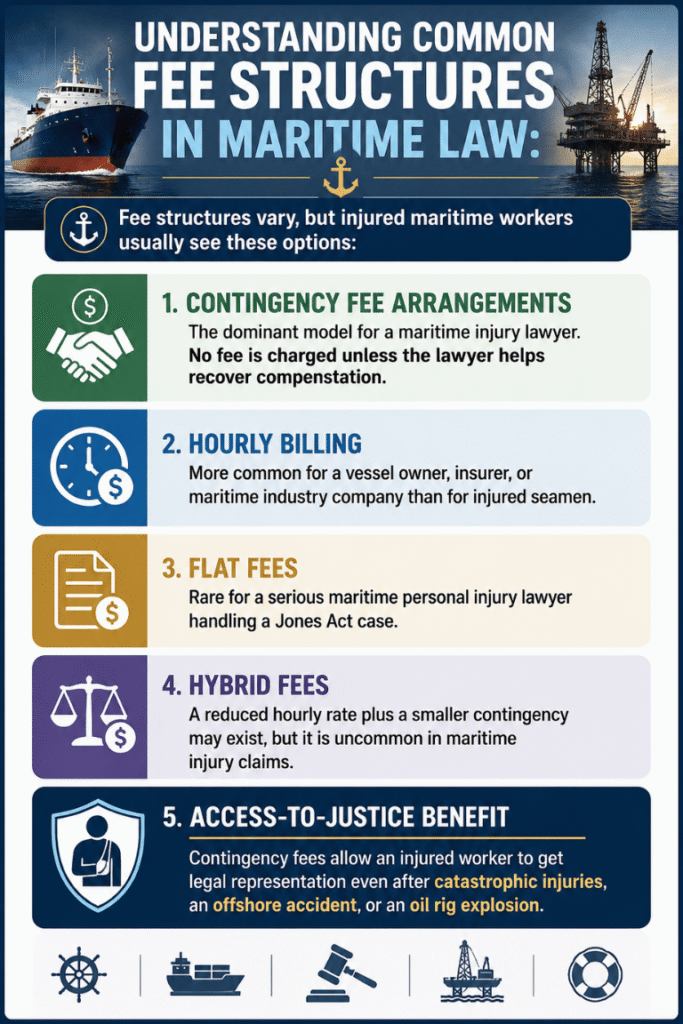
Fee structures vary, but injured maritime workers usually see these options:
-
Contingency fee arrangements: The dominant model for a maritime injury lawyer. No fee is charged unless the lawyer helps recover compensation.
-
Hourly billing: More common for a vessel owner, insurer, or maritime industry company than for injured seamen.
-
Flat fees: Rare for a serious maritime personal injury lawyer handling a Jones Act case.
-
Hybrid fees: A reduced hourly rate plus a smaller contingency may exist, but it is uncommon in maritime injury claims.
-
Access-to-justice benefit: Contingency fees allow an injured worker to get legal representation even after catastrophic injuries, an offshore accident, or an oil rig explosion.
What Maritime Attorneys Do for the Fee:
A maritime attorney does more than send a demand letter. The legal team investigates the maritime accident, preserves vessel logs and electronic data, interviews crew, and works with experts.
Key work often includes:
-
Filing pleadings in state or federal court under admiralty law and federal law.
-
Handling discovery, motions, depositions, and settlement negotiations.
-
Building a negligence claim by showing unsafe conditions or employer fault.
-
Evaluating medical expenses, lost wages, pain and suffering damages, and future care.
-
Working with marine safety experts, physicians, and vocational rehabilitation specialists.
-
Advising injury victims whether a fair settlement truly provides fair compensation.
“No Win, No Fee” in Maritime Injury Cases:
“No win, no fee” means that if the maritime injury attorney recovers no money, no attorney’s fee is owed. Maritime attorneys typically work on a contingency fee basis and usually take around 40% of the final recovery when the case is successful.
Many firms advance filing fees, expert witness fees, deposition transcripts, travel, and other court costs. Unlike hourly attorneys, maritime attorneys advance all case costs, which may include expenses for expert witnesses and other necessary resources, absorbing these costs if the case is unsuccessful when the contract says so. Other contracts require reimbursement even after a loss, so ask before signing.
Why Maritime Law Fees Are Often Higher Than Other Injury Cases:
In maritime injury cases, legal fees operate under distinct rules compared to standard personal injury or onshore workers’ compensation claims. Maritime attorney fees are generally higher than those for car accident cases due to the complexity of maritime law, which involves federal statutes and specialized knowledge.
A Jones Act case may involve seaman status, unseaworthiness, maintenance and cure, and third-party liability. The Jones Act, officially known as the Merchant Marine Act of 1920, allows injured seamen to sue their employers for personal injury damages resulting from negligence. The Jones Act provides a lower burden of proof for injured workers compared to traditional personal injury law, requiring only that the employer’s negligence played some part in causing the injury.
Is It Possible to Hire a Maritime Lawyer for Less Money?
Yes, but price should not be the only factor.
-
Some personal injury lawyers advertise lower fees but may lack maritime law trial experience.
-
Net recovery matters more than the lowest percentage.
-
A lower fee is not helpful if the lawyer misses maintenance and cure, unseaworthiness, or future wage loss.
-
Ask about prior Jones Act verdicts, offshore injury settlements, and whether the attorney has handled claims for offshore oil rig workers and other maritime workers.
-
An experienced maritime lawyer may recover damages that a general injury lawyer overlooks.
Beware of Escalating or Confusing Fee Agreements:
Some contracts use escalating percentages. The fee may be 33⅓% before a lawsuit, 40% after filing, and higher after trial or appeal. Other contracts use one flat percentage whether the maritime claim settles early or after a federal court trial.
Ask for examples in dollars. If a lawyer cannot explain the fee, costs, and likely deductions in plain English, slow down. Keep a signed copy and review it before accepting any settlement.
Know What You Owe Before Accepting a Settlement:
From the gross settlement, deductions usually include the attorney fee, advanced case costs, and medical liens. Maritime cases incur expenses for filing fees, expert witness fees, and deposition costs.
For example, an $800,000 settlement with a 40% fee means $320,000 goes to fees. If $50,000 in costs and $120,000 in hospital, Medicare, Medicaid, VA, or employer-funded medical liens remain, the injured worker receives about $310,000. Always request a written disbursement statement.
When Do Injured Maritime Workers Get Paid?
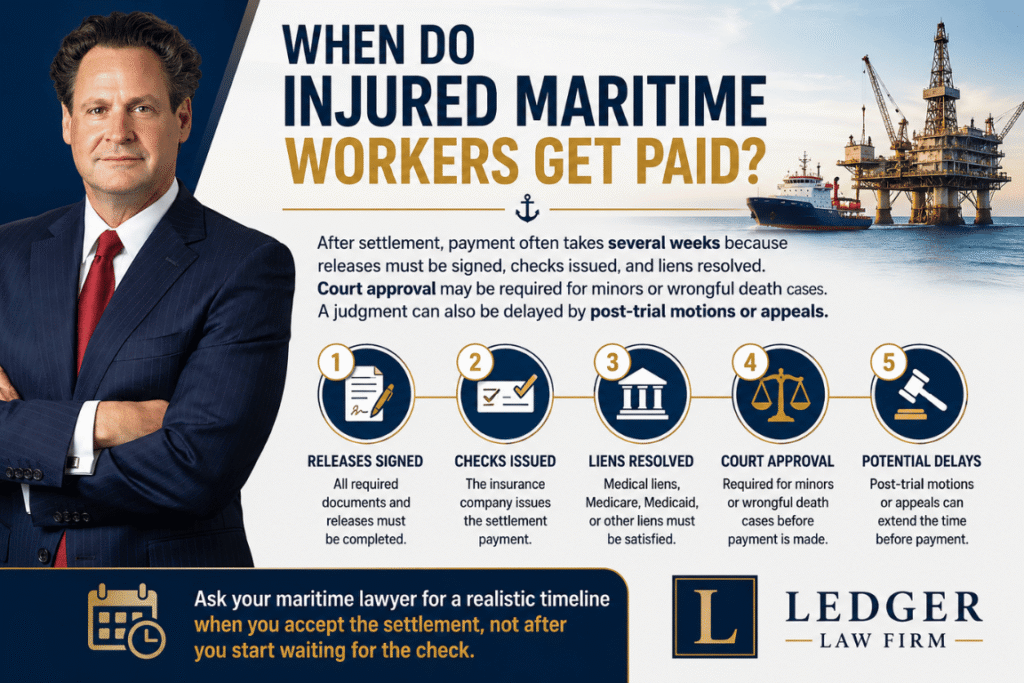
After settlement, payment often takes several weeks because releases must be signed, checks issued, and liens resolved. Court approval may be required for minors or wrongful death cases. A judgment can also be delayed by post-trial motions or appeals.
Ask your maritime lawyer for a realistic timeline when you accept the settlement, not after you start waiting for the check.
Contact Maritime Attorneys for a Maritime Case: Free Case Evaluation:

A free consultation is a practical first step after a maritime injury. Consultations are free and confidential for seamen, deckhands, harbor employees, rig workers, offshore workers, and dock workers. During the initial consultation, a maritime injury attorney reviews the accident facts, medical treatment, employer coverage, and available insurance.
Bring:
-
Pay records and tax documents.
-
Medical records and photos.
-
Accident reports or witness names.
-
Letters from the employer or insurer.
-
Questions about legal rights, legal action, and whether you may choose your own physician.
We can explain Jones Act negligence, unseaworthiness, maintenance and cure, third-party claims, and expected fees. A free case evaluation helps you decide whether to pursue claims.
Special Issues: Workers Compensation vs Jones Act and Other Maritime Claims:
Maritime injury claims can be filed by workers injured while aboard a vessel, offshore platform, or at a dock, and these claims are governed by maritime law rather than traditional workers’ compensation laws.
Under the Jones Act, only workers classified as ‘seamen’-those who spend 30% or more of their time on a vessel in navigable waters-are eligible to file claims for personal injury damages resulting from employer negligence. To qualify for protection under the Jones Act, a worker must be classified as a ‘seaman,’ which generally means spending 30% or more of their time on a vessel in navigable waters.
Unlike traditional workers’ compensation systems, which provide fixed benefits regardless of fault, the Jones Act allows maritime workers to pursue full compensation if their employer’s negligence caused or contributed to their injury. Under the Jones Act, injured maritime workers can file claims in either state or federal court, depending on the circumstances of their case.
In addition to the Jones Act, injured maritime workers may pursue maintenance and cure claims, which cover medical expenses and provide living expenses until the worker reaches maximum medical improvement. Maintenance and cure benefits are available to virtually all offshore workers who qualify as ‘seamen’ under the Jones Act, allowing them to file for these benefits when injured on the job.
Maintenance refers to a stipend covering the basic living expenses, such as food and shelter, that a seaman would have received while working on a vessel. Maintenance covers daily living expenses while an injured worker is recovering, typically ranging from $50 to $100 a day. Maintenance rates are often modest, frequently between $20 and $50 per day, and may not cover the worker’s actual living expenses.
Cure refers to the medical expenses incurred by the injured seaman, which must be covered until the seaman reaches maximum medical improvement. Employers are legally required to pay maintenance and cure benefits regardless of fault, meaning that even if the employer is not responsible for the injury, they must still provide these benefits.
Longshore and harbor workers may fall under the Longshore and Harbor Workers’ Compensation Act, sometimes searched as harbor workers compensation act, with different fee rules. The Death on the High Seas Act, or high seas act, allows family members to file claims for wrongful death resulting from maritime accidents occurring in international waters, providing a legal avenue for compensation. Other laws may involve OCSLA or claims against the federal government.
Catastrophic Maritime Injuries and Their Impact on Fees and Costs:
Catastrophic injuries increase both case value and litigation costs. Examples include traumatic brain injuries, amputations, spinal cord injuries, severe burns, shoulder injuries, and injuries from an oil rig explosion.
These cases often require expert testimony on future medical treatment, life-care planning, and loss of earning capacity. Maritime injury claims can include various types of negligence claims, where injured workers can seek compensation for damages caused by unsafe working conditions or employer negligence.
An unseaworthiness claim requires maritime employers to provide safe workspaces and seaworthy vessels, meaning that if someone is injured due to the poor condition of the vessel, they can file a claim for unseaworthiness. If a defective condition on the ship, such as faulty equipment or lack of safety gear, caused an injury, the injured party may be able to recover damages under the doctrine of unseaworthiness, even without direct employer negligence. Proving unseaworthiness can be challenging, as it requires evidence of liability, which is why it is important for injured workers to consult with a maritime attorney to investigate and preserve evidence.
Conclusion: Making Smart Choices About Maritime Attorney Fees:
Understanding contingency percentages, case costs, maintenance and cure, and settlement deductions helps injured maritime workers avoid financial surprises. The right maritime attorney should explain every fee term before you sign and every deduction before money is disbursed. Do not choose legal representation only because it is cheap; choose a lawyer who knows the Jones Act, admiralty law, and the legal process. If you were injured on the job, seek compensation through a free case evaluation before deciding how to move forward.
FAQ
Frequently Asked Questions


Usually 33.3% to 40% of the recovery. Higher percentages may apply if the case is heavily litigated, tried, or appealed.
Yes, but compare experience, resources, and results. A cheaper lawyer may not create the highest net recovery.
No. Focus on maritime verdicts, trial readiness, communication, and knowledge of general maritime law.
They consider complexity, risk, expected costs, expert needs, and whether the case belongs in state or federal court.
Usually no. The contingency covers attorney time, while expenses are typically reimbursed from the settlement or award.
Typical costs include filing fees, service of process, medical records, depositions, expert witnesses, travel, and mediation.
There can be. Ask about every deduction, cost reimbursement, liens, and any fee increase before signing.
Rarely. Fees are usually fixed by the signed agreement, so negotiate before representation begins.
Yes. The client decides whether to accept or reject, but should weigh the lawyer’s advice on value, risk, and fees.
It lists gross recovery, attorney’s fee, costs, medical liens, reimbursements, and the final net payment.
Most physical personal injury settlements are not taxable under current IRS injury settlement rules, but wage components, interest, or punitive damages may be. Speak with a tax professional.
Typically, no attorney’s fee is owed. Whether advanced costs must be repaid depends on the written agreement.
Many resolve in 9–24 months. Complex catastrophic injuries, surgery, or trial can take longer.