Key Takeaways:
-
DOHSA applies to wrongful death beyond three nautical miles from the U.S. coastline, or beyond twelve nautical miles for commercial aviation.
-
DOHSA is strictly triggered by the geographical location where the fatal injury occurs.
-
Eligible family members usually recover only pecuniary damages, such as lost wages, financial support, medical expenses, and funeral expenses.
-
Decedent’s contributory negligence can reduce, but not eliminate, the financial remedy.
-
Lawsuits filed under the Death on the High Seas Act (DOHSA) are subject to a three-year statute of limitations from the date of the death.
-
DOHSA often becomes the exclusive remedy and preempts many state law and general maritime law claims.
-
Experienced counsel is critical because fault requires careful examination in dohsa lawsuits.
Offshore deaths are handled differently from ordinary wrongful death cases. A rig explosion, commercial fishing vessel sinking, cruise passenger overboard incident, helicopter crash to a platform, or fatal aircraft crash over water can trigger the death on the high seas act instead of ordinary state law.
The Death on the High Seas Act (DOHSA) is a federal US maritime statute codified under 46 U.S.C. §§ 30301–30308 that provides a legal framework for families to seek financial recovery when a loved one dies due to a wrongful act, negligence, or unseaworthiness in international waters. DOHSA was enacted in 1920 to provide a uniform legal remedy for wrongful death cases occurring on the high seas, following increased awareness of maritime deaths after the Titanic disaster.
What Does DOHSA Mean in Maritime Law?
In maritime law, DOHSA is a federal wrongful death statute for deaths occurring on the high seas. The Death on the High Seas Act (DOHSA) is a federal law that provides a legal remedy for wrongful death cases occurring beyond three nautical miles from the United States coastline. If a death occurs within 3 nautical miles, DOHSA does not apply, and state wrongful death laws or general maritime law govern the case.
For maritime incidents, high seas means waters beyond three nautical miles from shore. In commercial aviation death cases, DOHSA applies only to accidents beyond twelve miles from U.S. shore, allowing claims under state law for incidents within that distance. DOHSA focuses on providing legal remedy and fair compensation for economic harm, not punishment or emotional loss. That is why the first strategic question is whether DOHSA, the jones act, state law, or another remedy controls.
Death on the High Seas Act Explained for Offshore Accident Claims:
The phrase death on the high seas act, the high seas act, and the seas act all refer to a statute with strict location, damages, and filing rules. These dohsa rules affect deceased’s surviving family members after cases involving vessels sailing offshore, aircraft accidents, and maritime workers killed far from shore.
Scope and When DOHSA Applies:
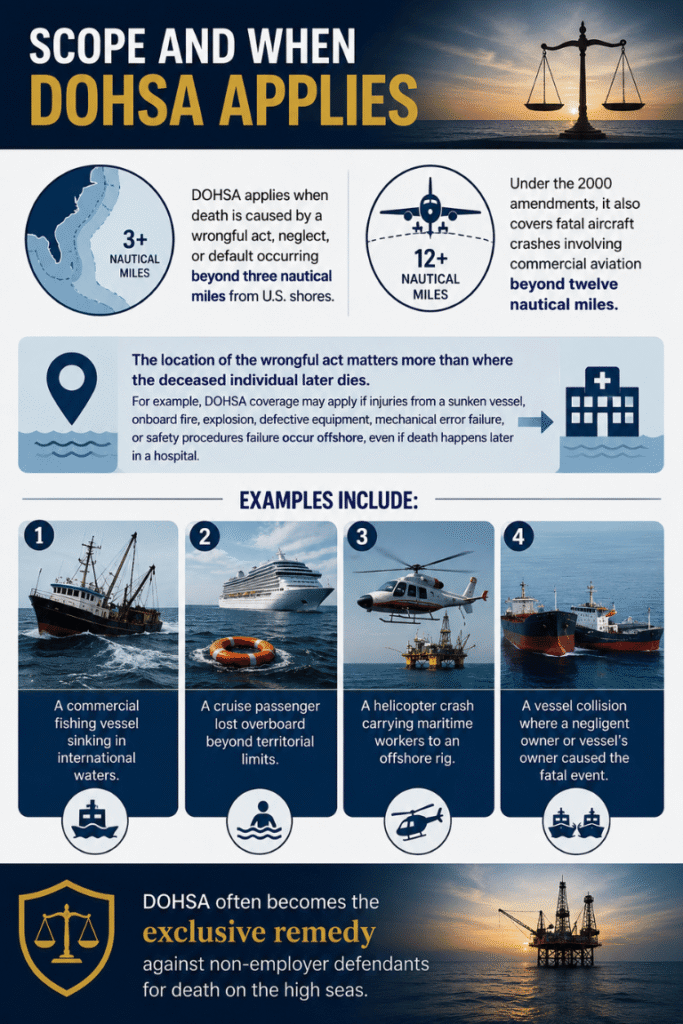
DOHSA applies when death is caused by a wrongful act, neglect, or default occurring beyond three nautical miles from U.S. shores. Under the 2000 amendments, it also covers fatal aircraft crashes involving commercial aviation beyond twelve nautical miles.
The location of the wrongful act matters more than where the deceased individual later dies. For example, DOHSA coverage may apply if injuries from a sunken vessel onboard fire, explosion defective equipment, mechanical error failure, or safety procedures failure occur offshore, even if death happens later in a hospital.
Examples include:
-
1. A commercial fishing vessel sinking in international waters.
-
2. A cruise passenger lost overboard beyond territorial limits.
-
3. A helicopter crash carrying maritime workers to an offshore rig.
-
4. A vessel collision where a negligent owner or vessel’s owner caused the fatal event.
DOHSA often becomes the exclusive remedy against non-employer defendants for death on the high seas.
Who Can Bring a DOHSA Claim?
A dohsa compensation claim is filed by the decedent’s personal representative for qualified beneficiaries. DOHSA allows the decedent’s spouse, parent, child, or dependent relative to recover for pecuniary losses sustained due to the death, but does not permit recovery for non-pecuniary damages such as pain and suffering.
A dependent parent, other dependent relative, spouse, or child may receive financial proceeds, but the decedent’s estate usually plays the procedural role. One dohsa suit is typically filed, and recovery is allocated based on dependency, financial support, and other financial costs caused by the death.
Unlike Jones Act claims, DOHSA does not require the person to be a seaman. Passengers, contractors, and other maritime workers can qualify if dohsa applies.
Damages Under DOHSA: Focus on Pecuniary Loss:
Under the Death on the High Seas Act (DOHSA), eligible family members can only recover for pecuniary losses, which are financial losses that can be calculated with precision, such as lost wages and funeral expenses. Pecuniary damages may include future lost earnings, household services, funeral costs, funeral expenses loss, and some medical expenses.
Damages under DOHSA are typically calculated based on the financial benefits that the beneficiaries might have reasonably expected to receive from the decedent had their life not been terminated, considering factors like age and earning potential. Economists often assist with calculating lost wages, benefits, and financial support counseling needs.
Non-Pecuniary Damages and the Aviation Exception:
DOHSA does not allow for recovery of non-pecuniary damages, such as pain and suffering or loss of companionship, which are often significant in other wrongful death claims. Standard maritime DOHSA cases also bar non economic damages, suffering damages, and punitive damages; the Supreme Court confirmed this limit in Mobil Oil Corp. v. Higginbotham.
The 2000 amendments to DOHSA allow claimants in commercial aviation cases to recover non-pecuniary damages for loss of care, comfort, and companionship, although pre-death pain and suffering remains non-recoverable. This exception does not let maritime claimants recover non pecuniary damages, which remains controversial.
Decedent’s Contributory Negligence and Comparative Fault:
If the deceased was partly at fault for the incident leading to their death, contributory negligence can reduce the financial remedy awarded to the family under DOHSA. The defendant must prove decedent’s contributory negligence and show that it helped cause the death.
Examples include failure to wear a life jacket, intoxication, ignoring warnings, or follow safety procedures failure. Careful examination of physical evidence, toxicology, witness accounts, and training records can reduce unfair blame.
Proving Negligence and Causation Under the High Seas Act:
A successful claim must show a wrongful act, neglect, default, unseaworthiness, or employers negligence caused death. Evidence may include maintenance logs, voyage data, weather records, crew training files, CCTV, expert reports, and proof of appropriate medical care incompetence or medical care incompetence after rescue.
Liability may involve owners, operators, manufacturers, charterers, or foreign entities. DOHSA allows for claims under the laws of a foreign country alongside or instead of DOHSA claims, provided that the foreign law provides a cause of action for wrongful death on the high seas.
Interaction with Jones Act, State Law, and DOHSA Preemption:
DOHSA preempts state laws and general maritime law claims, meaning that if DOHSA applies, it is generally the exclusive remedy available for wrongful death claims on the high seas. While DOHSA preempts state laws, it does not preempt Jones Act claims against a deceased seaman’s employer, allowing for broader remedies under the Jones Act.
Claimants may assert claims under both DOHSA and the Jones Act if both the decedent’s employer and another third party were at fault for the death, allowing for potential recovery under both legal frameworks. Some interpretations of DOHSA suggest that claimants may pursue broader state law wrongful death claims against negligent parties responsible for shoreside events that contributed to a death occurring on the high seas.
Statute of Limitations, Procedure, and Case Timeline:
The statute of limitations for filing a DOHSA claim is generally three years, but it is advisable to file as early as possible due to the complexity of these cases. The case usually involves appointing a personal representative, filing a civil action in federal court, discovery, mediation, and trial if no settlement occurs.
Many dohsa claims resolve in 12–36 months, but complex aviation, offshore, or multinational matters can take longer.
How an Attorney Assists in a DOHSA Case:

A lawyer helps preserve evidence, identify every defendant, calculate pecuniary losses, and protect legal remedy rights before insurers push for a quick release. Counsel also understands dohsa law, dohsa regulations, personnel dohsa statute questions, and how to seek compensation without losing stronger claims.
This matters in lawsuits filed after aircraft accidents, rig disasters, cruise incidents, and fatal aircraft crashes where the statute covers fatal aircraft crashes differently than maritime losses.
Conclusion:
DOHSA is a crucial but narrow remedy for wrongful death on the high seas. It can help families recover financial costs caused by an offshore death, but its limits on non-pecuniary recovery make early strategy important.
The right path depends on location, defendants, employment status, and whether the Jones Act, state law, foreign law, or DOHSA controls. If your family is facing an offshore loss, speak with experienced maritime counsel promptly to protect evidence, preserve deadlines, and pursue the available recovery under the high seas act.
Related: Offshore Death
FAQ
Frequently Asked Questions

Yes. Family members may file under DOHSA, and sometimes the Jones Act, if negligence caused an offshore death.
A case usually qualifies when a wrongful act causing death occurs beyond three nautical miles from shore, or twelve for commercial aviation.
Yes. Seamen may have Jones Act claims against employers while DOHSA governs third-party claims.
Negligence is proven with records, witnesses, experts, safety manuals, and evidence that reasonable maritime safety standards were not followed.
Yes. Bad weather does not block liability if negligent routing, preparation, or rescue decisions caused the death.
The family can still pursue a dohsa suit, and fault will be decided through evidence under maritime law.
The family can still pursue a dohsa suit, and fault will be decided through evidence under maritime law.
The family can still pursue a dohsa suit, and fault will be decided through evidence under maritime law.
The family can still pursue a dohsa suit, and fault will be decided through evidence under maritime law.
The family can still pursue a dohsa suit, and fault will be decided through evidence under maritime law.