Key Takeaways:
-
Foreign seamen—Filipino engine room workers, Brazilian waiters, Ukrainian deck officers, and Indonesian housekeepers—form the backbone of international shipping. These maritime workers are typically hired abroad through crewing agencies in Manila, Mumbai, or Eastern Europe, signing employment contracts that will govern their rights for years at sea.
-
After the 1990s expansion of international cruise and offshore energy fleets, shipowners began routinely inserting arbitration clauses into these contracts. These provisions require disputes—including personal injury claims, wage disputes, and wrongful death actions—to be resolved in foreign forums like Manila, London, or Nassau under foreign law rather than in U.S. district court proceedings.
-
Foreign seamen injured on vessels calling at U.S. ports between 2000 and 2026 have frequently faced a defendant's motion to compel arbitration under the New York Convention, which can push their cases out of American courts entirely.
This creates a fundamental tension between the Federal Arbitration Act’s seaman exemption, the Jones Act’s negligence protections, and international treaty obligations favoring foreign arbitral awards.
This article examines how U.S. courts have treated the foreign seaman’s arbitration clause, common law rights, and choice of law issues—particularly in circuits like the Fifth and Eleventh Circuit that handle substantial cruise ship and offshore energy litigation.
Foreign Seaman and Common Law Rights in Arbitration With Seamen’s Employment Contracts:
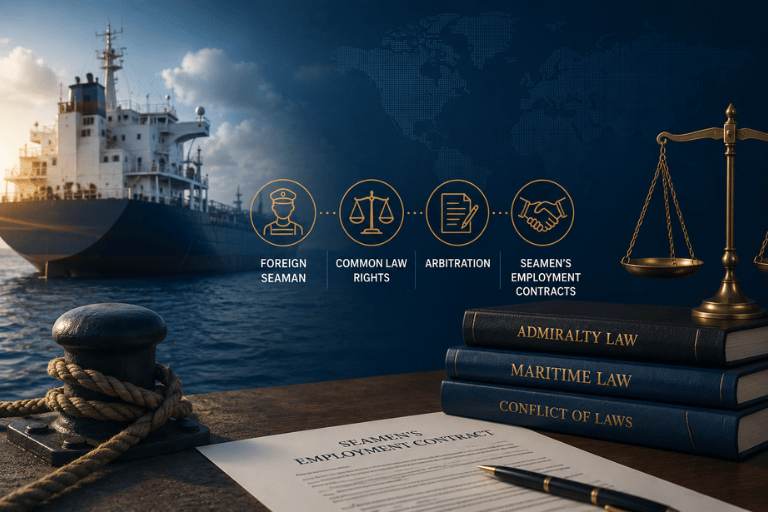
An arbitration clause in a maritime employment contract is a provision requiring that disputes be resolved through private arbitration rather than court litigation. These clauses typically appear in the “Standard Terms and Conditions” that seamen sign at hiring offices in Manila, Mumbai, or Odessa—often without meaningful opportunity to negotiate.
Many foreign seaman’s contracts designate foreign law (Philippine law, Norwegian law, Bahamian law) and foreign arbitration forums for disputes involving personal injury, lost wages, and termination. A written agreement to arbitrate is required for these arbitration agreements to be enforceable, and common law and international treaties often make them more enforceable for foreign seamen than for American citizens working in U.S. territorial waters.
Consider a concrete example: A Filipino seaman injured aboard a Miami-based cruise ship may discover that his seaman’s employment contract requires arbitration in Manila under Philippine law. Despite the injury occurring in U.S. waters and the vessel owner maintaining headquarters in Florida, the arbitration provision contained in his contract could remove his case from federal courts entirely.
Key characteristics of these clauses:
-
Cover Jones Act negligence claims, unseaworthiness, and maintenance and cure claims.
-
Designate a foreign forum (often the seaman’s nationality jurisdiction).
-
Specify foreign law governing the dispute.
-
Remove the right to a jury trial available in American court proceedings.
-
The New York Convention treats these as “commercial” contracts, allowing shipowners to seek enforcement in U.S. courts.
The Federal Arbitration Act, New York Convention, and the Seamen’s Exemption:
The Federal Arbitration Act, enacted in 1925, established a strong presumption favoring enforcement of written arbitration agreements in matters affecting foreign or interstate commerce. The FAA generally requires trial courts to enforce arbitration provisions in maritime contracts.
However, Section 1 of the FAA contains a critical carve-out: it expressly excludes “contracts of employment of seamen, railroad employees, or any other class of workers engaged in foreign or interstate commerce” from mandatory arbitration. The U.S. Supreme Court has ruled that seafarers are “wards of admiralty,” emphasizing the need for special protections due to the unique hazards they face at sea. This exemption reflects centuries of admiralty tradition treating seamen as deserving special solicitude.
Despite this exemption, courts began using the New York Convention (implemented through Chapter 2 of the FAA) to enforce foreign arbitration clauses in crew contracts starting in the 1980s and 1990s:
-
In Bautista v. Star Cruises, the Eleventh Circuit ruled that foreign seamen’s contracts are subject to arbitration under the Convention on the Recognition and Enforcement of Foreign Arbitral Awards, provided the agreements meet certain criteria.
-
Arbitration clauses in employment agreements for American seamen working in U.S. waters are generally disfavored and likely to be deemed invalid, especially if the seaman and employer are both American.
-
Cases from the Fifth Circuit and Eleventh Circuit have held that foreign seamen’s employment contracts can be treated as “commercial” relationships under the York Convention, allowing enforcement of foreign arbitration for injuries and maintenance and cure claims.
The core conflict remains unresolved: whether the combination of the FAA and New York Convention can override U.S. statutory protections like the Jones Act and general maritime law remedies when arbitration clauses require application of foreign law.
Common Law and Jones Act Rights of Foreign Seamen:
Jones Act status does not depend on the seaman’s nationality. To qualify as a Jones Act seaman, an employee must satisfy a two-part test established by the U.S. Supreme Court, which does not require U.S. citizenship or residency:
- Contribution to vessel function: The worker must contribute to the essential function of the vessel or fleet
- Substantial connection: The worker must have a substantial connection to a vessel or fleet (typically 30% or more of work time)
The Jones Act provides some of the most robust protections for maritime workers, often superior to those of foreign counterparts and U.S. land-based workers under standard worker’s compensation systems. Seamen are considered a protected class under the General Maritime Law of the United States, which affords them special protections and general deference under the law.
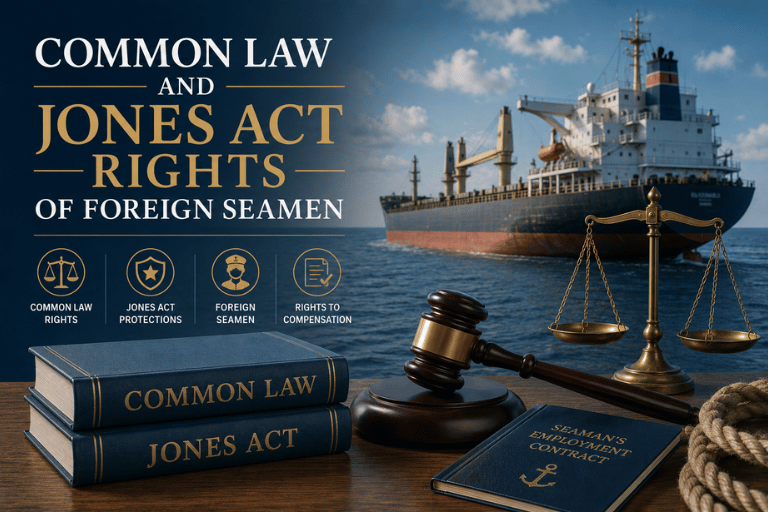
Even foreign seamen may have U.S. common law and statutory rights when the subject vessel or employer has significant U.S. contacts. When a foreign seaman is employed by a United States company, U.S. legal policies and public interests may protect the seafarer, even if the employment contract specifies foreign law or forum:
Right | Description | Availability to Foreign Seamen |
Jones Act Negligence | Sue employer for negligence causing injury | If substantial U.S. connection exists |
Unseaworthiness | Strict liability for unfit vessel conditions | Retained under general maritime law |
Maintenance and Cure | Medical care and living expenses during recovery | Available regardless of fault |
Wage Claims | Protection under Seaman’s Wage Act | If certain U.S. connections exist |
Foreign seamen may still argue employer negligence under the Jones Act if the ship has a substantial connection to the U.S. A Filipino engine room worker on a Florida-based cruise ship or a Honduran waiter serving U.S. passengers could both potentially assert Jones Act claim rights despite their foreign nationality and contracts.
Choice of Law and the Lauritzen–Rhoditis Framework:
Determining which country’s laws apply to an injury claim for foreign seamen is often a complex legal battle known as “choice-of-law” analysis, which is frequently contested in U.S. courts. Courts apply the framework from Lauritzen v. Larsen (1953) and Hellenic Lines v. Rhoditis (1970) to determine whether United States law applies.
Key factors in plain language:
-
Flag of the vessel.
-
Place where the wrongful act or injury occurred.
-
Seaman’s nationality.
-
Place where the employment contract was executed.
-
Allegiance or base of operations of the shipowner (often referred to as the shipowner's base).
-
Where the business is actually run from.
U.S. courts have increasingly focused on the “base of operations” of a shipping company to determine if U.S. law applies to a foreign seaman’s case, regardless of the vessel’s flag. The “shipowner’s base” factor often tips the scale when the employer’s real economic center is in the United States.
Example: A Greek seaman working on a Bahamas-flagged cruise ship could still obtain Jones Act protections if the vessel owner maintains headquarters in Miami, manages operations from Florida, collects revenue primarily from U.S. passengers, and the injury occurred during a voyage departing from a U.S. port. Despite the foreign flag and employment agreement specifying Bahamian law, the strong U.S. base of operations creates a significant factor supporting application of U.S. maritime law.
How Arbitration Clauses Can Limit or Waive Foreign Seamen’s Rights:
Arbitration clauses, especially those with foreign choice-of-law provisions, can substantially reduce or eliminate rights that foreign seamen would otherwise have under U.S. common law and statutes. Mandatory arbitration clauses often force foreign seamen to arbitrate in their home country or the ship’s flag state, removing the U.S. jury trial option entirely.
How arbitration changes the process:
-
No jury trial: Private arbitrators, not juries, decide the case.
-
Limited discovery: Far fewer tools to investigate employer conduct.
-
Private hearings: No public accountability for maritime employers.
-
Very limited appeal rights: Unlike district court decisions, arbitration awards face minimal judicial review.
-
Different substantive law: Foreign law may not recognize Jones Act negligence or full maintenance and cure claim remedies.
Arbitration under foreign law (Norwegian law, Panamanian law, Philippine law) may not recognize Jones Act negligence, unseaworthiness, or full maintenance and cure remedies—reducing compensation compared to U.S. maritime law. For practical purposes, a seaman injured aboard a vessel calling at U.S. ports may receive dramatically lower compensation in foreign arbitration than in an American court applying maritime law.
However, employers cannot simply contract away their legal liability for negligence under the prevailing maritime law. The Eleventh Circuit has ruled that arbitration provisions in seafarers’ contracts that designate foreign law as the governing law are unenforceable as they violate U.S. public policy, particularly when they deprive seamen of their statutory rights under U.S. law.
Courts examine whether the practical effect of a foreign arbitration clause is to deprive an injured seaman of all meaningful Jones Act or wage remedies. Where that is the case, the clause may be struck down.
Base of Operations and the Reach of U.S. Maritime Law Despite Arbitration:
Even when an employment contract points to arbitration abroad, courts still examine the shipowner’s real base of operations to decide what law applies and whether enforcing the arbitration clause would violate public policy.
A company with these characteristics is likely to have a U.S. base of operations:
-
Headquartered and managed in the United States.
-
Handles crewing, scheduling, and payroll from U.S. offices.
-
Collects revenue primarily from U.S. passengers or U.S. operations.
-
Maintains significant assets in U.S. ports.
Example: A Caribbean cruise line flying a Bahamian flag but controlled from Miami—with management, payroll, marketing, and revenue collection all centered in Florida—has a U.S. base of operations despite the foreign flag. Courts applying this legal doctrine have protected foreign seamen’s Jones Act and maintenance and cure rights even when contracts specified foreign arbitration, because the sufficient interest and connections to the United States override contractual forum designations.
Norwegian Cruise Line, Carnival Cruise Line, and similar major cruise operators with U.S. headquarters face heightened scrutiny when attempting to enforce foreign arbitration clauses against injured foreign seamen. The base of operations analysis can keep U.S. law relevant despite what the contract says.
Enforceability and Challenges to Foreign Arbitration Clauses:
Arbitration clauses are contractual and not automatically enforceable. Courts can refuse enforcement if clauses are unconscionable or violate strong public policy protecting seamen. Arbitration agreements involving foreign seamen must meet certain common law and contractual standards to be valid.
Typical arguments used to challenge arbitration clauses:
-
Inconsistency with the Jones Act: The clause attempts to waive statutory negligence rights.
-
Deprivation of maintenance and cure remedies: Essential benefits cannot be eliminated by contract.
-
Foreign choice of law eliminating statutory rights: Applying foreign law would strip all meaningful remedies.
-
Procedural unconscionability: Signing under pressure, without translation, or in a hospital.
-
Substantive unconscionability: One-sided terms imposing harsh limits on damages.
Important distinctions between tools shipowners use:
Mechanism | What It Does | Key Difference |
Arbitration Clause | Binding private adjudication | No jury, limited appeal, private |
Forum-Selection Clause | Specifies mandatory court location | Preserves jury trial and appeal rights |
Forum Non Conveniens | Discretionary dismissal to another forum | Judge weighs convenience factors |
Circuits like the Eleventh Circuit and the Southern District of Florida have a substantial body of maritime cases involving cruise ships and bulk carriers where courts have struck down foreign law arbitration clauses that waive U.S. statutory protections for injuries sustained at sea.
Unconscionability and Post-Injury Arbitration Agreements:
Unconscionability includes both procedural unfairness and substantive unfairness:
Procedural unconscionability factors:
-
Pressure to sign immediately after injury.
-
Lack of translation into seaman’s native language.
-
Signing while hospitalized or under medical treatment.
-
No opportunity to consult with a law firm or insurance company representative.
Substantive unconscionability factors:
-
One-sided terms favoring only the vessel owner.
-
Harsh limits on damages or complete elimination of maintenance and cure.
-
Requirement to arbitrate in a distant foreign forum at seaman’s expense.
Post-injury arbitration agreements for seamen can be enforceable if they do not violate the FAA and do not infringe upon the seaman’s rights under the Jones Act, as established in the Fifth Circuit’s ruling in Terrebonne v. K-Sea Transportation Corp. That court upheld a post-injury agreement where the seaman received meaningful consideration (like advances on maintenance and cure) and the agreement was properly explained—but preserved the seaman’s underlying statutory rights.
Example: A seaman who signs an arbitration agreement after a 2022 offshore injury in the Gulf of Mexico while still under medical treatment may have grounds to challenge enforcement if the agreement was presented without translation, signed under pressure from a foreign corporation’s representatives, and offered nothing meaningful in return.
Despite arbitration, foreign seamen retain certain rights under U.S. general maritime law and sometimes the Jones Act. Foreign seamen in arbitration cases typically retain core substantive protections under common law and general maritime law—the question is whether those rights can be effectively vindicated in the designated forum.
Practical Steps for Foreign Seamen Injured at Sea:
Decisions made in the days and weeks after an offshore injury can determine whether a foreign seaman keeps or loses important legal rights. Acting quickly is essential.
Immediate steps after injury:
- Seek immediate medical care and insist on an accurate, detailed official accident report documenting how the injury occurred
- Keep copies of all documents:
- Employment contract and any arbitration provision
- Documents signed after injury
- Medical records and treatment notes
- Communications with employer about wages and maintenance and cure
- Do not sign new contracts, releases, or post-injury arbitration agreements without independent legal advice—even if pressured by company representatives promising repatriation or continued maintenance and cure payments
- Document everything:
- Wages earned and time aboard the subject vessel
- Promises made about provide maintenance and medical care
- Names of witnesses to the injury
Contact a U.S. maritime attorney familiar with the Jones Act, the Federal Arbitration Act, and international maritime employment contracts immediately—especially before returning home
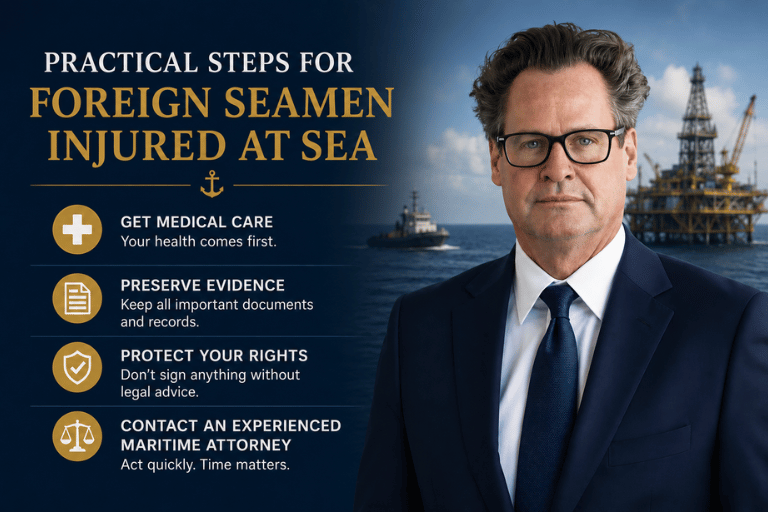
Foreign seamen have the right to seek U.S. legal counsel to evaluate jurisdiction despite arbitration clauses. Early legal review can identify arguments based on choice of law, base of operations, and public policy that may keep a case in American court rather than forcing it into foreign arbitration.
In cases where a seaman is injured, they have the right to seek maintenance and cure benefits, which are essential for medical expenses and living costs while recovering from injuries sustained at sea. An experienced maritime attorney can help ensure these rights are preserved.
Conclusion: Protecting Common Law Rights in a World of Mandatory Arbitration:
While arbitration clauses and the New York Convention give shipowners powerful tools to move cases out of U.S. courts, foreign seamen still have significant protections under U.S. maritime law, the Jones Act, and common law principles. Seamen are considered a protected class under U.S. maritime law, which provides them with special legal rights and protections, including the right to sue for negligence and unseaworthiness under the Jones Act.
Key factors that can preserve access to U.S. courts and full remedies:
-
Seaman status under the Supreme Court’s two-part test (regardless of nationality).
-
Base of operations analysis examining where the employer actually runs its business.
-
Choice of law factors weighing U.S. connections against foreign elements.
-
Public policy limits prevent complete waiver of statutory rights like maintenance and cure.
Foreign seamen retain the right to pursue claims under the doctrine of unseaworthiness, holding vessel owners liable for injuries caused by unfit vessels. These core substantive protections remain available even when arbitration is compelled.
Every case is fact-specific: the language of the arbitration clause, the vessel’s flag, the employer’s base of operations, and the seaman’s work history all matter. A rising star in maritime litigation may involve novel arguments about these factors that could reshape the legal doctrine in this area.
Foreign seamen and injured seamen should seek prompt legal advice before agreeing to arbitration or accepting settlements. Consulting with a U.S. maritime attorney to evaluate the enforceability of arbitration clauses in their contracts—and to understand whether common law and statutory rights can be preserved—is the essential first step in protecting rights that may otherwise be lost to foreign arbitration.