Key Takeaways:
-
US oil rig accidents have caused mass casualties, environmental harm, and sweeping offshore drilling reforms over decades.
-
The Deepwater Horizon explosion in the Gulf of Mexico remains the most devastating US offshore drilling disaster ever recorded.
-
Several incidents, including Lake Peigneur and Vermilion Block 380, involved natural gas leaks and blowouts rather than crude oil spills.
-
Many victims and families sought compensation through maritime law, the Jones Act, and related offshore injury claims.
Offshore oil rigs are massive engineering structures designed to extract hydrocarbons from reservoirs thousands of feet beneath the ocean floor. Offshore workers in the oil and gas industry face unique hazards daily—high-pressure wells exceeding 15,000 psi, volatile natural gas compositions, and remote locations often 100 miles offshore where rescue times stretch to hours amid unpredictable weather.
Offshore drilling has been shaped by catastrophic failures that triggered radical shifts in federal oversight and industry standards. In 1969, an oil production platform experienced a blowout off the coast of Santa Barbara, releasing over four million gallons of oil into the ocean. This incident led to significant environmental harm and contributed to the establishment of the Environmental Protection Agency and the Clean Water Act. The National Environmental Policy Act was directly inspired by a major oil spill that galvanized the modern environmental movement.
Blowouts, explosions, and fires remain common causes of deadly oil rig disasters. Accidents in the oil industry have historically reshaped safety regulations, leading to a shift from simple checklists to comprehensive Safety Management Systems. The industry has moved toward “Safety Case” regulations requiring operators to identify hazards and prove they have mitigation measures in place. For context, the Piper Alpha disaster on July 6, 1988, in the North Sea is the deadliest offshore oil disaster in history, claiming 167 lives.
This article covers 10 of the worst offshore accidents based on loss of life, serious injuries, and legal consequences. Understanding these events helps improve safety standards and informs injured workers about their legal options.
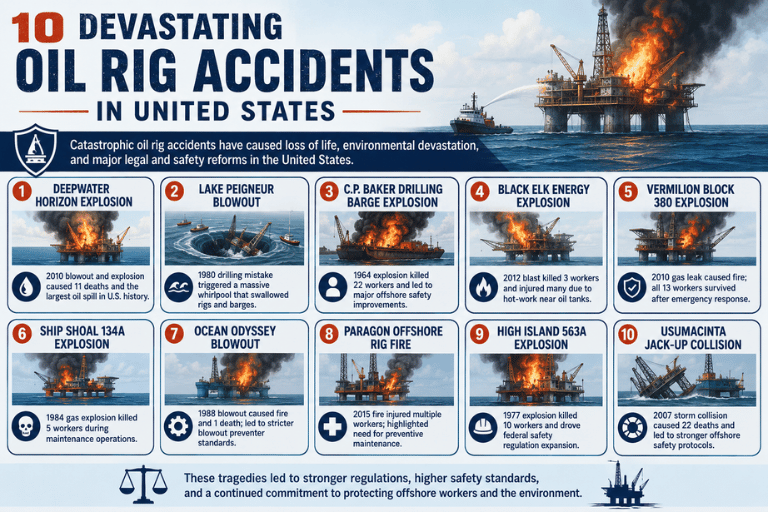
10 Devastating Oil Rig Accidents in United States
1. Deepwater Horizon Explosion:
On April 20, 2010, the Transocean-owned Deepwater Horizon drilling rig suffered a catastrophic blowout while drilling the Macondo well about 41 miles off Louisiana in the Gulf of Mexico. High-pressure hydrocarbons escaped when cement plugs failed to isolate the well, permitting a methane-rich gas influx that overwhelmed the blowout preventer. The massive explosion and resulting fire engulfed the rig, which capsized and sank two days later.
The Deepwater Horizon disaster resulted in the largest oil spill in US history, with an estimated 4 million barrels of oil released into the Gulf of Mexico over 87 days, causing extensive environmental damage. In the aftermath, BP faced record-setting settlements and fines, marking some of the largest environmental penalties ever imposed in the United States. Improved testing and verification procedures for well cement jobs are now recognized as essential to prevent gas from migrating into the wellbore. The disaster occurred when oil began flowing uncontrollably from the ocean floor, devastating 1,100 miles of Louisiana marsh and killing hundreds of thousands of birds.
Deepwater Horizon Explosion Injuries & Fatalities:
The Deepwater Horizon explosion on April 20, 2010, resulted in 11 fatalities. Out of 126 crew members aboard, 17 suffered serious injuries including severe burns, blast trauma, and smoke inhalation. The chaotic nighttime evacuation saw 99 survivors escape via lifeboats amid 80-foot waves. Many injured crew members later pursued Jones Act and general maritime law claims for medical expenses and lost earnings, with psychological trauma including PTSD affecting 30% of responders.
Legal Consequences of the Deepwater Horizon Explosion:
Federal investigations found BP grossly negligent under the Clean Water Act. Following the Deepwater Horizon explosion, BP agreed to pay over $20 billion in fines and settlements, marking the largest environmental penalty in US history. Criminal charges resulted in BP’s $4 billion felony fine, while Transocean paid $1 billion and Halliburton $1.2 billion.
The Bureau of Safety and Environmental Enforcement was created to separate safety oversight from leasing revenue and mandated stricter blowout preventer inspections. The establishment of BSEE replaced the old Minerals Management Service to provide stricter oversight of offshore operations. Following the Deepwater Horizon explosion in 2010, new safety regulations were implemented, including stricter blowout preventer standards and improved emergency response protocols.
2. Lake Peigneur Blowout:
On November 20, 1980, a Texaco-contracted drilling rig operating under Lake Peigneur in Louisiana accidentally punctured the roof of an active salt mine. The mistake triggered a massive whirlpool that swallowed the drilling rig, eleven barges, trees, and large sections of shoreline. The Delcambre Canal temporarily reversed flow as Gulf water rushed into the collapsing lake and mine caverns, creating one of the most visually catastrophic disasters in US drilling history.
This incident occurred during exploratory gas drilling rather than crude oil extraction. The lake’s depth changed from 3 feet to over 1,300 feet in places, and salinity tripled, devastating freshwater fisheries.
Lake Peigneur Blowout Injuries & Fatalities:
The Lake Peigneur blowout on November 20, 1980, created a massive whirlpool that swallowed a drilling rig and eleven barges, but remarkably, all 55 workers escaped unharmed. All 50 underground miners also surfaced safely via elevators. Quick evacuation and alarms allowed offshore workers and miners to flee as the sinkhole expanded, with only minor injuries and emotional trauma reported.
Legal Consequences of the Lake Peigneur Blowout:
In the aftermath of the Lake Peigneur Blowout, Texaco settled lawsuits for approximately $32 million to cover damages, and the incident led to regulatory changes for geological surveys to prevent similar accidents. Additional settlements totaling roughly $13 million went to fishermen and landowners. The accident led to stricter subsurface mapping requirements and coordination protocols between drillers and mining operations.
3. C.P. Baker Drilling Barge Explosion (1964):
On June 30, 1964, the C.P. Baker drilling barge in the Gulf of Mexico suffered a sudden gas blowout while working a well for Pan American Petroleum about 75 miles offshore Louisiana. Natural gas and drilling mud surged onto the deck, ignited via hot manifold contact, and caused violent explosions. The barge burned and partially sank before the fire was controlled by supply boats dumping mud onto the flames.
The C.P. Baker drilling barge explosion in 1964 resulted in 22 deaths and was one of the earliest offshore oil rig disasters, leading to significant changes in safety regulations. The event exposed the dangers of uncontrolled gas flows and inadequate blowout preventer systems common at the time.
C.P. Baker Drilling Barge Explosion Injuries & Fatalities:
Twenty-two workers were killed, making this one of the deadliest US offshore incidents of the 20th century. Survivors suffered severe burns, broken bones from 50-foot jumps into the Gulf, and smoke inhalation. Challenging rescue operations relied on nearby vessels and Coast Guard support in burning, oil-slicked waters.
Legal Consequences of the C.P. Baker Explosion:
Families and injured workers brought Jones Act and unseaworthiness claims against the vessel owner and operator, settling for approximately $5-10 million (equivalent to $50 million today). The C.P. Baker Drilling Barge Explosion in 1964 led to the establishment of emergency shutdown procedures and improved firefighting training across US offshore drilling operations. The disaster helped establish requirements for double ram blowout preventers and emergency disconnects.
4. Black Elk Energy Explosion (2012):
On November 16, 2012, an explosion erupted on Black Elk Energy’s West Delta 32 oil production platform about 17 miles southeast of Grand Isle, Louisiana. Workers were conducting welding and maintenance work near oil tanks still containing flammable hydrocarbons. Hot-work ignited residual waste oil and vapors, triggering a powerful blast and massive fire that caused significant damage to the platform. Five workers jumped into the water to escape the burning platform.
Black Elk Energy Explosion Injuries & Fatalities:
Three contract workers were killed and at least 11 others suffered life altering injuries, several with life-threatening burns. Victims were mostly welders and laborers employed by subcontractors. Survivors experienced long-term physical scarring, chronic pain, and psychological trauma, with many facing extensive medical bills.
Legal Consequences of the Black Elk Energy Explosion:
The Black Elk Energy Explosion led to criminal charges against the company for violating federal safety regulations, resulting in a fine of $4.2 million and highlighting the accountability of offshore contractors under US maritime law. Civil lawsuits under the Jones Act sought compensation for wrongful death and serious injury. BSEE strengthened enforcement of hot-work permits and contractor oversight following this disaster.
5. Vermilion Block 380 Explosion (2010):
On September 2, 2010, a Mariner Energy production platform on Vermilion Block 380 in the Gulf of Mexico caught fire after a gas leak. The disaster occurred during maintenance when gas escaped from piping and ignited, engulfing the structure in flames visible 20 miles away. Located about 100 miles offshore Louisiana, the platform was not actively producing oil when the explosion occurred. The incident intensified public concern following the Deepwater Horizon oil spill just months earlier.
Vermilion Block 380 Explosion Injuries & Fatalities:
All 13 offshore workers on the platform were rescued alive after jumping into the Gulf and awaiting Coast Guard helicopters and support vessels. Several workers suffered non-fatal injuries including smoke inhalation and minor burns. Effective emergency drills and quick action by trained crew members prevented fatalities.
Legal Consequences of the Vermilion Block 380 Explosion:
Initial reports found no large-scale pollution similar to the Deepwater Horizon oil spill. BSEE issued recommendations for improved gas detection and fire suppression on production platforms. Injured workers used maritime law to pursue compensation, though fewer high-profile lawsuits followed compared to other disasters.
6. Ship Shoal 134A Explosion (1984):
On February 21, 1984, a Forest Oil Corporation platform on Ship Shoal Block 134A off Louisiana experienced a gas-fueled explosion and fire. The blast occurred during maintenance work where natural gas containing H2S had accumulated in work areas. Fire broke out and engulfed decks and living quarters, forcing some workers to flee into the water. The event became a key lesson in managing gas hazards during routine maintenance on aging oil production platforms.
Ship Shoal 134A Injuries & Fatalities:
Five workers were killed and three were injured in the explosion and fire. Injuries included severe burns and trauma from falls. The tragedy emphasized the lethal risk of undetected gas pockets around hot-work and electrical equipment where crew members operate heavy machinery.
Legal Consequences of the Ship Shoal 134A Explosion:
The Ship Shoal 134A Explosion in 1984 resulted in the creation of a hot-work permit system, which requires pre-authorization and gas testing during welding or cutting operations offshore. These permit systems became standard across US offshore drilling and influenced international best practices, reducing similar incidents significantly.
7. Ocean Odyssey Blowout (1988):
In 1988, the Ocean Odyssey semi-submersible experienced a catastrophic blowout while drilling under contract for Atlantic Richfield in the North Sea. Failure of blowout preventer components allowed uncontrolled gas to reach the surface and ignite. The intense fire damaged the rig significantly, forcing crew abandonment by helicopter and lifeboats.
Blowout preventers require more rigorous testing and redundant systems to function properly as the final line of defense against well surges. The incident highlighted vulnerabilities in control systems for deep, high-pressure wells similar to those drilled by US operators.
Ocean Odyssey Injuries & Fatalities:
One worker was killed and several others suffered injuries during the explosion and emergency evacuation. Most crew members survived thanks to rapid evacuation procedures and available rescue craft. Long-term physical and emotional impacts affected the surviving crew.
Legal Consequences of the Ocean Odyssey Blowout:
Investigations prompted stricter blowout preventer maintenance and testing standards worldwide, including for US waters. The push for real-time well pressure monitoring emerged from this disaster. US regulators incorporated these lessons into deepwater drilling standards leading up to and following the Deepwater Horizon disaster.
8. Paragon Offshore Rig Fire (2015):
In April 2015, a Paragon Offshore jackup rig in the Gulf of Mexico experienced a fire in its drilling mud circulation systems. Overheating equipment and flammable vapors caused flames near the drilling package. Crew members executed shutdown procedures, activated fire suppression, and coordinated with nearby vessels and the Coast Guard. The fire underscored the importance of preventive maintenance and real-time monitoring in modern offshore drilling.
Paragon Offshore Rig Fire Injuries & Fatalities:
No deaths occurred, but multiple workers suffered injuries ranging from smoke inhalation to minor burns during evacuation. Quick action by trained offshore workers helped keep casualty numbers low, demonstrating the value of adequate training and life saving equipment.
Legal Consequences of the Paragon Offshore Rig Fire:
BSEE investigations criticized the rig’s maintenance documentation and inspection practices. Enforcement actions included fines related to inadequate equipment upkeep and safety system records. The case reinforced expectations for rigorous preventive maintenance and audits for all US oil rigs.
9. High Island 563A Explosion (1977):
On November 1, 1977, the High Island A-563 platform in the Gulf of Mexico suffered a catastrophic natural gas explosion during a workover operation. Gas escaped from equipment being serviced, accumulated, and ignited when a welding torch was used nearby. The major explosion destroyed much of the structure, with flames visible for miles. High Island 563A became a defining incident for early federal involvement in offshore worker safety.
High Island 563A Injuries & Fatalities:
Ten workers were killed and at least 7 were presumed dead or injured, making it one of the deadliest US offshore disasters of the 1970s. Injuries included severe burns and blast-related trauma. The profound emotional toll affected families along the Texas and Louisiana coasts.
Legal Consequences of the High Island 563A Explosion:
Litigation encouraged the federal government to expand inspections and safety rules for offshore platforms. The US Geological Survey’s offshore safety responsibilities eventually evolved into today’s BSEE regulatory framework. New requirements for gas detection, pressure control equipment, and worker training emerged following this incident.
10. Usumacinta Jack-Up Collision (2007):
On October 23, 2007, the Usumacinta jack-up rig collided with the PEMEX Kab-101 platform in the Bay of Campeche during a severe storm with extreme weather conditions. High winds caused the jack-up’s legs to strike the platform, rupturing wellheads and causing oil and natural gas leaks. Explosions and fires followed attempted shut-in operations, forcing workers to abandon structures in hazardous conditions. Multiple US contractors were involved, creating legal links to US courts.
Investigations into major oil rig accidents revealed the importance of anticipating severe weather and enhancing crew training for emergency evacuations.
Usumacinta Jack-Up Injuries & Fatalities:
Twenty-two workers died, many drowning after lifeboats capsized in rough seas or being overcome by exposure. Dozens suffered additional injuries including hypothermia and trauma from falls. Failed lifeboat launches and inadequate storm evacuation planning compounded the tragedy, highlighting equipment failures and structural failures under severe weather conditions.
Legal Consequences of the Usumacinta Jack-Up Collision:
Lawsuits were filed in US courts against American contractors despite the accident occurring in Mexican territorial waters. Legal debates over jurisdiction affected compensation available to offshore workers and families. Stricter stability requirements and improved search and rescue protocols for offshore workers were prompted by this disaster, and the incident spurred closer US-Mexico cooperation on Gulf safety practices.
Get Legal Assistance After an Oil Rig Accident:
Injured offshore workers and families of those killed may be protected by the Jones Act, general maritime law, and other federal statutes. The Oil Pollution Act of 1990 made companies legally responsible for full cleanup costs and natural resource damages. Increased legal liability for companies failing to adhere to safety protocols encourages a stronger safety culture in the oil industry.
Typical recoverable damages include medical expenses, lost wages, future earning capacity, and wrongful death benefits. Large oil and gas companies quickly deploy defense teams after disasters, making prompt legal action essential.
Jonesact.info is an important resource where offshore workers can learn about their legal rights, deadlines, and options after a serious oil rig or production platform accident. Consult an experienced maritime injury attorney using information from jonesact.info to prepare questions and understand the claims process.
Conclusion: Lessons from the Worst US Oil Rig Disasters:
These 10 worst oil rig accidents in US history reveal consistent patterns: equipment failures, human error, insufficient training, and extreme weather conditions combine into catastrophic events. Key lessons learned from oil rig accidents include better maintenance of blowout preventers, improved emergency response protocols, and stricter regulatory oversight. The Bohai 2 oil rig disaster in 1979 resulted in the capsizing of the rig due to severe weather, leading to 72 deaths and highlighting environmental risks in adverse conditions—lessons still relevant today.
From the Deepwater Horizon disaster to High Island 563A, each tragedy prompted safety reforms, yet accidents occur and serious risks remain for offshore workers in the oil and gas industry. The dual need for strict safety culture and strong legal protections for injured workers and grieving families has never been clearer.
Resources like jonesact.info and qualified maritime attorneys can help protect your rights after an offshore drilling or production accident. If you or a loved one has been affected by an oil rig explosion or incident, don’t navigate the constant threat alone—seek experienced legal guidance today.
FAQ
Frequently Asked Questions

The Deepwater Horizon explosion and oil spill in 2010 was the largest offshore oil spill in U.S. history.
11 workers were killed and 17 others were injured in the explosion.
The Deepwater Horizon oil spill occurred on April 20, 2010.
Approximately 3.19 million barrels, or nearly 134 million gallons of oil, spilled into the Gulf of Mexico.
The spill lasted 87 days and was finally capped on July 15, 2010.
The rig was owned by Transocean and operated under contract with BP.
BP paid a total of $20.8 billion in settlements and penalties, the largest environmental damage settlement ever reached in U.S. history.
The explosion was primarily caused by the failure of a cement barrier in the production casing string, compounded by the blowout preventer's failure to seal the well, allowing high-pressure oil and gas to escape to the surface.
The disaster occurred in the Gulf of Mexico, approximately 41 miles off the coast of Louisiana.
The 1989 Exxon Valdez tanker spill is considered the nation's second-largest oil disaster, with the 1969 Santa Barbara blowout ranking third.
The Santa Barbara oil spill occurred on January 28, 1969, releasing approximately three million gallons of oil into the Santa Barbara Channel and leaving an 800-square-mile stain on the ocean's surface.
Union Oil's Platform A experienced a well blowout while workers were drilling a fifth well, causing high-pressure oil and gas to burst through the seabed and into the ocean.
The Santa Barbara spill is widely credited with igniting the modern environmental movement, directly inspiring the creation of Earth Day, and leading Congress to pass landmark legislation including the National Environmental Policy Act and the Clean Water Act within three years.
The Exxon Valdez was an oil tanker that struck a reef off the coast of Alaska and spilled approximately 10.8 million gallons of crude oil into Prince William Sound.
The Exxon Valdez tanker spill occurred on March 24, 1989.
The deadliest offshore oil disasters include the Piper Alpha explosion in the North Sea in 1988, which killed 167 people and remains the world's deadliest offshore disaster; the Deepwater Horizon explosion in 2010, which killed 11 workers and caused the largest offshore oil spill in history; and the 1969 Santa Barbara blowout, the third-largest oil spill in U.S. history.
167 people died in the Piper Alpha disaster on July 6, 1988.
After Deepwater Horizon, the 2010 Drilling Safety Rule introduced heightened standards for well design, casing, and cementing, and new federal regulations required improved blowout preventer systems and thorough crew training. After Piper Alpha, the Cullen Inquiry's 106 recommendations completely overhauled offshore health and safety oversight in the UK, requiring operators to submit mandatory Safety Cases demonstrating control of all major accident hazards.
Yes, injured oil rig workers can file lawsuits under the Jones Act, the Longshore and Harbor Workers' Compensation Act, and general maritime law, allowing them to pursue compensation claims against operators, contractors, subcontractors, and equipment manufacturers responsible for the accident.
Major oil rig disasters cause devastating environmental damage, including the Deepwater Horizon spill which coated roughly 1,300 miles of Gulf Coast in oil, killed an estimated 800,000 birds and 65,000 turtles, and caused a 51% decline in dolphin populations in Louisiana, while the 1969 Santa Barbara spill stretched across hundreds of miles of California coastline, killing thousands of birds, fish, and marine mammals.