Key Takeaways:
-
The main cause of the Costa Concordia accident was human error after the ship deviated from its planned route.
-
Captain Francesco Schettino ordered an informal close-coastal salute near Giglio island.
-
The cruise ship struck the le scole reef after navigating too close to shore in shallow waters.
-
Disabled or ignored navigation safeguards, weak bridge communication, and delayed evacuation procedures worsened the disaster.
-
Thirty two people died, while more than 4,200 passengers and crew were rescued.
-
The Costa Concordia disaster forced major changes to cruise line safety rules, muster drills, and route controls.
-
Costa Crociere's chief executive said in July 2014 that removing the wreck would cost 1.5 billion euros, about $2 billion, PBS NewsHour reported.
On the night of 13 January 2012, the costa concordia was sailing through a calm Tyrrhenian sea near giglio island. The mood on board was relaxed: restaurants were open, many passengers were settling into the first evening of their cruise, and the huge ship looked like a floating resort, complete with restaurants, theaters, and four swimming pools.
Then the ship struck submerged rocks.
Within minutes, water flooded critical spaces, lights failed, and the cruise ship began to list. Passengers were first told the problem was only an electrical fault, but the situation was already far more serious. By the next morning, the concordia lay on her starboard side near isola del giglio, half-submerged and visible from the shore.
The central question is still unsettling: how could one of the most advanced modern cruise ships run aground on a known reef in good weather? The answer is not a single broken machine or a freak act of nature. It is a chain of choices involving navigation, human error, bridge discipline, company culture, and delayed emergency response.
This article explains the cause of the Costa Concordia accident in practical terms, from the fatal route deviation to the evacuation and the reforms that followed across the cruise industry.
10 Main Reasons – What Caused the Costa Concordia Accident?
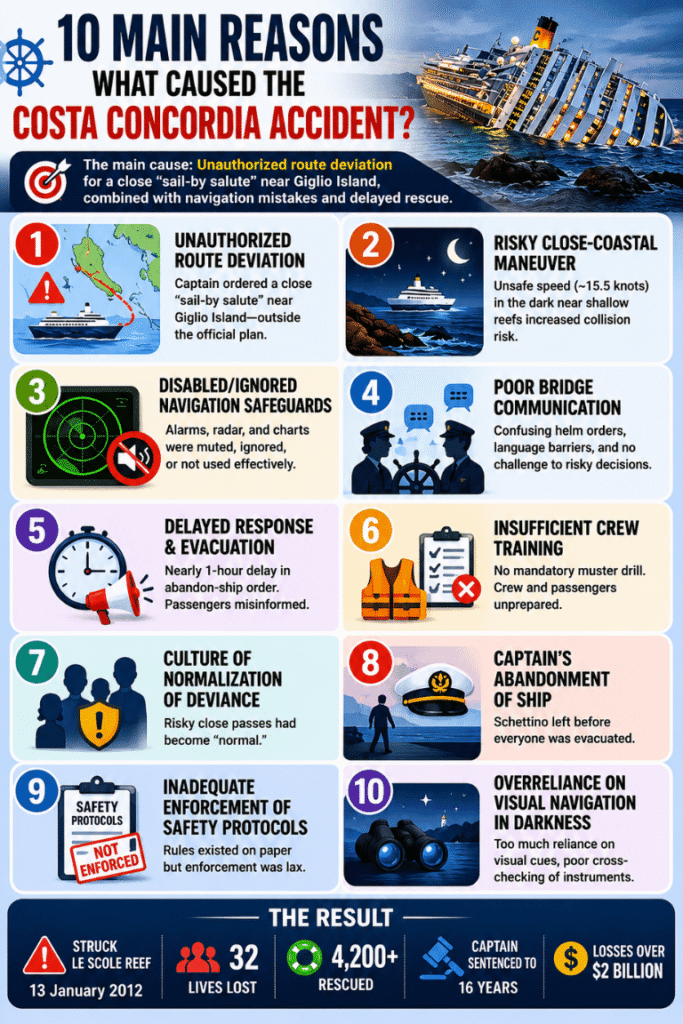
The primary cause of the incident was an unauthorized route deviation for a close “sail-by salute” near giglio island, combined with navigation mistakes and a severely delayed rescue operation process.
1. Unauthorized Route Deviation:
The primary cause of the Costa Concordia incident was an unauthorized deviation from the planned course. Captain Francesco Schettino ordered a close “sail-by salute” near Giglio Island, bringing the ship dangerously close to the shore and the submerged Le Scole reef. This maneuver was not part of the official passage plan and significantly reduced safety margins.
2. Risky Close-Coastal Maneuver:
The ship navigated at an unsafe speed of approximately 15.5 knots in dark conditions near shallow reefs. This close-coastal maneuver increased the risk of collision with underwater hazards, leaving little room for error or corrective action.
3. Disabled or Ignored Navigation Safeguards:
Despite having advanced navigation systems such as electronic charts, radar, and alarms, many safety features were muted, ignored, or inadequately used. This failure in utilizing technology effectively contributed to the bridge’s poor situational awareness.
4. Poor Bridge Communication and Resource Management:
Communication breakdowns and weak bridge resource management played a critical role. Confusion over helm orders, language barriers with the helmsman, and a lack of challenge to the captain’s risky decisions led to delayed or incorrect maneuvers.
5. Delayed Emergency Response and Evacuation:
There was a significant delay of nearly an hour between the collision and the formal abandon-ship order. Passengers were initially misinformed that the issue was an electrical fault, which slowed muster and evacuation efforts. This delay worsened the situation as the ship’s list increased and the sinking made rescue and evacuation more difficult.
6. Insufficient Crew Training and Preparedness:
Many crew members were not adequately trained for emergency situations. The absence of a mandatory muster drill before departure meant passengers were unfamiliar with evacuation procedures, leading to confusion and chaos during the emergency.
7. Culture of Normalization of Deviance:
A systemic culture within Costa Cruises and the wider industry tolerated risky practices, such as unauthorized close passes to shore, because previous attempts had not resulted in occurrences. This normalization of deviance lowered safety standards and encouraged complacency.
8. Captain’s Abandonment of Ship:
Captain Schettino abandoned the ship before all passengers and crew had evacuated, violating maritime protocols. He was later convicted of multiple charges, including manslaughter, causing a maritime disaster, and abandoning ship, and was sentenced to 16 years in prison. His premature departure undermined leadership during the crisis and contributed to the overall chaos.
9. Inadequate Enforcement of Safety Protocols:
Although formal safety management systems existed, enforcement was lax. The failure to rigorously apply passage plans, conduct regular drills, and maintain bridge discipline allowed unsafe practices to persist unchecked.
10. Overreliance on Visual Navigation in Darkness:
The bridge team relied heavily on visual cues despite darkness and challenging coastal geography. This overreliance, combined with insufficient cross-checking of electronic navigation data, impaired hazard detection and timely response.
These causes combined to create a catastrophic chain of events that led to the grounding, flooding, and eventual capsizing of the Costa Concordia, making it one of the most significant maritime disasters in recent history.: Human Error, Risk Culture & Lasting Lessons
Background: The Costa Concordia And Her Final Voyage:
Costa Concordia was a 114,500 GT cruise ship operated by Costa cruises, also known as costa crociere, under the wider carnival corporation business group. Launched in 2005 and entering service after her maiden voyage period, she represented the scale and confidence of modern cruise ships in the early 2000s.
The ship was about 290 metres long and designed as a floating hotel. It carried thousands of maritime travelers and crew, with multiple restaurants, entertainment venues, swimming pools, cabins, and a large superstructure that made stability and rescue planning especially important in maritime emergencies.
On 13 January 2012, the ship was beginning a Mediterranean itinerary from Civitavecchia, with planned calls at ports such as Savona, Marseille, Barcelona, Palma, Cagliari, and Palermo. There were roughly 4,229 people on board, including about 3,206 passengers and 1,023 crew members from many nationalities. Later reporting, including coverage by the New York Times, focused heavily on how safety procedures and leadership failures were perceived internationally.
Close coastal “salutes” were informal sail-bys in which a cruise line vessel passed near a town or island as a spectacle. Costa Concordia had made previous close passes near giglio island in 2011, which helped create a dangerous sense that the maneuver was acceptable if handled confidently.
That confidence became one of the key weaknesses in the Concordia disaster.
The Fatal Maneuver Near Giglio Island:
On the evening of 13 January 2012, the cruise ship deviated from its normal track to perform an informal salute near giglio island. Captain Francesco Schettino ordered a closer approach than the approved safe route, reportedly to impress seafarers, crew contacts, and people ashore.
The planned closest point of approach was reduced dramatically. Instead of remaining well clear of coastal hazards, the ship moved within a few hundred metres of the rocky coast and the submerged le scole reef. At that point, the margin for error had almost disappeared.
The vessel was navigating in the dark at an unsafe speed of 15.5 knots in an area known for shallow reefs. Even a small delay in identifying the reef or turning away could become fatal at that speed.
Navigation systems should have helped. Electronic charts, radar, track monitoring, and alarms are designed to warn bridge teams when a ship leaves its safe passage plan or approaches shallow waters. Yet investigators found that warnings were muted, ignored, or not used effectively on the bridge that night.
Poor situational awareness then turned a risky maneuver into a collision. The bridge relied too much on visual navigation in darkness, overconfidence in local knowledge, and insufficient cross-checking of the ship’s position against charts and electronic systems.
Captain Francesco Schettino deviated from the planned course to perform a close pass to Giglio Island, which ultimately led to the disaster when the ship struck a submerged rock. The ship struck the reef on the port side, tearing a long gash into the hull.
Human Error And Bridge Miscommunication:
Human error in this case does not mean one simple mistake. It means a sequence of misjudgments, unclear commands, weak challenge from bridge officers, and failure to follow procedures.
As the rocks came into view, Schettino ordered a last-minute turn. Reports and investigations pointed to confusion over helm orders, including language difficulties with the Indonesian helmsman and possible delayed or incorrect rudder execution. In one critical moment, the rudder response reportedly went in the opposite direction from what was intended.
That confusion mattered because the costa concordia was already too close to the reef. At more than 15 knots, a vessel of that size cannot turn like a small boat. Seconds of delay can be enough to remove the last chance of avoiding impact.
Bridge resource management also failed. Junior officers did not effectively challenge the captain’s decision to close the coast, and the bridge team did not maintain disciplined cross-checks of radar, charts, ECDIS, and the approved passage plan.
Investigators concluded that standard operating procedures at costa cruises were not properly followed. The issue was not that the ship’s crew had no rules; it was that the rules were not enforced when authority, habit, and spectacle pushed in another direction.
From Impact To Capsize: Flooding, Delays, And Evacuation Chaos:
At around 21:45, Costa Concordia’s port side scraped across submerged rocks at le scole. The collision ripped a breach of about 53 metres, or 174 feet, along the hull.
The damage was catastrophic because multiple watertight compartments were breached. The ship was designed to survive limited flooding, but not the flooding of five adjacent compartments. Water flooded machinery spaces, power systems failed, propulsion was lost, and the engine room became part of the emergency.
The ship initially listed toward the port side, then later rolled heavily to the starboard side as flooding progressed. The captain attempted to bring the damaged vessel toward shallower water near Giglio harbour, and the ship eventually ran aground on a rocky ledge. The ship remained there on its side for months after the sinking sequence began, with flooding leading to grounding and then a partial sinking before recovery work could begin.
The evacuation process was chaotic and delayed, and Captain Schettino abandoned the ship before all seafarers were evacuated. There was a significant delay of almost an hour between the impact and the formal abandon-ship order, during which seafarers were misinformed about the situation, being told it was merely an electrical fault.
That lost time had real consequences. As the list increased, many lifeboats on the higher side became difficult or impossible to launch. Many passengers climbed across tilting decks, waited near the stern, moved along the hull, or were transferred by rescue boats. Others jumped into the sea.
The evacuation of Costa Concordia was chaotic and slow, with many crew members insufficiently trained for emergency situations, leading to confusion among passengers about assembly points and procedures. The crew included people who acted bravely, but the overall evacuation procedures were poorly coordinated.
Rescue operations involved the Italian coast guard, local ferries, small craft, helicopters, and boats from the island. The coast guard response became one of the defining images of the night, especially as officials urged Schettino to return to the ship.
In plain terms, thirty two people died. More than 4,200 passengers and crew were eventually rescued, but the evacuation revealed how quickly a modern cruise ship can become dangerous when leadership, communication, and training fail together.
Organisational And Industry Failures Behind The Disaster:
The Costa Concordia disaster was not only about one captain. Schettino made the immediate decision that put the ship in danger, but the wider system allowed that kind of risk to exist.
A culture of “normalization of deviance” contributed to the disaster, where unauthorized risks were routinely taken by captains to please passengers or cruise lines. In practice, if a risky sail-by had happened before without consequences, it became easier to treat the next one as normal.
Costa Cruises had formal safety management systems, but the disaster showed gaps between written procedures and real behavior. Passage plans, bridge discipline, emergency communication, and passenger safety drills existed on paper, yet they did not prevent a dangerous deviation from becoming a shipwreck.
Training gaps also mattered. Some crew were unfamiliar with emergency duties, muster stations, and passenger communication. A full passenger muster had not yet been completed for everyone on that voyage, which added confusion when the emergency began.
This is the point that matters for the wider cruise industry: rules are only useful when they are practiced, audited, and enforced under pressure. The concordia disaster exposed weaknesses in safety culture, not just a failure of navigation.
Legal Consequences, Salvage Operations, And Lasting Lessons:
Captain Francesco Schettino was the central figure in the Costa Concordia disaster. His decision to deviate from the planned route and perform a close coastal salute near Giglio Island directly led to the ship striking the submerged Le Scole reef. This unauthorized maneuver, combined with navigation errors and poor bridge communication, set the stage for the catastrophe. During the emergency, Schettino’s leadership faltered; he delayed issuing the abandon-ship order and ultimately abandoned the vessel before all passengers were evacuated. His actions resulted in criminal charges, including manslaughter and causing a maritime disaster, for which he was found guilty and sentenced to 16 years in prison.
Schettino’s conduct highlighted the critical role of command responsibility and the devastating consequences of human error in maritime safety.Schettino’s conduct highlighted the critical role of command responsibility and the devastating consequences of human error in maritime safety. His unauthorized route deviation and failure to manage the crisis effectively led to tragic loss of life and widespread damage.
Salvage Operations: Righting the Ship Upright:
The Costa Concordia salvage operation was one of the largest and most complex maritime recoveries ever undertaken. After months of preparation, the ship was righted upright in September 2013 through a process called parbuckling, which involved rotating the vessel from its side onto a specially constructed underwater platform. Following this, the ship was towed in July 2014 to a salvage yard in Genoa, Italy, where it was dismantled and recycled.
Environmental Impact and Precautions:
The occurrence posed significant environmental risks due to the large quantities of diesel fuel and lubricants onboard—comparable to the cargo of a small oil tanker. To mitigate potential pollution, floating oil barriers were deployed, though high winds initially caused some oil to spread into surrounding waters. Approximately 200 giant fan mussels (Pinna nobilis) were manually relocated to protect marine life during the rescue mission. The wreck’s stability was closely monitored using satellite imagery and surface instruments to prevent it from sliding into deeper waters, which could have triggered a severe environmental disaster.
Industry-Wide Safety Reforms:
The Costa Concordia disaster exposed critical gaps in cruise ship safety protocols. In response, the Cruise Lines International Association (CLIA) and international regulators mandated comprehensive audits of safety management systems, enhanced training compliance, and emergency readiness. Mandatory muster drills for all passengers prior to departure became standard worldwide, addressing the previous lack of immediate safety instruction that contributed to evacuation chaos. Stricter enforcement of approved passage plans and bans on unplanned close-coastal approaches improved navigational safety. Additionally, bridge officers now have enhanced authority to challenge unsafe decisions, fostering a culture of accountability and safety.
The Cost of the Disaster:
Financially, the disaster was the costliest marine loss for insurers up to that time, with the cost to insurers expected to exceed $1 billion, Business Insurance reported in August 2013. The Costa Concordia was covered under multiple insurance policies, including Hull and Machinery Insurance, Protection and Indemnity (P&I) Insurance, and Environmental Liability Coverage. The incident also caused significant reputational damage and business interruption costs for Costa Cruises and its parent company.
Legacy and Lessons Learned:
The Costa Concordia tragedy remains a stark reminder of how human error and organizational culture can undermine even the most advanced maritime technology. The disaster catalyzed a cultural shift in the cruise industry, emphasizing rigorous training, disciplined navigation, and emergency preparedness. It also highlighted the importance of transparent communication and decisive leadership during crises. The legacy of Costa Concordia is evident today in improved safety standards, more robust evacuation procedures, and heightened regulatory scrutiny, ensuring that such a catastrophe is less likely to recur.
Conclusion:
The cause of the Costa Concordia accident was a complex interplay of human error, risky operational decisions, and systemic safety oversights. Captain Schettino’s unauthorized close-coastal maneuver near Giglio Island led to a catastrophic hull breach, compounded by delayed evacuation and poor crisis management. The disaster exposed weaknesses in cruise industry culture and safety practices, prompting sweeping reforms in navigation protocols, emergency training, and passenger safety drills. The subsequent salvage operation to right the ship upright and tow it to a yard was unprecedented in scale and cost. Ultimately, the Costa Concordia disaster serves as a powerful lesson in the critical importance of command responsibility, safety culture, and preparedness in maritime operations, shaping the future of cruise safety worldwide.
Related: Cruise Ship Injuries
FAQ
Frequently Asked Questions
The occurrence was primarily caused by Captain Francesco Schettino's unauthorized close-coastal route deviation near Giglio Island, leading the ship to strike submerged rocks.
Thirty-two people lost their lives in the incident.
Cruise lines worldwide implemented mandatory muster drills before departure, stricter enforcement of passage plans, improved crew training, and enhanced emergency readiness audits.
The ship was righted upright using a parbuckling technique and then towed to a salvage yard in Genoa for dismantling.
The overall salvage effort was expected to cost Carnival Corp, the owner of Costa Cruises, and its insurers more than $2.14 billion, Reuters reported in July 2014.