Key Takeaways:
-
Bar Harbor voters approved cruise ship disembarkation limits of 1,000 passengers daily in early November 2022, passing the initiative by 507 votes to address pedestrian congestion and safety concerns near Acadia National Park.
-
Judge Walker's decision in May 2026 ruled the 1,000-passenger limit remains effective only during July and August, deeming it unconstitutional during shoulder seasons under the pike balancing test.
-
The First Circuit Court partially upheld Bar Harbor's cruise ship ordinance in its August 2025 circuit opinion but partially remanded the case for further fact-finding on seasonal burdens.
-
Cruise tourism numbers have dropped sharply-from roughly 182,000 cruise ship passengers in 2024 to a projected figure under 50,000 in 2026-reshaping the local economy.
-
The legal battle, which has spawned multiple lawsuits, could set precedent for how other coastal towns regulate cruise ships under the commerce clause.
Bar Harbor, Maine-a small coastal gateway where Acadia National Park sits just minutes from the downtown area-has become the center of a greatly discussed legal battle over cruise ship regulation. In November 2022, bar harbor voters approved a citizen-initiated ordinance limiting cruise ship disembarkations to 1,000 per day at town-managed piers. The move triggered lawsuits from cruise-dependent businesses and maritime groups, pushing the dispute through federal court and the first circuit court of appeals. This article covers the bar harbor cruise ship lawsuit, court decisions, impacts on cruise lines and local businesses, and what comes next after judge walker’s remand decision in May 2026.
Bar Harbor Cruise Ship Lawsuit Overview:
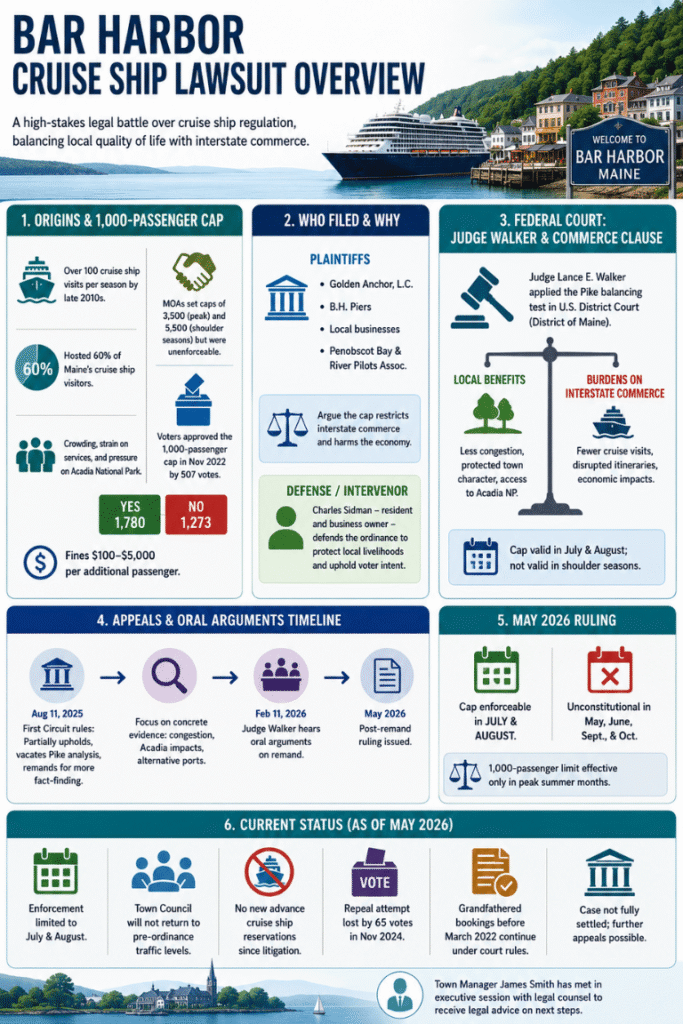
The bar harbor cruise ship lawsuit has become shorthand for the town of bar harbor’s high-stakes fight over cruise regulation. The legal battles over cruise ship regulations in Bar Harbor involve several interconnected lawsuits challenging the 2022 ordinance that limits cruise ship disembarkations to 1,000 daily. At its core, this partially remanded federal case pits local environmental and quality-of-life concerns against the interstate commerce interests of cruise lines and port service providers.
Origins of the Bar Harbor Story and the 1,000-Passenger Cap:
By the late 2010s, Bar Harbor was receiving over 100 cruise ship visits per season, with peak daily passenger counts far exceeding 1,000. Bar Harbor previously hosted 60% of Maine’s cruise ship visitors, making it one of the state’s major tourist attractions for maritime tourism. Residents voiced frustration over crowding in downtown bar harbor, strain on town services, and visitor pressure on Acadia national park.
Voluntary agreements (MOAs) with cruise lines had set caps of 3,500 during peak season and 5,500 in shoulder seasons, but these were unenforceable. Dissatisfaction led to the citizen initiative. Voters approved the disembarkation limits in November 2022 by 507 votes (approximately 1,780 yes to 1,273 no). The ordinance seeks to cap the number of cruise ship passengers allowed ashore daily, with fines of $100 to $5,000 per additional passenger.
Who Filed the Bar Harbor Cruise Ship Lawsuit and Why?
The primary lawsuit was filed in federal court by Golden Anchor, L.C., B.H. Piers, and other local businesses involved in cruise operations, alongside maritime interests including the Penobscot Bay & River Pilots Association. Plaintiffs argued that limited passenger disembarkations unlawfully restricted interstate commerce by constraining more cruise ships from calling on Bar Harbor.
Tender operators and shore service providers claimed direct economic harm from reduced cruise traffic. On the opposing side, defendant intervenor Charles Sidman-a resident and business owner-moved to protect local livelihoods by defending the ordinance, arguing voter intent and local control should prevail. Each party involved brought distinct economic and constitutional concerns to the table.
The Legal Battle in Federal Court: Judge Walker and the Commerce Clause:
The case landed before federal judge Lance E. Walker in the U.S. District Court for the District of Maine. Judge Walker applied the pike balancing test, weighing putative local benefits-reduced pedestrian congestion, protected town character, managing access to acadia national park-against burdens on interstate commerce.
Court rulings indicate a balance is needed between tourism management and economic impacts. Judge Walker initially found the cap could not constitutionally apply during shoulder seasons while viewing July and August differently, given documented congestion, public safety data, and infrastructure strain during the peak summer tourism season. Both sides filed a cross appeal, leading to the First Circuit’s involvement.
First Circuit Appeal and Oral Arguments:
The U.S. Court of Appeals ruled on August 11, 2025, in a detailed circuit opinion. Chief judge David Barron and circuit judge William Kayatta participated in the panel’s analysis. The First Circuit partially upheld judge walker’s approach but vacated the Pike analysis, requiring more refined fact-finding around seasonal harms.
The appeals court emphasized considering concrete evidence-congestion data, impacts on Acadia National Park, and availability of alternative ports. After the partial remand, the lower court scheduled additional oral arguments. Judge Lance Walker heard oral arguments on February 11, 2026, to refine the record before issuing his post-remand ruling.
The May 2026 Ruling: Seasonal Constitutionality of the Ordinance:
In May 2026, judge walker’s decision reaffirmed that bar harbor’s cruise ship cap is enforceable in July and August. A federal court ruled the 1,000-passenger cap unconstitutional during shoulder seasons-May, June, September, and October-because the burdens on interstate commerce outweigh demonstrated local benefits in those months.
The 1,000-passenger limit remains effective only during July and August, creating a seasonal framework. Proponents of the ordinance argue it preserves Bar Harbor’s quality of life during the most congested months. Some aspects remain open for further appeals, and the Town and intervenors have signaled interest in reviewing next steps, potentially seeking guidance that could reach as high as the supreme court, though no supreme court justice has weighed in to date.
Current Status of Bar Harbor’s Cruise Ship Ordinance:
As of the May 2026 ruling, Bar Harbor can enforce disembarkation limits only in July and August. The town council has committed publicly to not returning to pre-ordinance cruise traffic levels. Bar Harbor stopped accepting new advance cruise ship reservations amid ongoing litigation while designing new regulatory tools.
Notably, a repeal attempt of the ordinance lost by 65 votes in November 2024, reinforcing community support. Grandfathered bookings made before March 2022 continue under older rules but must comply with the court’s seasonal framework. The case is not fully settled-supporters are considering further appeals, and new regulations may prompt additional litigation. Town manager James Smith has participated in executive session meetings with legal counsel to receive legal advice on the town’s path forward.
Details of Bar Harbor’s Cruise Ship Ordinance:
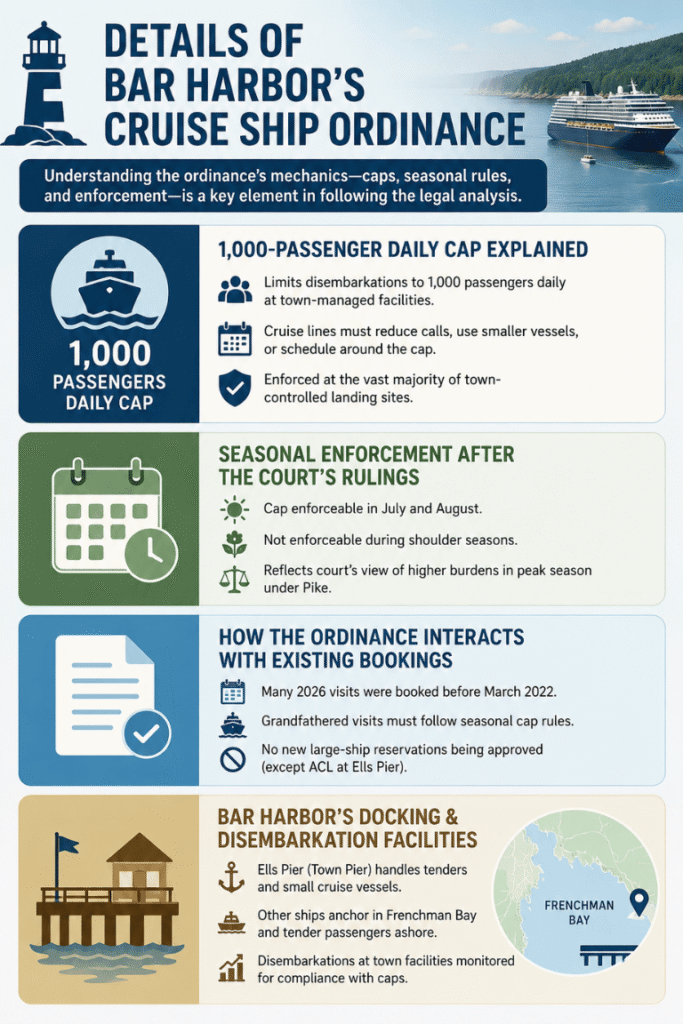
Understanding the ordinance’s mechanics-caps, seasonal rules, and enforcement-is a key element in following the legal analysis.
The 1,000-Passenger Daily Cap Explained:
The ordinance limits cruise ship disembarkations to 1,000 passengers daily at town-managed facilities, regardless of how many ships anchor. Prior to the ordinance, peak days sometimes saw over 3,000 cruise ship passengers coming ashore. Cruise lines must now reduce calls, use smaller vessels, or schedule around the cap. The cap directly reshapes how cruise itineraries are constructed, particularly for vessels carrying several thousand passengers, and is enforced at the vast majority of town-controlled landing sites.
Seasonal Enforcement After the Court’s Rulings:
Under the post-remand decision, Bar Harbor can enforce the cap in July and August but not during shoulder seasons. This reflects the court’s view that congestion and local burdens are significantly higher during peak season, justifying stronger regulation under Pike. The result is a hybrid regulatory environment-strict caps mid-summer, more flexibility for cruise ships in spring and fall, leaving each own cost of compliance to the cruise lines themselves.
How the Ordinance Interacts with Existing Cruise Ship Bookings:
Several cruise ship visits for 2026 were booked before March 2022, with many reserved on April 3, 2020. These were grandfathered under prior rules, though they must align with the seasonal cap framework. Beyond the American Cruise Lines docking agreement at Ells Pier, no new large-ship reservations are being approved. This mix of grandfathered visits and limited new bookings has substantially reduced overall cruise traffic.
Bar Harbor’s Docking and Disembarkation Facilities:
Bar Harbor operates a licensed Cruise Ship Disembarkation Facility at Ells Pier (Town Pier), handling tenders and small cruise vessels. Other ships anchor in Frenchman Bay and use cruise ship tendering to ferry passengers ashore. Disembarkation counts at these municipal facilities are monitored for compliance with caps, though the ordinance governs town-managed property rather than acadia national park lands directly.
Legal Analysis: Commerce Clause, Pike Test, and Federal Oversight:
The core legal question centers on whether Bar Harbor’s caps unlawfully burden interstate commerce under the U.S. Constitution’s commerce clause.
The Role of the Commerce Clause in Port Regulations:
The Commerce Clause gives Congress authority over interstate and foreign commerce. Under the Dormant Commerce Clause doctrine, state and local governments cannot impose laws that unduly burden national commerce. Bar Harbor’s ordinance was challenged as an overreach affecting cruise lines operating international and interstate routes.
The Pike Balancing Test and How It Applied to Bar Harbor:
The Pike test balances local benefits against burdens on commerce when a non-discriminatory law affects interstate trade. Local benefits cited included reduced congestion in the downtown area and managing visitor pressure on Acadia national park. Burdens included reduced cruise visitors, disrupted itineraries, and complications for the river pilots association and tender operators. Notably, cruise ship passengers do not contribute to parking congestion-a fact that complicated the town’s burden-of-harm arguments in some respects. The balancing ultimately led the court to partially uphold the cap for peak months while striking it for shoulder seasons.
First Circuit’s Partial Uphold and Partial Remand:
The first circuit court agreed with key elements of judge walker’s approach but requested more specific seasonal analysis. The case was partially dismissed on some claims while the Pike analysis was remanded, opening the door for the seasonal distinction in the post-remand decision. This opinion is now a significant reference for other communities considering local cruise ship limits.
Why the Ordinance Was Deemed Unconstitutional Outside July and August:
Outside July and August, the court found insufficient evidence of local harms to justify burdens on cruise commerce. Cruise ship visitors make up 5-7% of Bar Harbor’s total visitors, and in shoulder seasons their impact is proportionally smaller. Less restrictive alternatives-scheduling rules, infrastructure upgrades-could address concerns without a rigid cap, leaving Bar Harbor room to explore different regulatory tools.
What the Federal Appeals Court Specifically Ruled:
The First Circuit confirmed Pike balancing applies, endorsed parts of judge walker’s methodology, and declined to categorically bar local cruise regulation. The court left it to the lower court to craft evidence-based boundaries. This ruling underscores that local cruise ship regulations are possible when supported by data and tailored to specific conditions, though they must withstand scrutiny at each step.
Impacts on Cruise Ships, Tourism, and Bar Harbor’s Economy:
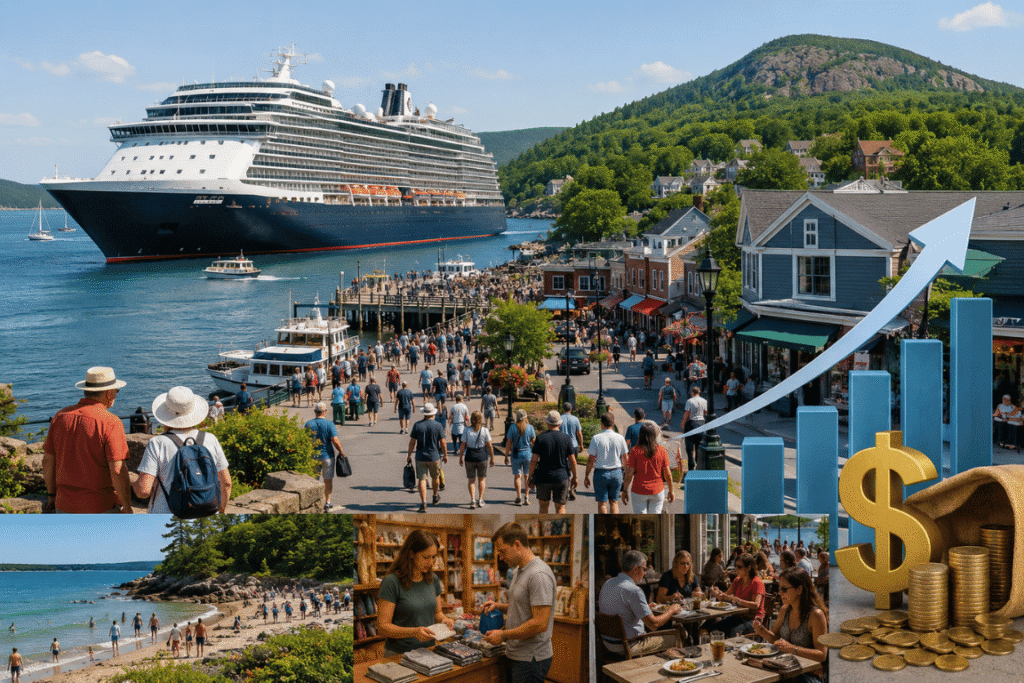
Beyond the legal analysis, the ordinance has reshaped bar harbor’s cruise ship landscape and the livelihoods of those who depend on cruise tourism.
How Cruise Traffic and Passenger Numbers Have Changed:
Since enforcement began, cruise traffic has declined dramatically. Projections show approximately 182,000 cruise ship passengers in 2024, dropping to roughly 67,000 in 2025, with 2026 projected under 50,000. Many large cruise lines have reduced or eliminated Bar Harbor calls, shifted to other coastal towns, or substituted smaller vessels. The bar harbor story has become an abiding personal impression for industry observers tracking overtourism management nationwide.
Effects on Local Businesses and the Waterfront Economy:
Local business opposition claims restrictions harm the local economy. Opponents argue that the cap harms local businesses and the town’s budget, particularly tender operators and shore services. Other local businesses, however, support the cap as a way to preserve Bar Harbor’s character. The town council has emphasized sustainable tourism, seeking to protect local livelihoods while avoiding unsustainable cruise volumes.
Implications for Acadia National Park and Visitor Experience:
Cruise ship passengers are a visible component of traffic through Bar Harbor to Acadia National Park. Supporters argue the cap reduces crowding on popular trails and viewpoints. Federal courts referenced Acadia’s role, recognizing Bar Harbor as a gateway community with limited infrastructure. Even with fewer cruise passengers, overall park visitation remains high, and the cap is one factor among many in broader congestion management.
How Cruise Lines Are Responding:
Major cruise lines are reassessing Bar Harbor, evaluating whether smaller ships or alternative ports better fit their itineraries. Some may bypass Bar Harbor during July–August to avoid complications while considering shoulder-season calls. Lines serving the Canada–New England route are watching this legal battle closely, as it may influence negotiations with other ports. Long booking lead times mean decisions made now will shape Bar Harbor’s cruise landscape for several seasons ahead.
Bar Harbor’s Next Steps: Policy, Planning, and Community Debate:
Following the court rulings, Bar Harbor is revisiting its regulatory approach while community debate continues.
Town Council’s Response and Policy Direction:
The town council publicly affirmed it will not return to pre-ordinance cruise traffic levels. Officials are prioritizing data-driven solutions to manage visitor flows and comply with constitutional limits. Council meetings, including executive session discussions with legal counsel, have focused on potential policy revisions and long-term tourism strategies.
Work of the Sustainable Tourism Task Force:
Bar Harbor’s sustainable tourism task force has been charged with gathering data and community input to inform new cruise ship management tools. The Task Force examines alternatives such as scheduling limits, environmental monitoring, and infrastructure investments. Public participation through meetings and surveys remains central to this process.
Supporters’ and Opponents’ Plans After the Ruling:
Supporters of the cap, including Charles Sidman, have indicated they may pursue further appeals or new ballot measures. A repeal attempt of the ordinance lost by 65 votes in 2024, demonstrating sustained community backing. Opponents-including plaintiffs and maritime interests may challenge any new regulations they view as functionally equivalent to invalidated caps. The ruling has shifted the battleground to policy design and potential new litigation.
Regional and National Significance of the Bar Harbor Case:
Other coastal towns are watching the Bar Harbor case as a test of how far localities can regulate cruise ships under the commerce clause. Environmental groups, tourism boards, and cruise lines across North America are examining whether this model could be replicated or challenged elsewhere. Data-driven, seasonal approaches may become standard for any port seeking to impose similar passenger caps, making this case a benchmark in the national conversation about overtourism and local control.
Conclusion:
Bar Harbor’s cruise ship lawsuit reflects a broader struggle to balance local quality of life, environmental stewardship, and the economic role of cruise tourism. The May 2026 ruling leaves Bar Harbor with enforceable July–August caps, sharply reduced cruise volume, and an ongoing community conversation about sustainable tourism. As other coastal towns monitor this case, it demonstrates that data-driven, seasonal regulation can survive constitutional scrutiny-but only when evidence supports it. For small gateway communities like Bar Harbor, the path forward demands legal precision, stakeholder cooperation, and policies grounded in facts rather than assumptions. Stay informed by checking the Town of Bar Harbor’s official updates as this bar harbor story continues to evolve.
FAQ
Frequently Asked Questions

The First Circuit partially upheld the use of Pike balancing, declined to strike down local regulation outright, and sent the case back to Judge Walker to refine which seasonal applications of the cap are constitutional.
Golden Anchor, L.C., other cruise-dependent businesses, and the Penobscot Bay & River Pilots Association filed suit against the Town of Bar Harbor, with Charles Sidman intervening to protect local livelihoods and defend the ordinance.
After the May 2026 ruling, Bar Harbor's 1,000-passenger daily cap can be enforced only in July and August; its application to other months has been held unconstitutional.
Core constitutional questions have been largely resolved at the district level, but the dispute remains ongoing as parties consider further appeals and new regulations may prompt additional litigation.
It is a voter-approved limit allowing no more than 1,000 cruise ship passengers to disembark per day at town-managed facilities, originally intended for the full cruise season but now enforceable only in July and August.
Voters sought to reduce downtown congestion, preserve Bar Harbor's small-town character, and better manage visitor impacts on nearby Acadia National Park during the peak summer tourism season.
Judge Walker ruled the ordinance unconstitutional for months outside July and August but upheld its enforceability during those two peak summer months.
Bar Harbor can enforce the 1,000-passenger daily cap in July and August only and cannot enforce it in other months of the cruise season.
The court found the ordinance's burdens on interstate and foreign commerce outweighed its local benefits during shoulder seasons, failing the Pike balancing test in those months.
Golden Anchor, L.C., other cruise-related businesses, and maritime entities like the Penobscot Bay & River Pilots Association are the primary plaintiffs challenging the ordinance.
Litigation was filed soon after voters approved the ordinance in November 2022, with federal court proceedings unfolding from late 2022 into 2026.
The case was heard in the U.S. District Court for the District of Maine by Judge Lance Walker, with appeals reviewed by the U.S. Court of Appeals for the First Circuit.
While not a total ban, the ordinance and related uncertainty have reduced cruise visitation dramatically, with 2026 passenger projections falling below 50,000 compared to much higher pre-ordinance levels.
Supporters are exploring further appeals, new citizen initiatives, and participation in the town's policy process to maintain or strengthen limits on cruise ship visitation.
LBC is not a central term in the Bar Harbor case; in broader maritime contexts, it typically refers to "lower berth capacity," a measure of passenger berths on cruise ships.