Key Takeaways:
-
A boat liability waiver can be enforceable, but it does not automatically defeat every personal injury claim.
-
Liability waivers usually address inherent risks and ordinary negligence, not gross negligence or intentional harm.
-
Federal maritime law, including 46 U.S.C. § 30509/§ 30527, can void some passenger contracts.
-
Unclear, hidden, or overly broad language is often read against the company that drafted it.
-
Injured passengers may still have legal rights and should ask an attorney to review the specific facts.
Boat rentals, charters, scuba diving trips, and sightseeing tours often begin with signing a waiver at the dock or online. A boat liability waiver is a written legal agreement and a legal document signed before engaging in boating activities, usually asking participants to acknowledge risks and sometimes waive the right to sue.
These contracts can protect boat owners from lawsuits resulting from typical boating risks, but they are not absolute. After an injury, a court will determine whether the agreement is valid, what it covers, and whether the injured person still deserves compensation.
Boat Liability Waiver: Is It Valid After an Injury?
A boat liability waiver can be valid after an injury, but enforceability depends on maritime law, state law, the wording, and the specific circumstances of the accident. Courts ask whether the person knowingly accepted such risks, whether inherent risks were understood by participants, and whether the harm came from the activity’s nature or from negligent conduct.
Inherent risks are dangers associated with an activity’s nature, like waves, wet decks, weather, seasickness, or ordinary docking bumps. Liability waivers are enforceable if risks are inherent to activities, but liability waivers may not protect against negligence, and a waiver may not protect against negligence or reckless behavior. Waivers reduce risk but do not eliminate the possibility of a lawsuit.
How Boat Liability Waivers Work in Practice:
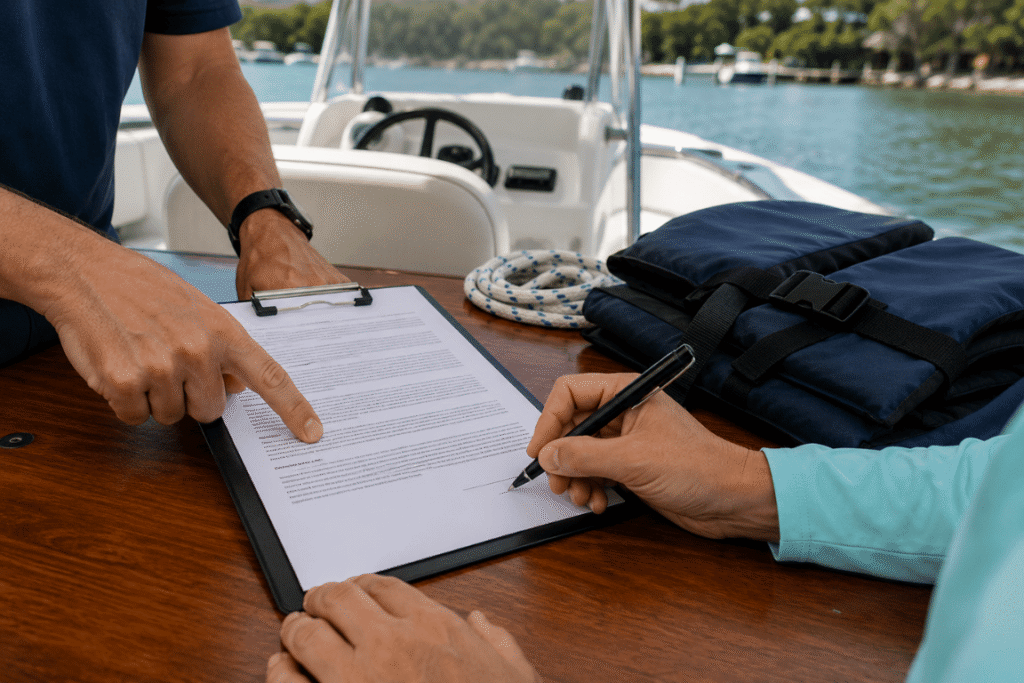
A waiver is a risk agreement built on assumption of risk, release, and hold harmless agreement language. Key elements of a waiver include identification of parties and acknowledgment of risks; waivers list potential risks associated with an activity, and a robust boat liability waiver is critical for protecting businesses from legal liability.
Typical clauses say the renter accepts full responsibility for participation, equipment use, property damage, and injuries caused by ordinary boating dangers. Responsibility for damages states the renter is financially responsible for any damage to the boat. An indemnification agreement states the renter will pay for legal fees caused by their actions.
A short paraphrased example might read: “I acknowledge boating dangers, assume the potential risk of injury or death, release the owner, business, directors, officers, agents, and employees from permitted claims, and agree to hold them harmless.” A valid form should include a clear signature line and date from the primary renter.
Common Types of Boat Liability Waivers and Agreements:
Common documents include day-rental waivers, guided fishing or snorkeling waivers, cruise excursion releases, private charter contracts, and online recreational activity forms. Some are one-page dock forms; others are multi-page digital contracts accepted months before an event.
A parent may sign on behalf of a child, but courts often review child releases closely. The less time clients have to fully understand the agreement, the more likely a judge may question whether consent was real.
Maritime Law and Federal Limits on Boat Liability Waivers:
Accidents involving boats on navigable waters may fall under maritime rules, not just local law. Federal statutes can void clauses limiting liability for passenger personal injury or death caused by a vessel owner’s negligence on qualifying voyages.
In Ehart v. Lahaina Divers, discussed in the Ninth Circuit’s 2024 opinion, a same-port Hawaii snorkeling trip raised whether federal “between ports” limits applied. The court allowed the ordinary-negligence waiver defense to continue, but gross negligence claims remained outside the release.
Passengers vs. Crew: Different Rules for Waivers:
Professional seamen have stronger protections than paying passengers. Employers generally cannot use liability waivers to block a crew member’s injury claim, while passengers may sign waivers that are upheld only in proper circumstances.
When a Boat Liability Waiver Is Enforceable:
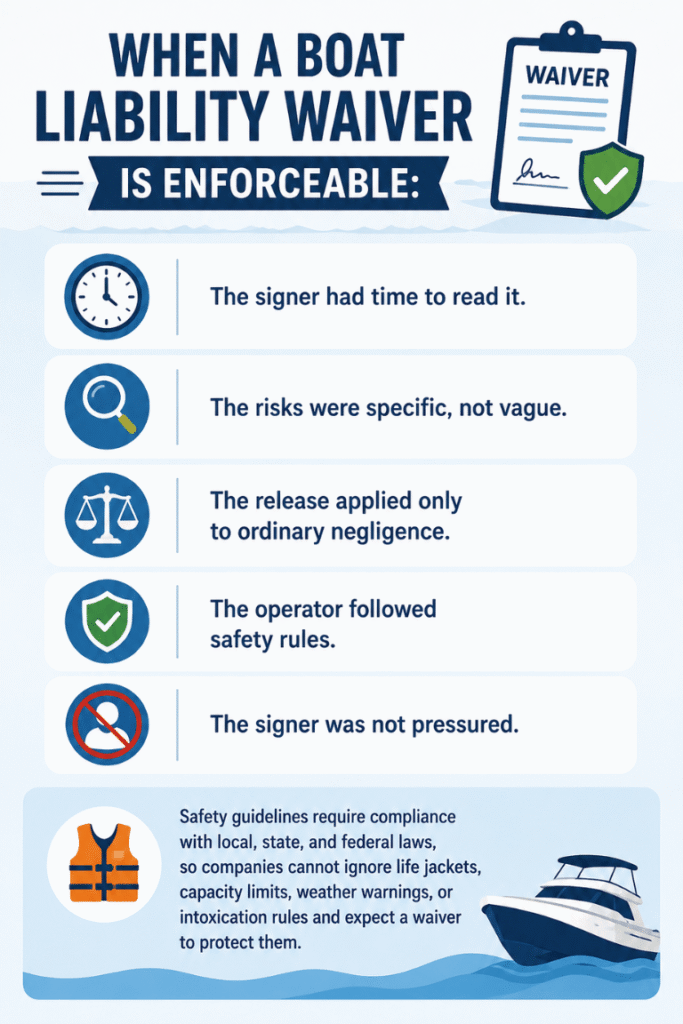
Some states strictly enforce waivers if they meet clear language standards. Courts generally look for plain references to negligence, personal injury, the parties, the activity, and the exact risks being accepted.
A waiver is more likely enforceable when:
-
The signer had time to read it.
-
The risks were specific, not vague.
-
The release applied only to ordinary negligence.
-
The operator followed safety rules.
-
The signer was not pressured.
Safety guidelines require compliance with local, state, and federal laws, so companies cannot ignore life jackets, capacity limits, weather warnings, or intoxication rules and expect a waiver to protect them.
Inherent Risks vs. Negligent Conduct:
Inherent risks exist despite reasonable care by operators. A slippery deck after spray may be inherent; overloaded boats, broken navigation lights, defective equipment, or a captain texting while steering may show negligent conduct.
The U.S. Coast Guard reported 3,887 recreational boating incidents in 2024, with 556 deaths and 2,170 injuries, showing why safety and responsibility matter.
When a Boat Liability Waiver Is Void or Unenforceable:
The legality of waivers differs from state to state. In Hawaii, waivers must meet specific criteria to be valid, and Hawai‘i law protects operators from liability for inherent risks; however, swimming injuries are excluded from liability coverage in waivers. California law states waivers cannot exempt liability for fraud or willful injury. In Mississippi, waivers only cover activities explicitly listed.
A waiver may fail if it hides key terms, conflicts with federal law, is signed under pressure, lacks a proper signature, covers a different activity, or demands that a party waive claims for reckless conduct. Courts also resist clauses trying to erase gross negligence, because justice and public policy limit how far companies can shift responsibility.
Gross Negligence, Recklessness, and Intentional Misconduct:
Gross negligence means more than carelessness, such as speeding through a crowded marina at night or ignoring known engine defects. If a company is held liable for reckless disregard, a harmless agreement usually will not save it.
Your Legal Rights After a Boat Injury With a Signed Waiver:
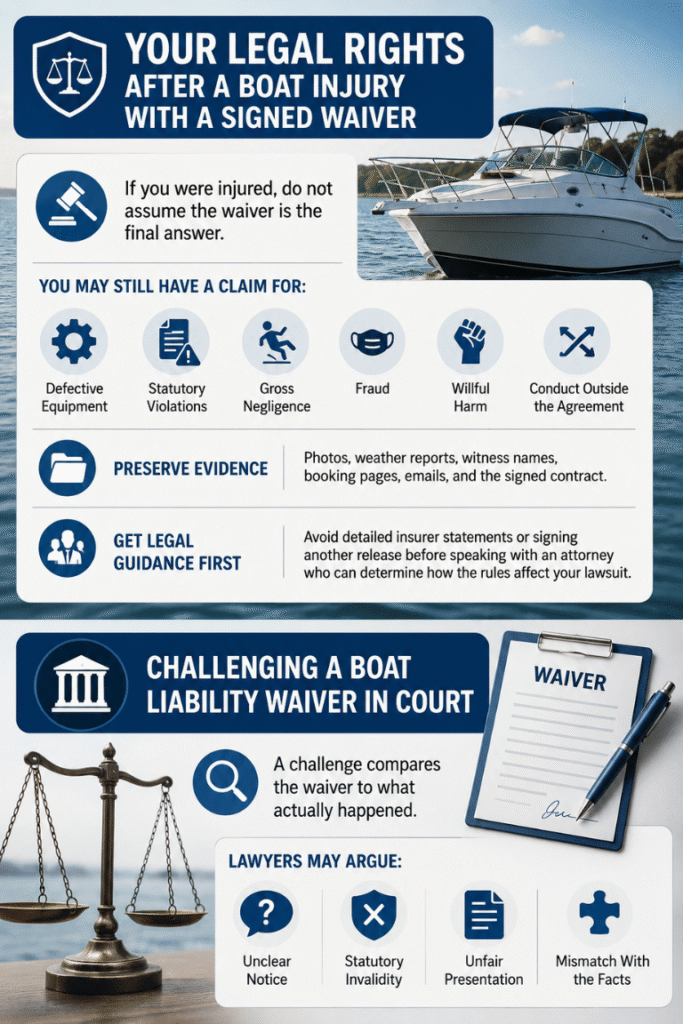
If you were injured, do not assume the waiver is the final answer. You may still have a claim for defective equipment, statutory violations, gross negligence, fraud, willful harm, or conduct outside the agreement.
Preserve photos, weather reports, witness names, booking pages, emails, and the signed contract. Avoid giving detailed insurer statements or signing another release before speaking with an attorney who can determine how the rules affect your lawsuit.
Challenging a Boat Liability Waiver in Court:
A challenge compares the waiver to what actually happened. Lawyers may argue unclear notice, statutory invalidity, unfair presentation, or a mismatch between the release and the specific facts.
Practical Tips Before You Sign a Boat Liability Waiver:
Before you participate, read the agreement, ask about life jackets, check the vessel, confirm emergency procedures, and walk away if something feels unsafe. Be aware that signing a waiver may waive your right to sue, so keep a photo or copy with the date visible.
Conclusion: Don’t Assume a Boat Waiver Ends Your Case:
Boat liability waivers and hold harmless agreements can reduce claims, but they do not erase every duty. Federal maritime statutes, state rules, and public policy still limit what a company can avoid. If you are injured, gather documents quickly and have an attorney review the waiver, the facts, and your legal rights.
Related: Boating Accidents
FAQ
Frequently Asked Questions

Yes, it can be binding if clear, lawful, and voluntary, but it usually will not cover gross negligence or safety violations.
Yes, you may still sue if the facts involve defective equipment, reckless conduct, or claims outside the waiver.
Sometimes; a court reviews the language, law, activity, and circumstances before deciding.
It may be void if vague, hidden, unlawful, pressured, or aimed at gross negligence or intentional harm.
Possibly, but only if negligence is clearly covered and the law allows that claim to be waived.
Poor drafting, missing parties, no signature date, unclear risks, or illegal terms can make it invalid.
It can use a waiver as a defense, but it is not always enough to avoid being liable.
Generally no; courts rarely let companies waive gross negligence.
You may seek compensation for claims not covered by the agreement or not permitted to be waived.
Yes, an attorney can challenge it based on law, wording, fairness, and evidence.
Ambiguity is often read against the drafter, which can help preserve your personal injury claim.