Key Takeaways:
-
On May 21, 2025, a 26-foot shrimp boat sank in Possession Sound near Everett and Mukilteo on a Wednesday afternoon, leaving three missing boaters and one survivor rescued by passing boaters.
-
Two bodies were later recovered from the submerged vessel at 165 feet deep water; a third boater remains missing and is presumed drowned as of the latest local news updates.
-
Everett Police, Everett Fire, the U.S. Coast Guard, and multiple marine units led an extensive search-and-rescue and subsequent recovery effort.
-
Anyone involved in a boating accident in Everett WA should call 911, seek medical help, preserve evidence, and report to law enforcement and the coast guard when required.
-
Victims and families may pursue compensation for wrongful death, medical bills, and other losses with help from an experienced Everett boating accident attorney.
A significant boating accident occurred in Possession Sound in May 2025 that shook the Everett community and drew attention across the pacific northwest. What began as an ordinary shrimping expedition on a spring afternoon ended with a sinking vessel, a frantic rescue, and three people unaccounted for beneath the cold waters of Puget Sound.
This article provides a comprehensive account of the incident based on current public reports, including what happened to the missing boaters, how the bodies recovered were found, and what the ongoing investigation has revealed. It also covers the legal rights and practical steps available to injured survivors, families of victims, and anyone who may face a similar tragedy on Washington waters.
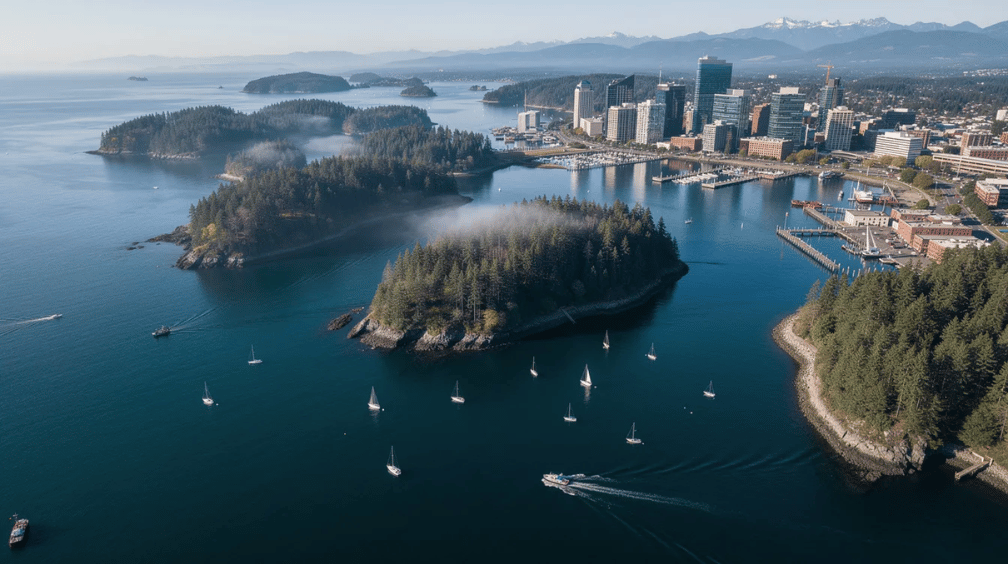
Possession Sound sits between Everett, Mukilteo, and Whidbey Island and is a popular area for recreational boating and shrimping. Boating accidents often result in fatalities due to drowning, and the conditions in these deep, cold waters make survival and recovery extraordinarily difficult.
Whether you are following this story in the news, preparing for your own time on the water, or seeking legal guidance after an accident, the sections below will walk you through the facts, the law, and the steps that matter most.
Boating Accident Everett WA: Shrimp Boat Sinks in Possession Sound, 3 Missing:
Timeline of the Possession Sound Shrimp Boat Sinking:
On Wednesday afternoon, May 21, 2025, four people set out shrimping aboard a 26-foot shrimping vessel in Possession Sound near Everett and Mukilteo. The area is commonly used by local shrimpers during the spring season opener, and conditions appeared manageable for an afternoon on the water.
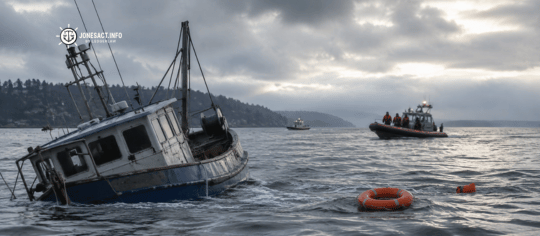
A 26-foot shrimping vessel sank on May 21. Around 1 p.m. on that day, the boat began taking on water while the crew was actively shrimping. The situation deteriorated rapidly. Within minutes, the boat sinking scenario became reality, and the vessel went under before a full rescue could be organized.
Key details of the timeline:
- ~1:00 p.m., May 21 – The vessel begins taking on water northeast of Mukilteo, off Everett’s waterfront.
- Minutes later – The boat submerges. Emergency calls go out. A man in his 50s ends up in the water and is spotted by nearby boaters.
- Early afternoon – Multiple agencies respond, launching an immediate search across Possession Sound.
The exact location was in waters with steep underwater drop-offs, where depths reach well over 100 feet not far from shore. Water temperature in late May in this part of Puget Sound is typically between 50°F and 55°F, cold enough to cause rapid onset hypothermia and significantly limit survival time for anyone without a life jacket or immersion suit.
Missing Boaters and Survivor: Who Was on Board?
Four people were aboard the vessel that afternoon:
Person | Age Range | Status |
Boat owner | Man in his 60s | Recovered (deceased) |
Owner’s son | Man in his 20s | Missing, presumed drowned |
Co-worker | Woman in her 40s | Recovered (deceased) |
Fourth passenger | Man in his 50s | Rescued (survived) |
Three people were reported missing after the boat sank: the man in his 60s, the man in his 20s, and the woman in her 40s. The man in his 50s was the sole person rescued from the water.
Everett police and the coast guard treated the case as a probable drowning event after hours of unsuccessful rescue efforts. The multigenerational nature of the trip, a father and his adult son going out shrimping together alongside friends, underscores the deeply personal loss at the center of this incident.
Some details about family relationships and identities have been withheld by authorities out of respect for the families and due to the ongoing investigation.
Rescue of the Surviving Boater:
After the vessel went under in Possession Sound, the man in his 50s was spotted in the water by passing boaters who acted as a good samaritan crew, pulling him from the cold water. One man in his 50s was rescued and reported uninjured after the incident, though he was evaluated for cold-water exposure.
He was transported to shore and then taken to Providence Regional Medical Center in Everett for further medical assessment. Initial reports indicated he did not sustain serious physical injuries, but the psychological trauma of witnessing the boat rescue scenario and losing companions was significant.
His account of the events is expected to be crucial for investigators reconstructing what happened in the moments before and during the sinking. Immediate assistance from nearby mariners, including boat rescue efforts by private boaters, often makes the difference between life and death in fast-developing marine emergencies.
Multi-Agency Search, Coast Guard Response, and Recovery Efforts:
Within minutes of the first emergency call, a rapid deployment of resources flooded the scene. The agencies involved included:
- Everett police marine unit.
- Everett fire department (everett fire response teams).
- U.S. Coast Guard (station seattle and air station port angeles assets).
- Washington department of Fish and Wildlife officers.
- Snohomish County marine operations.
Search assets included rescue swimmers, dive teams, marine patrol boats, drones, and helicopters sweeping Possession Sound. The coast guard broadcast alerts to all mariners in the area to keep a sharp lookout for debris or missing people in the water and to report sightings immediately.
The U.S. Coast Guard suspended its active search on May 21 after determining that survival was no longer likely given the water temperature, elapsed time, and conditions. By May 22, the mission transitioned from search-and-rescue to a recovery effort. The depth (exceeding 100 feet offshore in the accident area) and poor visibility at the bottom of Possession Sound near the accident site made diving hazardous and complicated every phase of the operation.
Submerged Vessel Located: Two Bodies Recovered:
Finding the vessel was the next critical step. A remotely operated vehicle from the Innerspace Exploration Team located the shrimp boat resting about 165 feet below the surface of Possession Sound. The boat was found upside down 165 feet underwater.
The recovery operation involved multiple agencies including the coast guard. Seattle police harbor patrol and pierce county marine operations collaborated with the Everett police marine unit during the underwater operation. Additional equipment was brought in, and the Everett police dive team coordinated closely with ROV operators.
A remotely operated vehicle was used to search the boat’s interior before any human divers entered the water.
On May 31, 2025, two bodies were recovered from 165 feet deep water:
- The boat owner, a man in his 60s, was recovered from the vessel.
- A woman in her 40s was also recovered from the vessel.
Two bodies were recovered 165 feet underwater after crews managed to raise the boat from the seafloor to shallower waters at approximately 35 feet, where dive teams could more safely access and inspect the vessel.
Ongoing Search for the Third Missing Boater:
The third missing person, the man in his 20s, was not found inside the boat’s interior or anywhere near the wreck. A man in his 20s remains missing and is presumed drowned.
Search efforts shifted to:
- Shoreline and surface recovery patrols along Everett, Mukilteo, and Whidbey Island coasts.
- Monitoring tidal patterns and currents in Possession Sound that influence where missing persons or debris may eventually surface.
- Public appeals from everett police and the coast guard asking waterfront residents, marinas, and local boaters to report any potential remains or personal items.
In similar cases, remains may be discovered days or even weeks later, sometimes by recreational boaters or beach walkers. The families of three missing boaters, now reduced to one missing person still unaccounted for, continue to wait for closure. The emotional toll on families when a loved one’s body has not been recovered is immense and ongoing.
Authorities have noted the department’s good fortune in recovering two of the three victims, given the extreme depth and challenging conditions, but acknowledge the search remains active for the missing boater.
Cause of the Everett Shrimp Boat Accident: What We Know and Don’t Know:
The cause of the accident is still under investigation. As of the most recent public reports, no definitive explanation has been given for why the vessel sank.
Potential factors investigators will examine include:
- Hull integrity and any structural failures.
- Bilge pump condition and whether pumps were overwhelmed or malfunctioning.
- Overloading from passengers, shrimp pots, bait, coolers, and other gear.
- Shrimping gear setup and whether removing derelict gear or handling heavy equipment destabilized the boat.
- Mechanical failures in engine or plumbing systems.
The role of safety equipment is also central to the inquiry. Investigators will look at whether life jackets were available and worn, whether emergency flares and a working VHF radio were on board, and whether everyone had access to flotation when the boat began taking on water.
Regular boat maintenance is crucial to prevent malfunction, and maintenance records for the vessel will be part of the investigation file. Weather and sea conditions, operator experience, and possible impairment are standard components of any marine accident inquiry.
Even when exact causes remain uncertain, families may still pursue civil claims based on negligence, defective equipment, or other legal theories. The circumstances surrounding the sinking will continue to emerge as the investigation progresses.

Local Impact, Possession Sound Safety, and Lessons from the Everett Tragedy:
Community Reaction and Local News Coverage:
The incident has drawn widespread coverage from local news outlets in Everett, Seattle television stations, and regional newspapers. The story resonated deeply with Puget Sound residents because shrimping season is a beloved, routine activity for local families across the region.
Public attention has focused on both honoring the victims and questioning how such a tragedy could occur in daylight, in relatively calm conditions, and near populated shores. Community members have offered support to the families, and several have shared their own experiences of close calls on the water.
Readers are encouraged to follow reliable local news sources and official agency releases from Everett police department and the coast guard rather than rumors or speculation on social media.
Possession Sound Conditions and Boating Hazards Near Everett:
Possession Sound presents real hazards that even experienced boaters sometimes underestimate:
Hazard | Details |
Depth | Steep drop-offs; 150–200+ feet in main channels |
Water Temperature | 50–55°F in late May; hypothermia risk within minutes |
Currents | Strong tidal exchanges influenced by Admiralty Inlet |
Vessel Traffic | Ferry routes, commercial ships, recreational boats |
Submerged Hazards | Logs, crab/shrimp pot lines, derelict gear |
Weather Changes | Sudden wind, chop, reduced visibility |
Cold water temperatures, even in late spring, can quickly cause hypothermia and limit survival time for missing people in the water without flotation. Sudden weather changes, wind waves, and boat wakes from larger vessels can challenge smaller shrimp boats and open skiffs.
Boaters must check marine weather forecasts before departing. NOAA charts and local marine forecasts should be reviewed before every trip onto Possession Sound.
Safety Precautions for Shrimping and Recreational Boating:
Boating in Everett, WA is governed by state laws and local ordinances. The following safety steps are not optional; they can mean the difference between a close call and a catastrophe:
- Life jackets: All vessels must carry one U.S. Coast Guard-approved life jacket for each person on board. Wear them, not just carry them.
- VHF radio: A functional marine radio tuned to Channel 16 is essential for distress calls.
- Distress signals: Motorized boats must carry required safety equipment such as fire extinguishers and distress signals, including visual signaling devices.
- Boater Education Card: Operators aged 12 and older must possess a Washington Boater Education Card for certain boats (motor ≥15 hp).
- Pre-departure inspection: Check hull integrity, bilge pumps, fuel systems, and navigation lights before every trip.
- Float plan: File one with a trusted friend or family member, especially when heading into deeper parts of Possession Sound.
- Weight management: Distribute weight carefully when carrying multiple adults, coolers, shrimp pots, and bait. A 20–30-foot vessel can be overloaded faster than most people realize.
- No-wake compliance: Boaters must maintain no-wake speed near shorelines and swimmers.
- Sobriety: Operating a vessel under the influence of drugs or alcohol is prohibited under Washington law.
- Cold-water preparedness: Know cold-water survival techniques and carry immersion suits if available.
When a Fun Shrimping Trip Turns to Disaster: Emotional and Practical Fallout:
The shift from a routine shrimping expedition to a life-threatening emergency happened in minutes for the crew aboard this vessel. One moment they were hauling pots; the next, the boat was going under.
Common responses families face after a fatal boating accident:
- Shock and disbelief, especially when the scene went from normal to catastrophic in seconds.
- Survivor’s guilt for the rescued passenger who made it out while others did not.
- Long-term grief compounded by uncertainty when a loved one remains missing.
- Immediate practical burdens: funeral costs, loss of income, counseling needs, and complex insurance claims.
Many families feel overwhelmed navigating the investigation, media attention, and legal questions while still in mourning. Assisting families through these early stages with support from counselors, faith communities, and experienced attorneys can reduce stress and help them make informed decisions during the hardest time of their lives.
Legal Rights After a Boating Accident in Everett WA:
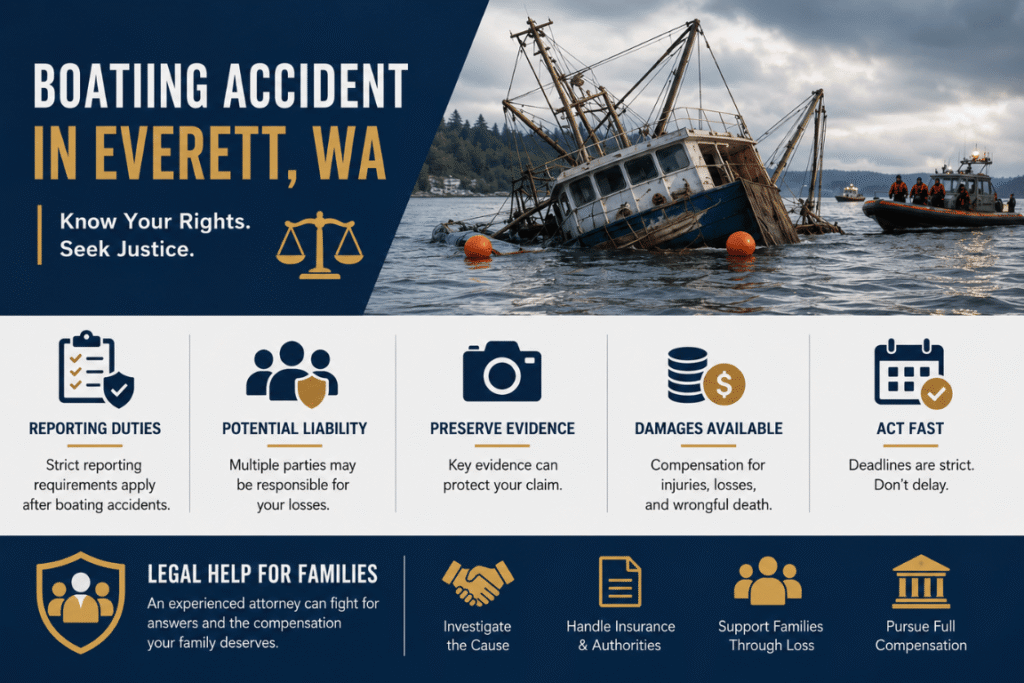
Washington Boating Accident Laws and Reporting Duties:
Washington law sets clear rules for when and how boating accidents must be reported:
- Death, disappearance, or serious injury: A written Boating Accident Report must be filed within 48 hours.
- Property damage only ($2,000 or more, under WAC 352-70-035): the report must be filed within 10 days.
- Local agencies must notify the Washington State Parks & Recreation Commission within 48 hours and submit a full report within 10 days of learning about a fatal or serious accident.
Reports must be made to local law enforcement (such as everett police) and may also need to go to the Washington State Parks Boating Program or coast guard. The vessel operator typically has the duty to file, but if the operator is unable (incapacitated or deceased), the boat owner bears that responsibility.
Failing to report can result in penalties and may complicate insurance and injury claims.
Potential Liability in a Shrimp Boat Sinking or Drowning Case:
Several parties could face liability depending on what the investigation reveals:
- Boat owner/operator – for negligence in maintenance, overloading, failing to carry required safety gear, or lack of proper training.
- Maintenance providers – if improper servicing of bilge pumps, hull, or engine contributed to the sinking.
- Equipment manufacturers – if a defective component (pump, seal, hull material) played a role.
- Rental companies – if the vessel was rented and inadequately maintained or inspected.
Washington uses a comparative fault system, meaning liability can be shared among multiple parties, including potential partial fault of passengers. Even when the specific cause of a sinking is unclear, circumstantial evidence such as the lack of life jackets, poor maintenance records, or failure to comply with safety laws can support a claim.
Surviving family members may bring wrongful death claims when a loved one dies in a boating accident near Everett.
Evidence to Preserve After a Boating Incident in Possession Sound:
Preserving evidence is critical and time-sensitive. Key items include:
- Photographs and video of the vessel before and after the accident, showing damage and defects.
- Electronic data: GPS tracks, navigation app history, text messages about conditions, VHF radio logs.
- Witness information: Contact details from nearby boaters, ferry crews, or shoreline observers who saw the accident unfold.
- Official records: Everett police incident reports, coast guard logs, dive/recovery reports, and coroner’s findings.
- Physical vessel: Do not repair or dispose of the damaged boat (if recovered) before an expert can inspect it for legal purposes.
The fact that the vessel in this case was raised and impounded by everett police means it is now available for forensic inspection, a critical step for any future legal claim.
Damages Available in an Everett Boating Accident Claim:
Victims and surviving family members can seek several categories of compensation:
Damage Type | Examples |
Economic | Medical bills, future treatment, lost wages, lost earning capacity, funeral and burial costs |
Non-economic | Pain and suffering, emotional distress, loss of consortium, loss of companionship |
Property | Value of the boat, personal gear, electronics destroyed in the sinking |
Washington generally does not cap most compensatory damages in personal injury or wrongful death boating cases. Recovering damages typically requires negotiation with insurance carriers or, if necessary, filing a lawsuit in Snohomish County courts.
Statute of Limitations and Deadlines in Washington Boating Cases:
Washington typically has a three-year statute of limitations for personal injury and wrongful death claims, including boating accidents. Missing this deadline can permanently bar victims and families from recovering compensation.
Special, shorter deadlines may apply if a government vessel or agency is involved, potentially triggering pre-suit claim notice requirements.
Families of the missing boaters near Everett should track key dates:
- Date of the accident (May 21, 2025).
- Date of death determination (when bodies were recovered or presumptive death established).
- Date of any official investigation findings.
Contact a boating accident attorney as early as possible so they can investigate while evidence and witness memories are still fresh.
How an Everett Boating Accident Attorney Can Help Families of Missing and Deceased Boaters:
An experienced attorney can:
- Coordinate with experts in marine safety, naval architecture, and accident reconstruction to determine why the boat sank.
- Interface with insurance adjusters, the coast guard, and everett police investigators so families are not overwhelmed.
- Guide families of missing boaters through presumptive death determinations and related legal procedures.
- Identify all potential sources of compensation: liability policies, underinsured coverage, and maritime insurance.
- Work on a contingency fee basis, meaning clients typically pay no attorney’s fees unless there is a recovery.
Step-by-Step: What to Do After a Boating Accident in Everett or Possession Sound:
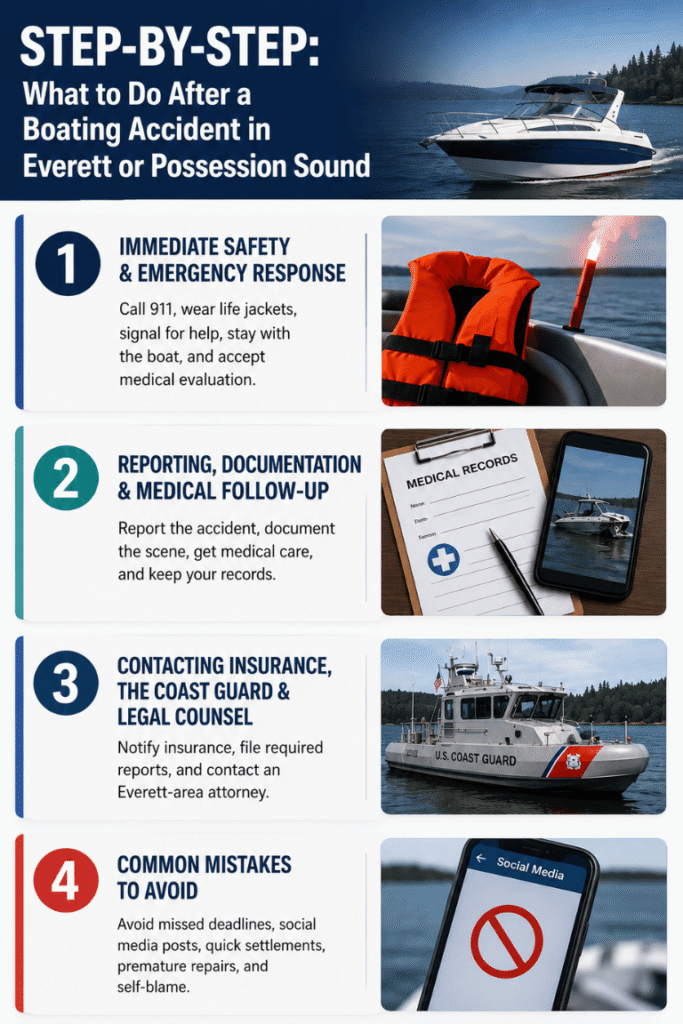
Immediate Safety and Emergency Response:
- Call 911 and broadcast a mayday on VHF Channel 16 immediately.
- Put on life jackets – assist children and non-swimmers first.
- Deploy visual distress signals (flares, strobe lights) so Everett fire, coast guard, and nearby vessels can locate you.
- Stay with the boat or any flotation if possible. Do not re-enter a sinking vessel unless directed by trained rescuers.
- Cooperate with first responders once rescued and accept medical evaluation even if injuries seem minor.
Reporting, Documentation, and Medical Follow-Up:
- Operators must remain at the scene (when safe) to aid victims and provide basic information to responding agencies.
- Take photos or short videos of conditions, vessel position, and injuries as soon as it is safe.
- Seek a full medical evaluation at Providence Regional Medical Center or another facility. Internal or delayed injuries are common.
- Keep copies of all medical records, discharge summaries, and follow-up treatment plans.
- Write a personal account of the event within a day or two to preserve memory of key details like time, weather, and boat behavior.
Contacting Insurance, the Coast Guard, and Legal Counsel:
- Notify your boat insurance carrier and, if applicable, homeowner or umbrella insurers.
- File the official written boating accident report with the coast guard and/or Washington State Parks Boating Program within the required deadlines.
- Do not give recorded statements to opposing insurers without first consulting a boating accident attorney.
- Contact a lawyer licensed in Washington and experienced in marine and personal injury law within days of the accident.
Common Mistakes to Avoid After a Serious Boating Incident:
- Failing to report the accident within required deadlines
- Discarding damaged equipment or repairing the boat before an expert inspection
- Posting detailed accounts, photos, or speculation about fault on social media while investigations and the scene are still active
- Accepting quick, low settlement offers from insurers that waive the right to full compensation
- Assuming you have no claim because the cause is “unknown” – this may be incorrect under Washington law
- Self-blame that prevents you from exploring legitimate legal options
Contact an Everett Boating Accident Attorney:
The Possession Sound shrimp boat sinking is a devastating reminder that a day on the water can turn fatal without warning. If you or a family member has been affected by a boating accident in Everett WA or anywhere on Puget Sound, you do not have to navigate the aftermath alone.
A local Everett boating accident attorney understands the regional waters, the agencies involved, and the courts where these cases are heard. This familiarity can make investigating the incident and pursuing claims more efficient and effective.
Injured survivors and families of missing or deceased boaters are encouraged to request a free, confidential consultation to review their options. An attorney can help investigate the cause, work with marine experts, and pursue claims against negligent parties or insurers.
Reaching out quickly does not commit you to litigation. It preserves your ability to seek justice later, while ensuring critical evidence is not lost.
Timeline of the Possession Sound Shrimp Boat Accident:
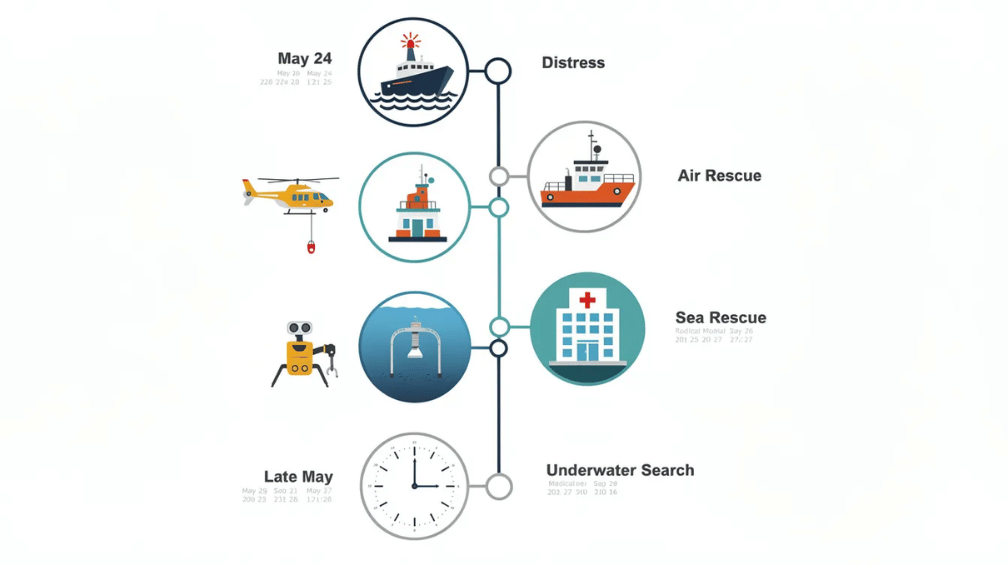
Key dates and events to visualize:
Date | Event |
May 21, ~1 p.m. | Boat begins taking on water; sinks in Possession Sound |
May 21, afternoon | Man in his 50s rescued by passing boaters; transported to hospital |
May 21, afternoon–evening | Multi-agency search launched; coast guard, everett fire, marine units on scene |
May 21, evening | Coast guard suspends active search; transition to recovery effort |
May 22 | Sunken vessel located on seafloor via sonar |
May 31 | Two bodies recovered from vessel at 165 feet; vessel raised to shallower waters |
Ongoing | Search continues for third missing boater (man in his 20s) |
What to Do Immediately After a Boating Accident in Everett WA:
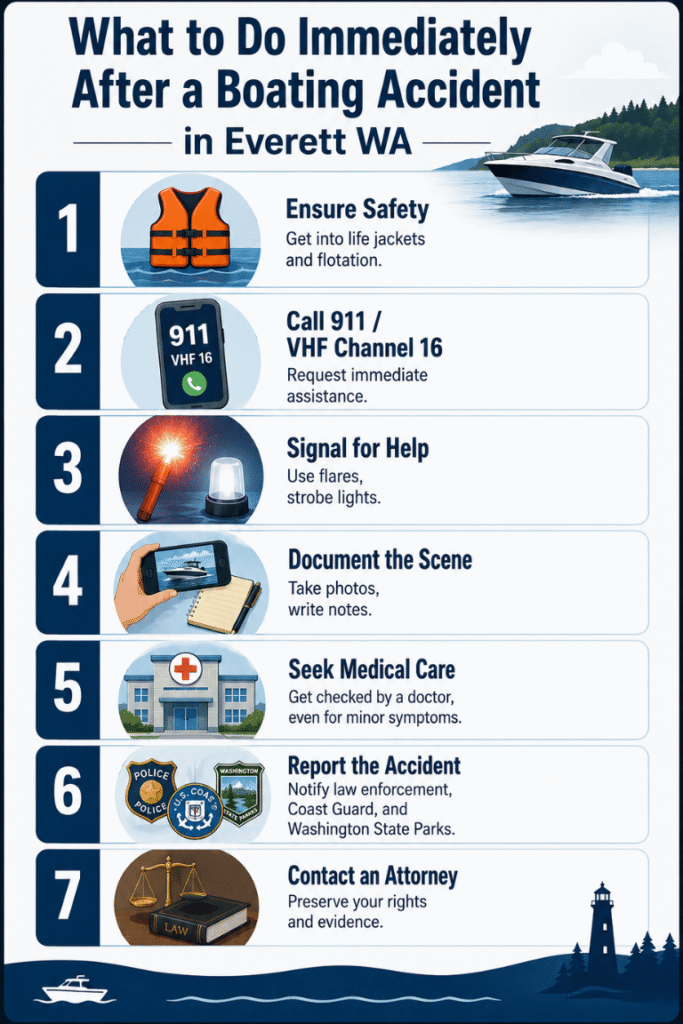
Steps illustrated:
- Ensure safety – get into life jackets and flotation.
- Call 911 / VHF Channel 16.
- Signal for help – flares, strobe lights.
- Document the scene – photos, notes.
- Seek medical care – even for minor symptoms.
- Report the accident – law enforcement, coast guard, State Parks.
- Contact an attorney – preserve rights and evidence.
Conclusion: Honoring Victims and Promoting Safer Boating in Everett WA
The Everett shrimp boat tragedy took the lives of at least two people, left one person still missing, and forever changed the lives of a surviving passenger and multiple families. The bodies recovered from 165 feet beneath Possession Sound are a stark reminder of how quickly a routine day on the water can become deadly.
Rigorous safety practices are not suggestions; they are lifelines. Every boater heading onto Possession Sound or the broader Puget Sound, particularly during busy shrimping and fishing seasons, owes it to their crew and their families to carry the right equipment, maintain their vessel, and respect the water.
Victims and families have legal rights to pursue accountability and compensation after a boating accident in Everett WA. No amount of money replaces a lost loved one, but holding responsible parties accountable can provide financial stability and drive meaningful safety improvements.
If you have been affected by a boating incident, seek both emotional support and experienced legal guidance. Learning from this tragedy is the only way to honor the people who were lost and to help prevent future losses on Washington’s waters.
Related: Boating Accidents
FAQ
Frequently Asked Questions

Call 911, put on life jackets, broadcast a mayday on VHF Channel 16, stay with the boat or flotation, and cooperate fully with first responders when they arrive at the scene.
Under Washington's boating accident rules (WAC 352-70-035 and 352-70-040), a written report is required within 48 hours when a person dies within 24 hours of the accident, disappears, or is injured and needs medical treatment beyond first aid, and within 10 days for all other reportable accidents, including those with only damage to vessels and other property of $2,000 or more.
Liability may rest with the boat owner, operator, maintenance provider, or equipment manufacturers depending on the investigation's findings regarding negligence, vessel condition, and compliance with safety laws.
The Everett police marine unit, everett fire department, U.S. Coast Guard, Washington State Parks Boating Program, and sometimes county or neighboring city marine units such as pierce County marine operations all may be involved.
Key evidence includes photographs, witness statements, official police and coast guard reports, medical records, vessel maintenance logs, and expert evaluations of the boat and its equipment.
Victims may seek medical expenses, lost wages, pain and suffering, property damage, and in fatal cases, wrongful death damages including loss of companionship and funeral costs for surviving family members.
Yes. Compensation may still be possible if negligence or defects can be inferred from the circumstances and available evidence, even when the precise mechanical cause is disputed or unable to be determined conclusively.
Most personal injury and wrongful death boating claims must be filed within three years of the date of injury or death, though claims against government entities may require earlier notice with shorter pre-suit deadlines.
Yes. Washington's comparative fault system allows you to recover damages even if you share some blame, though your compensation will be reduced by your percentage of fault.
Common causes include operator inattention, inexperience, alcohol or drug use, excessive speed, equipment failure, overloading, inadequate maintenance, and hazardous weather or water conditions.
While any injury attorney can file a claim, cases involving Possession Sound or Puget Sound boating accidents benefit from counsel familiar with maritime law, local agency procedures, and the unique challenges of marine accident investigation.
Timelines vary, but many claims resolve within several months to a year through settlement negotiation, while complex fatality or disputed-liability cases can take longer or require trial.
Many cases settle without trial, but victims should be prepared for litigation if insurers refuse to offer fair compensation for the losses that were reported and documented.
In some circumstances, families may pursue claims based on strong evidence of death and negligence, even if the body has not yet been found. Legal procedures for presumptive death may be invoked when evidence and the surrounding circumstances support it.
Nighttime and low-visibility accidents are common on Puget Sound. Investigators will examine lighting, navigation rules compliance, lookout practices, and whether the crew was unable to locate hazards when determining fault.