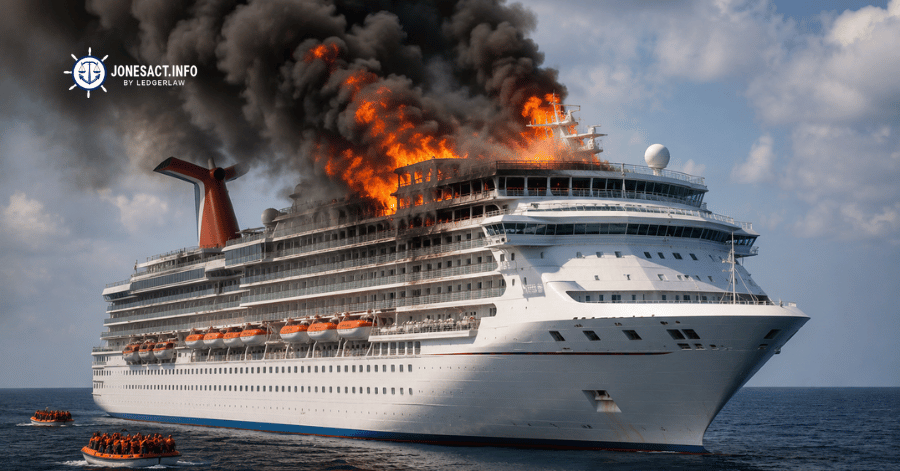
Since the 1900s, cruise ships have become a key part of entertainment and traveling. However, in the past 125 years, we have seen tragic cruise ship sinking events. So, how many cruise ships have sunk since the 1900s?
The loss of the Titanic is the most prominent maritime disaster in the public consciousness. But, in reality, the number of sunk cruise ships is extremely low. In fact, only 24 cruise ships have sunk over the past 113 years.
How Many Cruise Ships Have Sunk Throughout History?
A cruise ship sinking is a rarity. Since 1912, after the tragic event of the Titanic, only 24 cruise ships have sunk. So, each year, not even a single cruise ship has sunk. Also, in 2024, there were 34.6 million cruise ship passengers.
The huge number of people boarding cruise ships and the number of sunk ones show clear data. The chance of a cruise ship sinking is one in a million.
Cruise Ship Name | Reason for Sinking | Date |
RMS Titanic | Struck an iceberg | April 1912 |
Empress of Ireland | Collision with the Norwegian collier Storstad during dense fog | May 1914 |
Lusitania | Torpedoed by a German U-boat | May 1915 |
Britannic | Struck a sea mine (likely deployed by a German U-boat) | November 1916 |
Principessa Mafalda | Catastrophic mechanical failure (fractured propeller shaft causing flooding) | October 1927 |
Saint-Philibert | Capsized in a storm (overcrowded and lacked stability) | June 1931 |
Georges Philippar | Fire started from a faulty electrical installation | May 1932 |
SS Morro Castle | Mysterious fire | September 1934 |
Empress of Britain | Struck by a German bomber and later torpedoed by a German U-boat (WWII casualty) | October 1940 |
Andrea Doria | Collision with the Swedish American Line’s ship MS Stockholm in dense fog | July 1956 |
SS Admiral Nakhimov | Collision with the large bulk carrier Pyotr Vasev | August 1986 |
MTS Oceanos | Failed gasket caused massive flooding in the engine room (lost power) | August 1991 |
MS Estonia | Severe storm caused bow door locks to fail, leading to rapid flooding | September 1994 |
MS Achille Lauro | Fire broke out in its engine room | December 1994 |
MS Sea Diamond | Struck a volcanic reef (incorrectly charted) | April 2007 |
MV Explorer | Struck an iceberg | November 2007 |
Costa Concordia | Ran aground after the captain executed an unauthorized and risky maneuver | January 2012 |
RMS Titanic – April 1912
The sinking of the RMS Titanic is the most famous maritime disaster in history. On its maiden voyage, the ship struck an iceberg in the North Atlantic on April 15, 1912. There was poor planning regarding lifeboats. Also, the ship faced the swift flooding of the hull.
As a result, 1,500 lives were lost among the 2240 passengers and crews. The disaster immediately forced many changes in maritime law and standard safety features in cruise ships. Among them, notables are:
-
SOLAS (Safety of Life at Sea) Convention: It is the first international treaty established in 1914. It governs maritime safety.
-
Lifeboat Capacity: Mandatory requirement that all ships carry enough lifeboats for every person onboard.
-
International Ice Patrol: Established to monitor and report iceberg locations in the North Atlantic.
-
Radio Watch: Mandatory 24-hour radio watch, including secondary power sources. It ensures that distress calls are never missed.
Empress of Ireland – May 1914
Less than two years after the Titanic, the Empress of Ireland sank. The ship collided with the Norwegian collier Storstad during dense fog and sank quickly in the Saint Lawrence River.
The impact had damaged the ship’s midsection. So, she sank in only fourteen minutes. It caused over 1,000 casualties. After the tragic sinking of the Empress of Ireland, stricter rules for the watertight bulkheads were proposed. Also, authorities introduced emergency closing procedures for ocean liners.
Lusitania – May 1915
The sinking of the Lusitania was a pivotal event in World War I. A German U-boat torpedoed the British ocean liner off the coast of Ireland. She sank in just eighteen minutes. Over 1,100 people perished, including many Americans.
The attack was an act of war. Also, it raised significant questions about the protection of civilian vessels during wartime. Also, international diplomatic relations were at stake. It also accelerated the United States’ entry into the conflict.
Britannic – November 1916
The Britannic was a sister ship to the Titanic and Olympic. However, during World War I, authorities repurposed it as a hospital ship.
It struck a sea mine as it was anchored near the Greek island of Kea. The sea mine was likely deployed by a German U-boat. Although it was a non-combatant ship, it sank within an hour. Sadly, thirty people still perished, most of whom were healthcare workers.
Principessa Mafalda – October 1927
The Italian liner Principessa Mafalda was sunk off the coast of Brazil. The tragedy happened because of a catastrophic mechanical failure.
A fractured propeller shaft caused massive flooding. The crew failed to contain the flood. Also, there was poor planning for the passengers’ evacuation. It, coupled with shark attacks, led to a high death toll of around 314 people. The sinking highlighted that consistent, comprehensive safety drills are more than necessary.
Saint-Philibert – June 1931
The Saint-Philibert was a small excursion vessel. It capsized in a storm off the coast of Saint-Nazaire, France. The boat was already overcrowded. Plus, investigations revealed that it lacked sufficient stability for the severe weather conditions.
Approximately 450 people lost their lives. These were mostly families returning from a Sunday outing. Following it, new French regulations were updated about the stability and capacity limits for coastal passenger vessels.
Georges Philippar – May 1932
A fire broke out on the French liner Georges Philippar. It was just one week into its maiden voyage near the Gulf of Aden.
The fire started from a faulty electrical installation. However, it spread rapidly through the ship’s luxurious wooden paneling and poor compartmentalization. Thankfully, most were rescued. However, the ship was destroyed almost completely.
SS Morro Castle – September 1934
There was a mysterious fire in SS Morro Castle. The ship was off the coast of New Jersey. The fire started in a storage locker and burned the ship. It caused 137 deaths.
The investigation revealed poor fire response from the crew. Also, there was inadequate safety equipment. The possibility of arson compounded the event. It spurred significant reforms in U.S. fire safety laws. The new fire safety law emphasized non-combustible construction and improved alarm systems.
Empress of Britain – October 1940
The Empress of Britain was a magnificent Canadian Pacific Ocean liner. It was struck by a German bomber near the coast of Ireland during World War II. Later, the ship was taken under tow.
However, a German U-boat intercepted the operation, hitting the ship with a fatal torpedo. It was a direct casualty of the war. Later, many countries discussed ensuring the safety of civilian ships during war.
Andrea Doria – July 1956
Andrea Doria was an Italian passenger liner. It collided with the Swedish American Line’s ship MS Stockholm in dense fog off the coast of Nantucket. It took eleven hours to sink, resulting in forty-six fatalities.
Subsequent investigations found human error and insufficient radar usage. It showed the importance of:
-
Better bridge procedures.
-
Coordinated radio communication.
-
Reliable anti-collision technology.
SS Admiral Nakhimov – August 1986
SS Admiral Nakhimov was a cruise ship. It collided with the large bulk carrier Pyotr Vasev in the Black Sea near Novorossiysk. The impact created a massive breach. As a result, the cruise ship sank in just eight minutes, claiming the lives of 423 people.
The disaster exposed severe shortcomings in crew training and lookout procedures. Also, there was inadequate compliance with the International Regulations for Preventing Collisions at Sea (COLREGs).
MTS Oceanos – August 1991
The Greek cruise ship MTS Oceanos sank off the coast of South Africa. It had a failed gasket that caused massive flooding in the engine room. So, there was no power in the ship.
The captain abandoned the ship. So, the ship’s entertainment staff took over the famous evacuation. All 581 passengers and crew were rescued. The evacuation showed how quick thinking and professional conduct can save lives, regardless of official rank.
Later, in 1992, Captain Avranas and five other officers were convicted of neglecting their duties. Able Seaman AB Wiley was awarded the prestigious Honoris Crux Gold decoration. He was from the South African Defense Force.
MS Estonia – September 1994
The MS Estonia was basically a roll-on/roll-off ferry. However, it was used as a cruise ship. It faced a severe storm in the Baltic Sea while traveling from Tallinn to Stockholm. The storm caused the ship to sink.
The official reported that the bow door locks failed. So, water entered the car deck, causing a rapid flood. As a result, the ship capsized, resulting in 852 deaths. The disaster initiated the “Stockholm Agreement.” The agreement increased stability requirements for Ro-Ro ships.
MS Achille Lauro – December 1994
The MS Achille Lauro was already infamous for a 1985 hijacking. Nine years later, a fire broke out in its engine room. The fire destroyed the ship. It sank off the coast of Somalia.
Thankfully, the passengers and crew were successfully rescued. But, days later, the ship ultimately sank while being towed. The event highlighted the persistent risk of fire on aging vessels.
MV Explorer – November 2007
MV Explorer was a small, ice-strengthened expedition ship. In 2007, it struck an iceberg in the Bransfield Strait, Antarctica. The hole caused rapid flooding, and the ship sank within hours. All 154 passengers and crew were successfully rescued in the remote, frigid conditions.
The sinking raised serious concerns about:
-
Vessel suitability for cruising in tough conditions.
-
Enhanced ice navigation protocols in polar regions.
MS Sea Diamond – April 2007
The MS Sea Diamond was passing the volcanic reef near the Greek island of Santorini. At this time, it was stuck by the reef region and sank almost immediately.
The ship was incorrectly charted. So, the vessel hit a known hazard. Most passengers were evacuated. However, two people—a French father and daughter—were reported missing and presumed dead. The incident raised questions about the outdated charts and navigation errors.
Costa Concordia – January 2012
The Costa Concordia ran aground off the coast of Giglio, Italy. It happened after the captain executed an unauthorized and risky maneuver known as a “salute.”
The impact created a large hole in the hull, causing the ship to capsize. The disaster resulted in thirty-two deaths. It was the most recent major, high-profile sinking. The sinking of Costa Concordia spurred significant global updates about:
-
Crew training.
-
Emergency procedures.
-
Safety management systems.
Why Do Cruise Ships Sink?
Cruise ships sink because of collisions, human error, mechanical failures, and stability issues. Previously, a ship would hit an iceberg and sink. However, this has almost reduced to zero now.

Collisions with Natural Hazards
Previously, ships such as the Titanic sank from collisions with natural obstacles like icebergs. These days, modern vessels use advanced radar and sonar. So, the risk of hitting rocks, submerged reefs, and unexpected debris has reduced.
Most collisions happen because of treacherous or poorly charted waters. It can breach a hull and damage the vessel’s watertight integrity.
Human Error
Human error, as seen in the Costa Concordia and Andrea Doria disasters, is the most common reason in recent sinkings. Human mistakes include poor navigational decisions, inadequate training, and fatigue.
Also, there is a failure to follow established safety protocols. Plus, inappropriate responses to a crisis can cause the ship to sink.
Mechanical Failures
Mechanical failures include engine, propulsion, or power systems failure. It can severely compromise a ship.
At times, a fire could start in the engine room or a major system might fail. As a result, the crew might lose power to critical pumps and watertight doors. It can lead to uncontrollable flooding or the inability to maneuver the ship away from danger.
Stability Issues
A ship’s stability is vital to its safety. However, stability issues arise from design flaws. Also, improper operations can compromise the stability of the ship. It includes:
-
Taking on too much water during a storm.
-
Incorrect loading of cargo or supplies.
-
A rapid ingress of water following a collision.
An unstable ship can quickly list or capsize. So, the evacuation becomes extremely difficult and causes high fatalities.

Extreme Weather Conditions
Extreme storms and rogue waves are significant threats to cruise ships. The MS Estonia disaster occurred during a powerful storm. No doubt, modern vessels have stabilizers. Still, powerful and rough weather can damage a ship in no time.
Structural Integrity Compromises
There could be defects in a ship’s original construction. Also, ships undergo gradual wear and tear over decades. It will compromise its structural integrity. Old or poorly maintained vessels are more vulnerable to hull breaches from minor impacts. Fire damage can also weaken critical internal structures.
How Often Do Cruise Ships Sink?
Statistically, a cruise ship sinking is a rare event. Since 1912, only 24 or 25 ships have sunk. Also, most of these ships were sunk before World War II. And since the 2000s, there has been only one major cruise ship sinking.
Data shows that non-military passenger ship losses have been almost non-existent in the last decade. Cruise ships carry almost 30 million passengers annually. The comparison to the zero-to-low fatalities in recent incidents shows the rarity. It confirms that the industry operates at a very high safety level.
The Odds of a Cruise Ship Sinking – They’re Super Low!
The odds of a traveler being involved in a cruise ship sinking are minuscule. It is much lower than the risks while driving a car or flying. It has been made possible with the combination of:
-
Mandatory international safety standards.
-
Safety of Life at Sea (SOLAS) convention.
-
Modern preventative technology.
The Safety Measures That Prevent Cruise Ship Sinkings
Modern cruise ships employ advanced safety measures. It includes double hulls, sophisticated radar systems, redundant propulsion, and power systems. Moreover, there is advanced fire suppression technology.

Cruise ships also require mandatory comprehensive emergency drills for passengers and crew. It is known as the “Muster Drill,” which ensures a rapid, organized response during disaster.
Frequently Asked Questions

The Titanic and the Empress of Ireland caused thousands of fatalities in the early 1900s. However, since 2000S, the death toll from cruise ship sinkings has reduced dramatically. Maritime Injury Guide reported that since 2005, only 15 cruise ships have sunk. It resulted it around 50 to 55 deaths, include 32 in Costa Concordia.
Major cruise ship sinkings are incredibly rare. In the past two decades only 15-ships have sunk with most of them had no casualties. The improved safety measures ensure cruise ships are the safest way of traveling across the globe.
The most recent high-profile cruise ship sinking was the Costa Concordia in January 2012. Since 2012, no major cruise ships have been lost.
The chances of being involved in a cruise ship sinking is less than one in a million. Each year, cruise ships carry more than 30 million passengers. So, your chance of being involved in a cruise ship sinking is less than in a million.
If you are on a sinking ship, you should stay calm. Also, proceed to the muster station and follow the directions of the crew. Also, listen to the ship's emergency announcements. Locate your life jacket and wait calmly for instructions.
Conclusion
How many cruise ships have sunk? Since 1912, we found only 24 reported cases of cruise ship sinking incidents. However, injuries from slip and fall events in cruise ships are high. So, you should follow the safety guidelines on cruise ship. It can help you avoid mishaps and enjoy the cruise.
Related: Cruise Ship Injuries